VISIONS OF PARIS AND MOTHER GOOSE
Costume inspired by Marc Chagall's 'Visions of Paris' and analysis of the work itself.
“Paris is a reflection of my heart…I would dissolve there, never to be alone with myself.” -Marc Chagall.
Marc Chagall was born in 1887 in Liozne, near Vitebsk, in modern-day Belarus. He is equally important in the world of Jewish art as he is to the history of Modern art, being of Russian-French-Jewish heritage. This is apparent in his artwork, which combines Modernist techniques with Jewish tradition and Russian Mysticism. Chagall was deeply inspired by all the artistic mediums he was exposed to throughout his life. Chagall received a formal art education in St. Petersburg in 1906, where he became interested in painting, theatre, and costume design. His painted work celebrated his hometown and traditions.
After attending art school, he moved to Paris in 1910. These were some of the most formative years of Chagall's life. Paris was the center of art and culture in the early 1900s. At the time of Chagall’s arrival, Cubism was at its height. Chagall embraced Cubist philosophy, transforming the way the world was looked at in his paintings through a lens of a “psychic being.”
During Chagalls time in St. Petersburg for art school, he apprenticed under Ballets Russes designer Leon Bakst. Although studying as a student, he only began to make theatre and ballet costumes after fleeing from Europe to New York as a WWII refugee. In the spirit of Chagall, specifically the visual effect of one of his pieces in a set of eight lithographs titled ‘Visions of Paris', I created a costume titled ‘Mother Goose.’ The costume plays with themes such as truth, imagination, childhood, and identity; themes that are also present in the aforementioned Chagall piece.
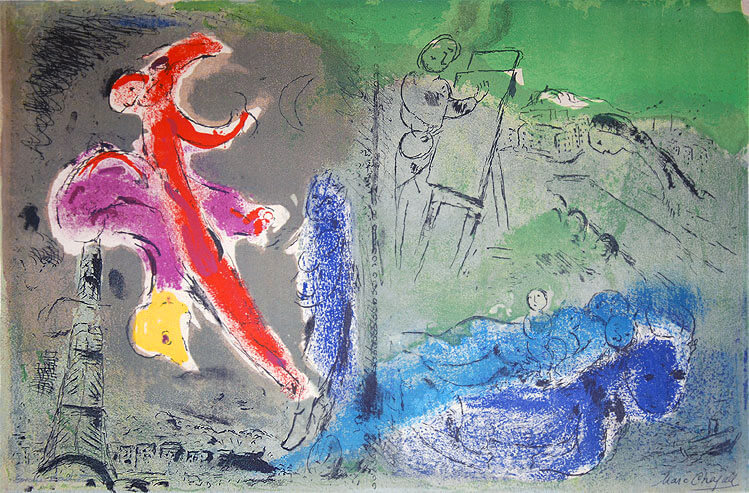
VISONS OF PARIS
The brush strokes produce an effect of rapidly moving images, going through someone's mind or floating in their subconscious all the time. The top of the image features a crescent moon painted red. This crescent moon morphs into a couple in each other's arms, flying above the Eiffel Tower on a giant bird. This portion speaks to Chagall’s dynamism, even in two dimensions. The progression of this one symbol turning from planet to lovers in embrace fills the viewer with warmth, regardless of how abstract it is rendered. While the embraced lovers form a cutting-knife shape, the purple bird supporting their flight is pillowy and light, providing a soft base for them to fly on. While the lovers are removed from the rest of the world, in their own space, which they created together, they still interact with this bird, the surroundings of Paris. The two have access to a unique vantage point, a perspective others don’t possess. The whole conglomerate these shapes create (the moon, the lovers, the bird, the Eiffel tower) shows the complete interconnectedness Chagall feels towards everything in the city. Usually, such abstract forms can push the viewer away, keeping a spikey distance; these do the opposite–a playful invitation to tease out the different parts up close, then step back and see them as a whole, new feeling.
On the right of the piece, we see a painter at the easel. This artist–while also perhaps representing the general creative attitude of Parisians at the time–could be Chagall himself, maybe even Chagall creating this painting. This feature blurs the laws of time and space, creating an extra layer to an already complex experience. Looking closely, you see the painter's head upside down. He’s observing, but how? This translates into Chagall relying on feeling to make his art. Chagall playfully uses the idea of an upside-down head to mimic the feeling of not observing in the present but more reflecting on impressions and past experiences. Along with this, it could be a simple visual metaphor for a new perspective. How else would someone be able to draw such surreal images? An anthropomorphic crescent moon, flying bodies, floating streets, a green sky, and blue-colored grass? Imagine what the world looks like when you’re a child on the playground, hanging on the monkey bars upside down for so long that your vision starts to blur. What makes that “distortion” and what you see when upright “real life?”
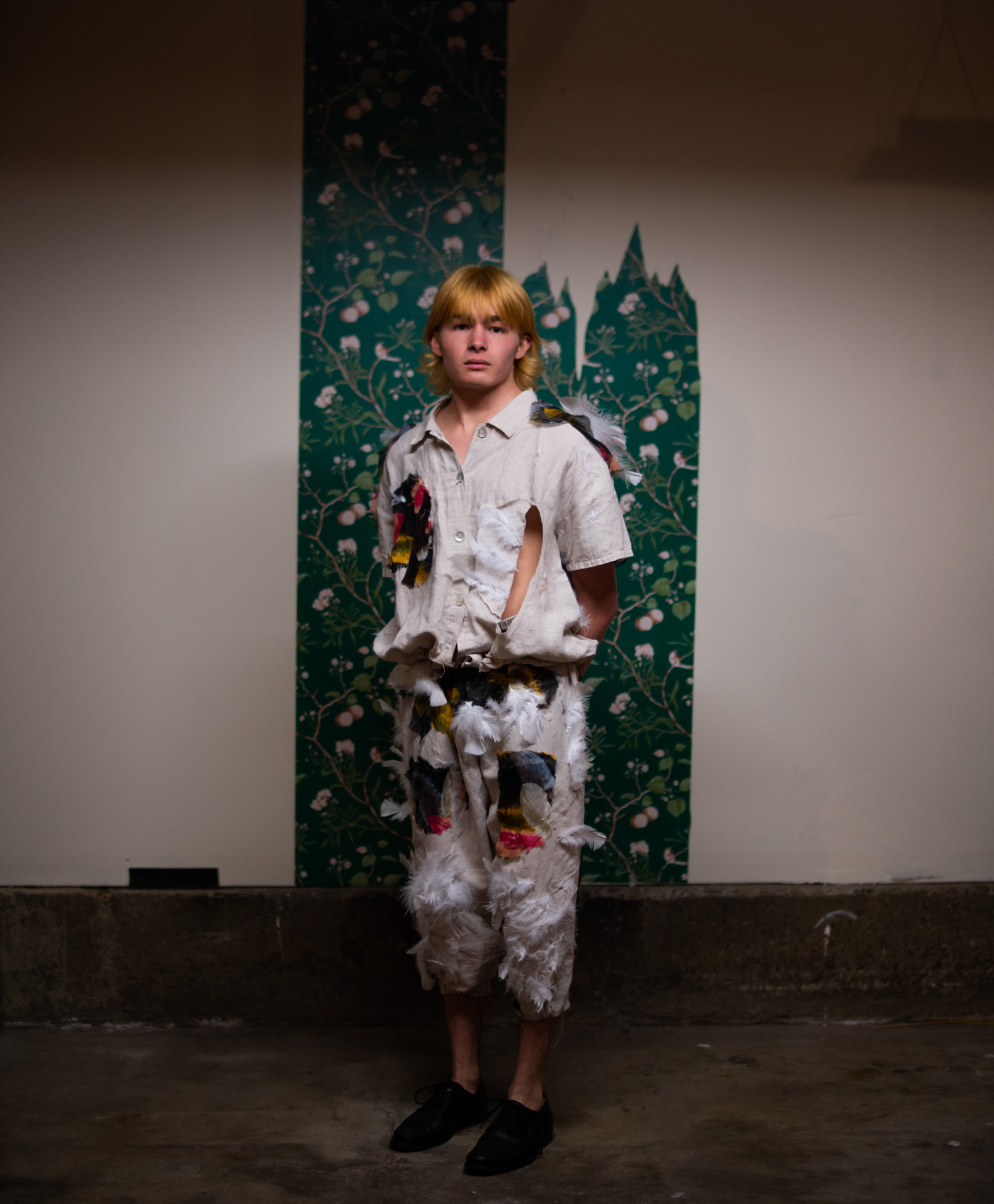
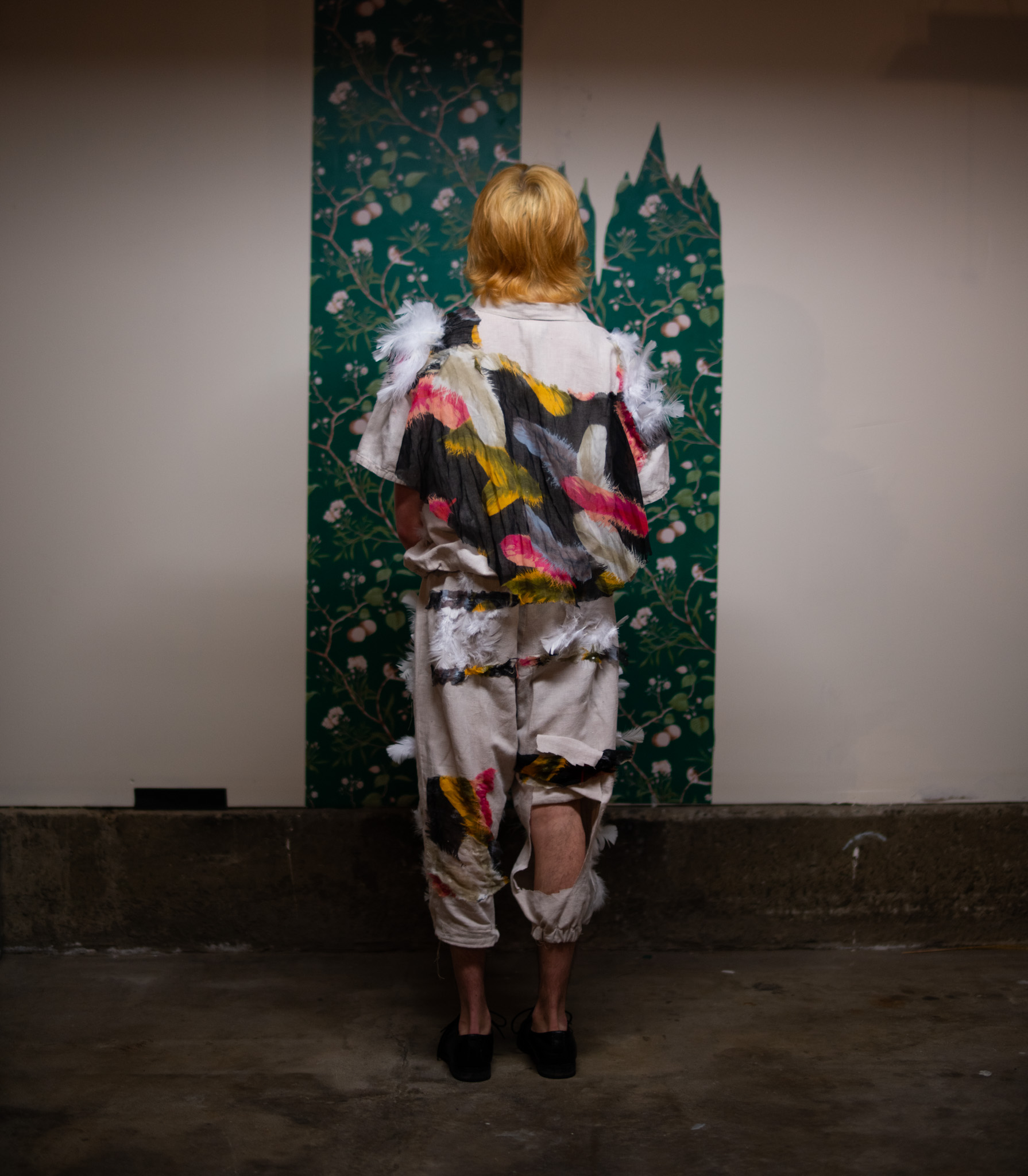
'MOTHER GOOSE'
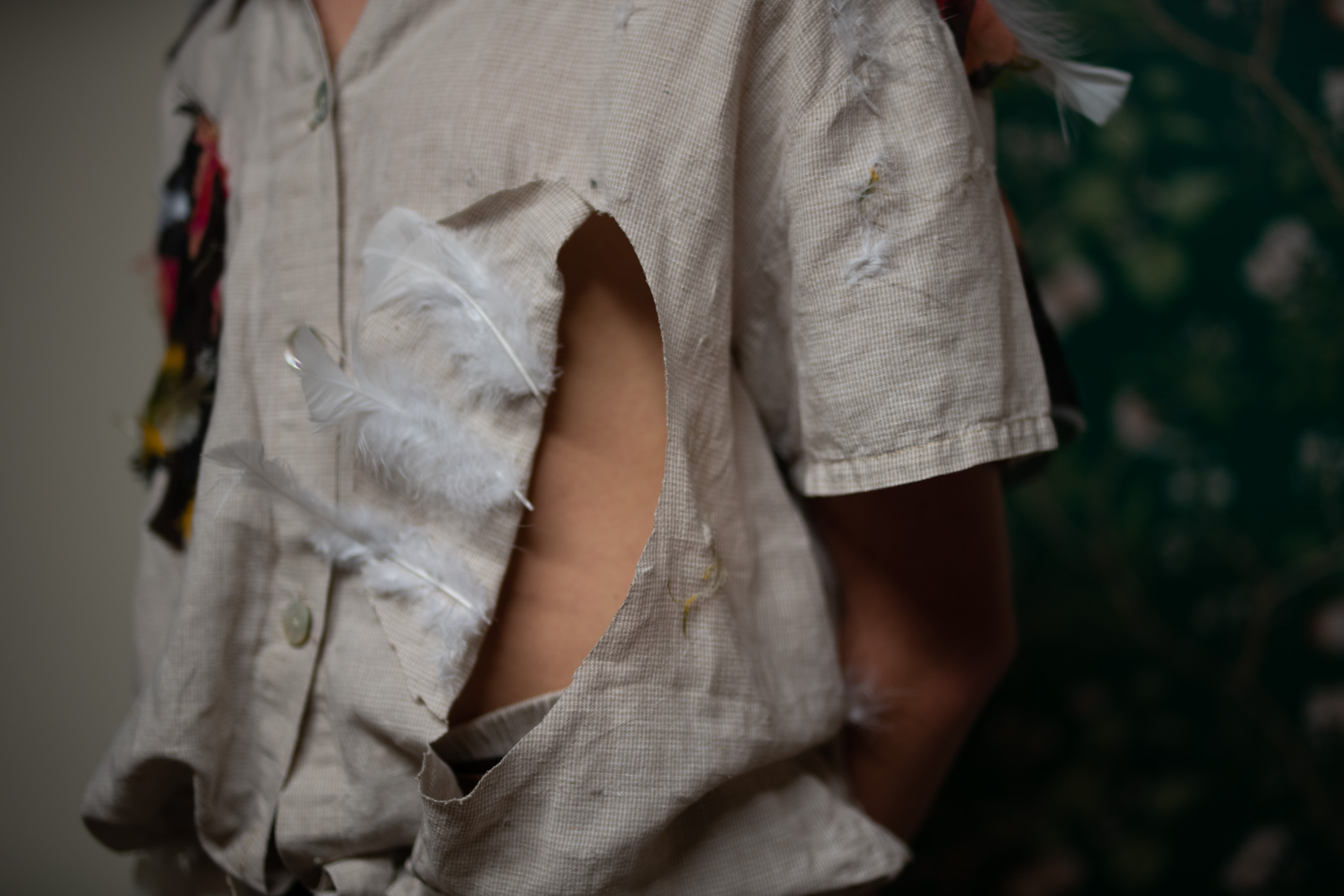
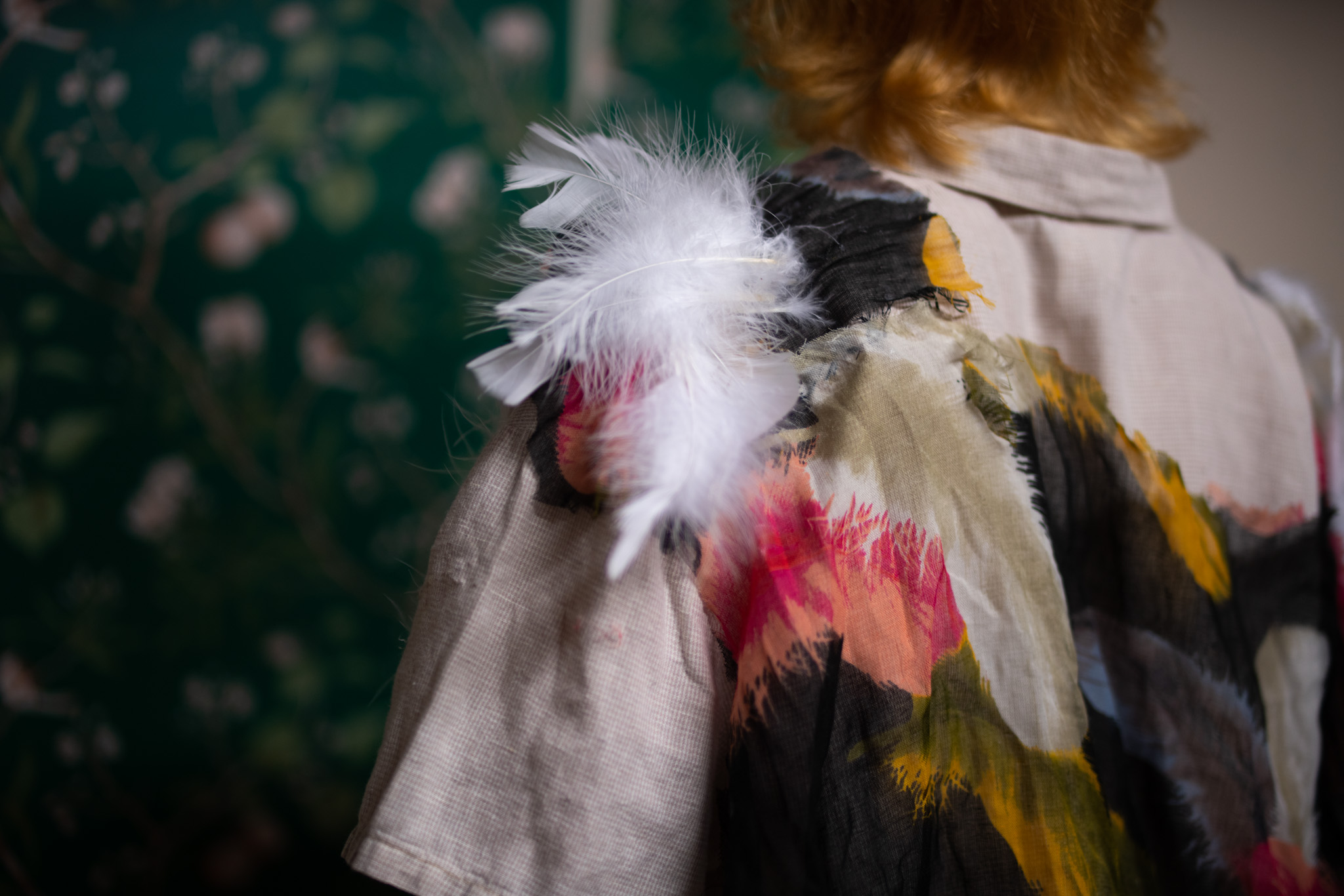
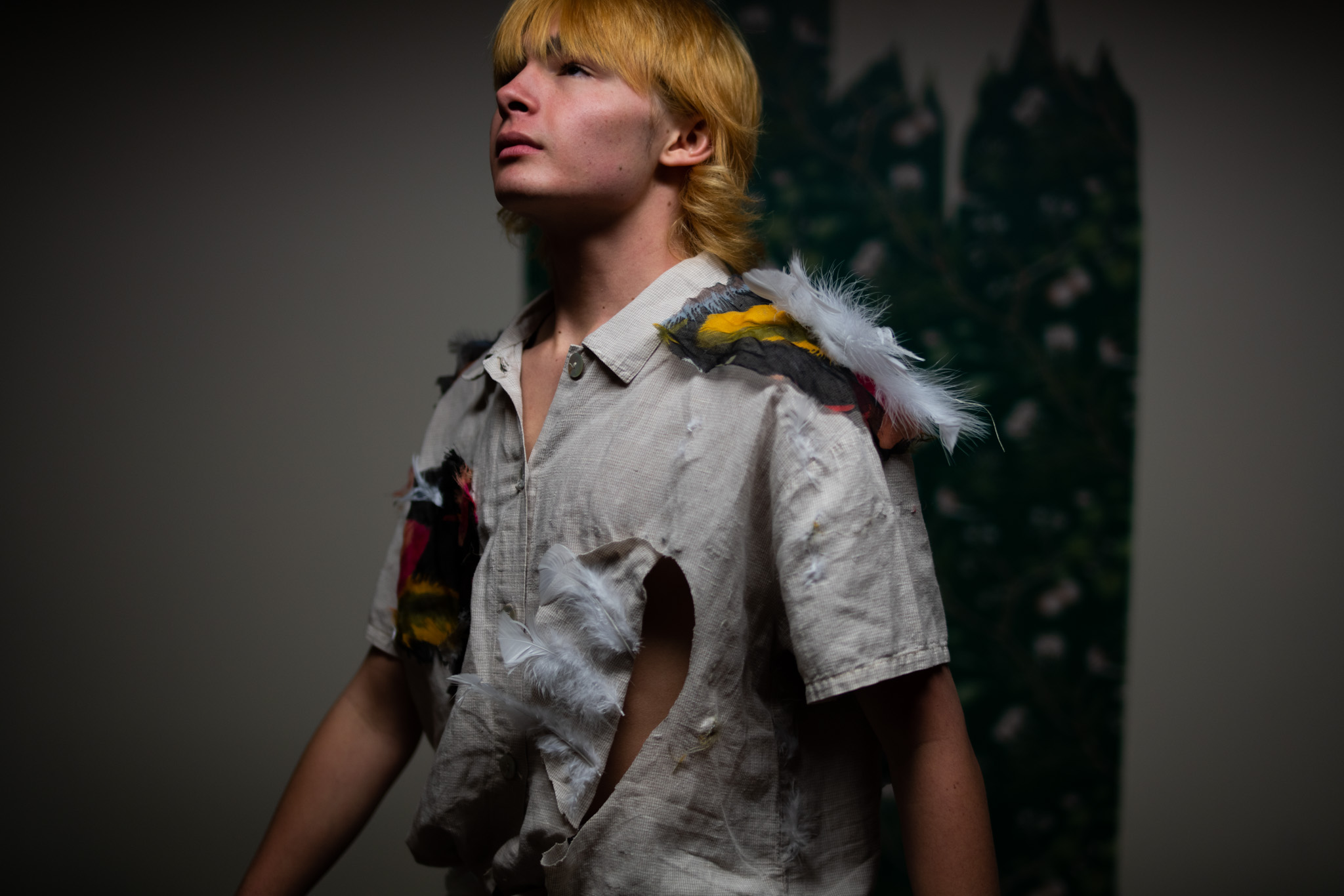
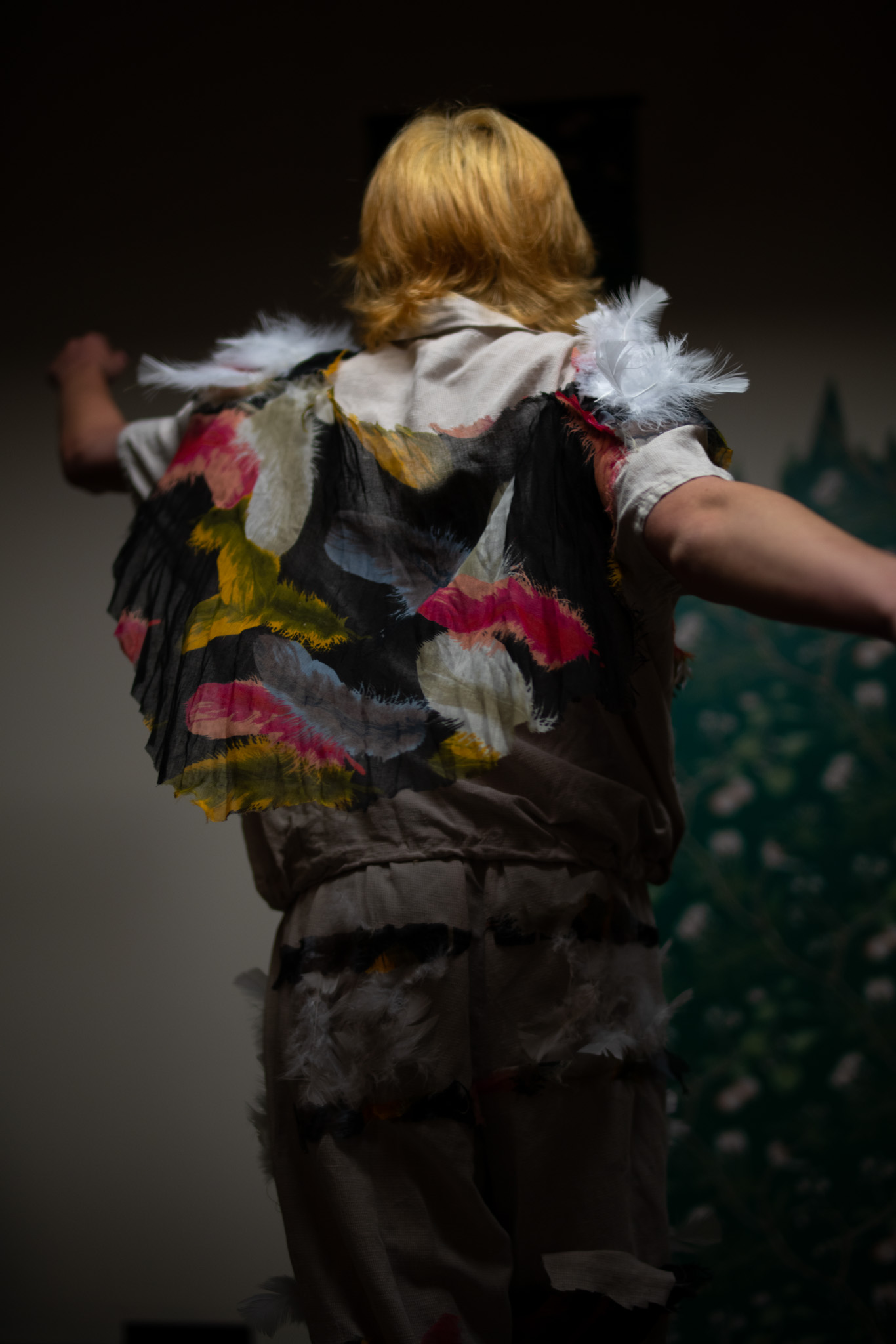
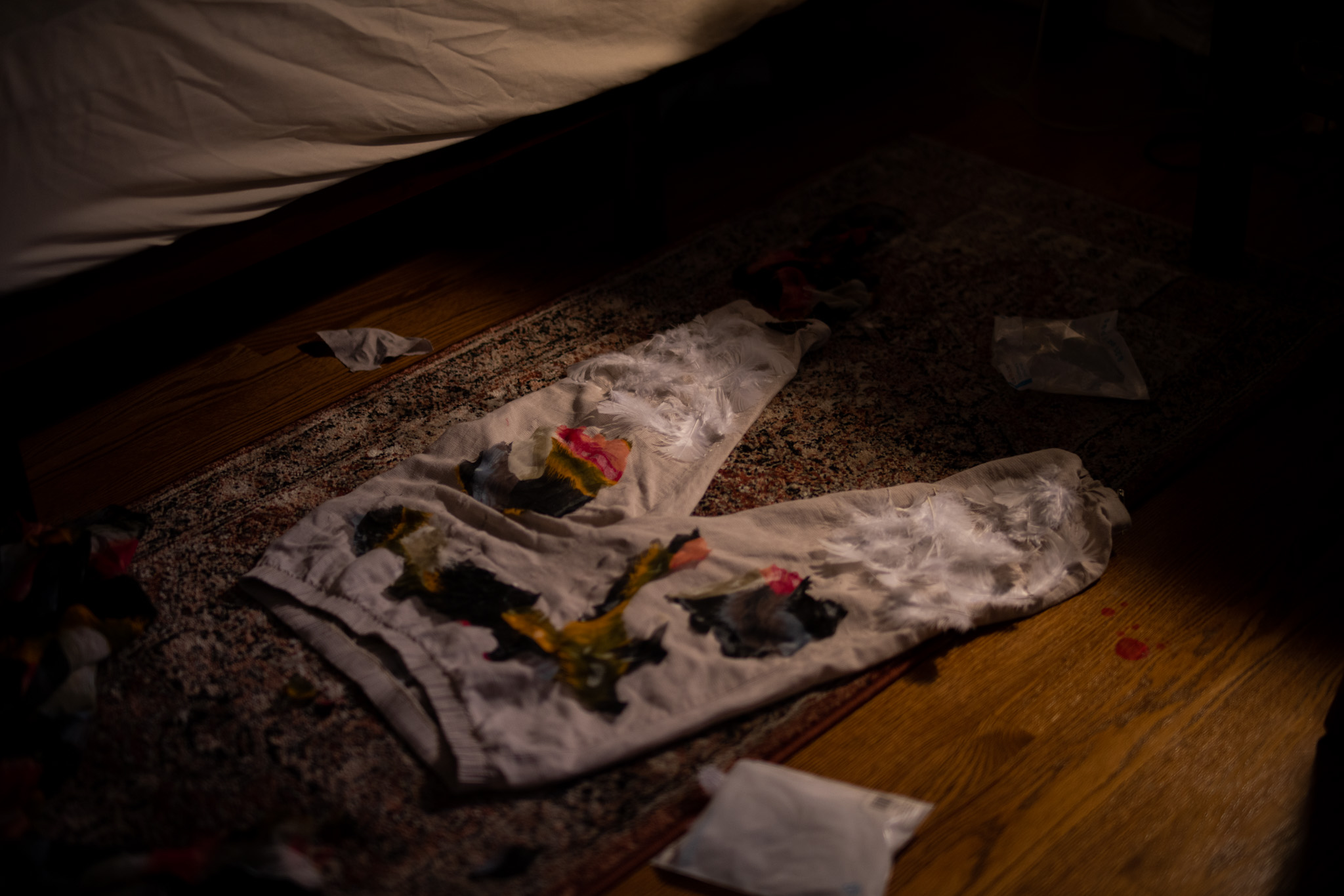
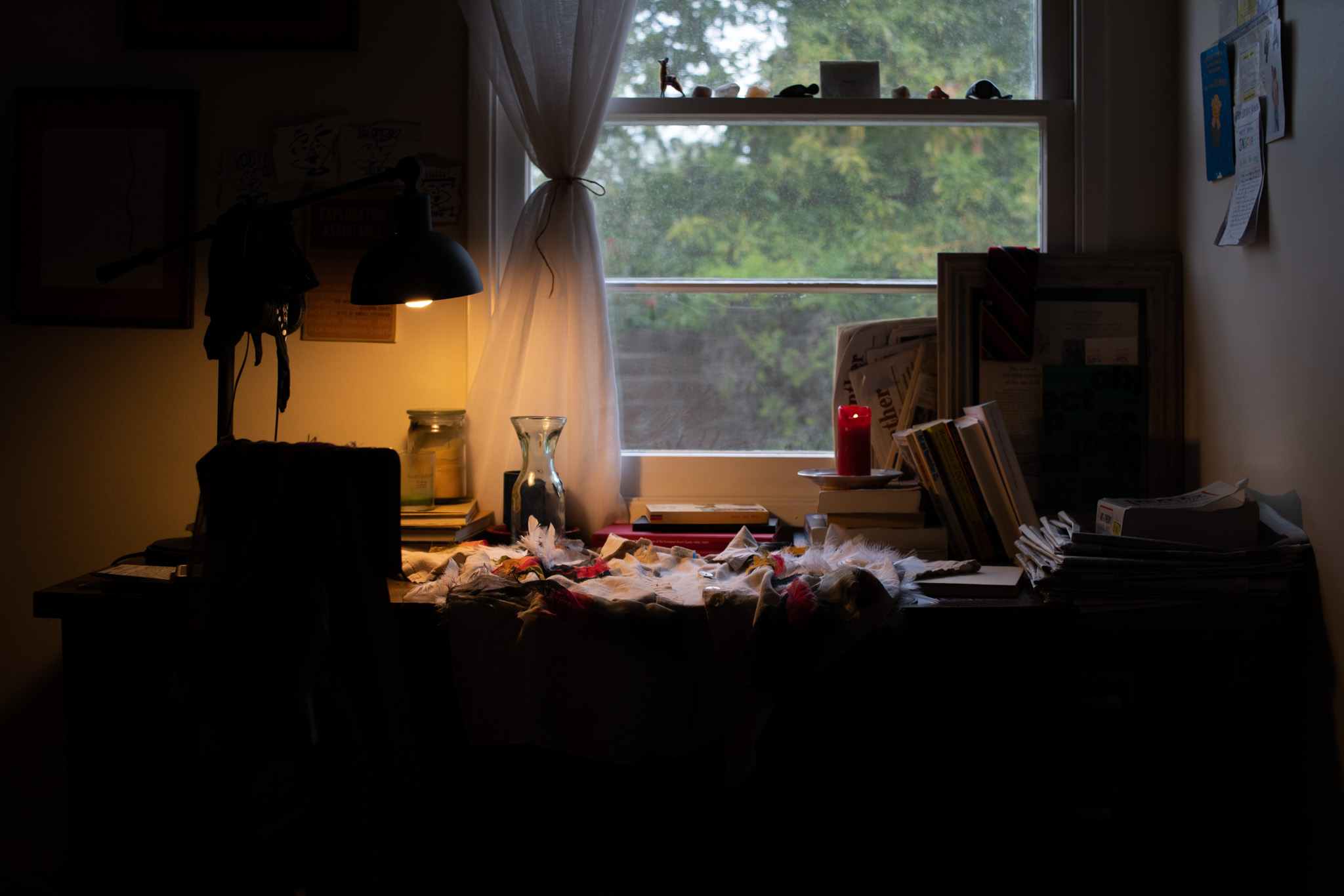
In the spirit of childlike imagination, I aimed for the piece to look like a human-plucked chicken hybrid. A mix of a child’s homemade costume and an intrusive thought while eating a drumstick. Much like Chagalls paintings, there is a rudimentary and make-shift aesthetic, embracing the transparency of the construction process. The meaning of the title is in reference to the children's folk story/character/author, Mother Goose.
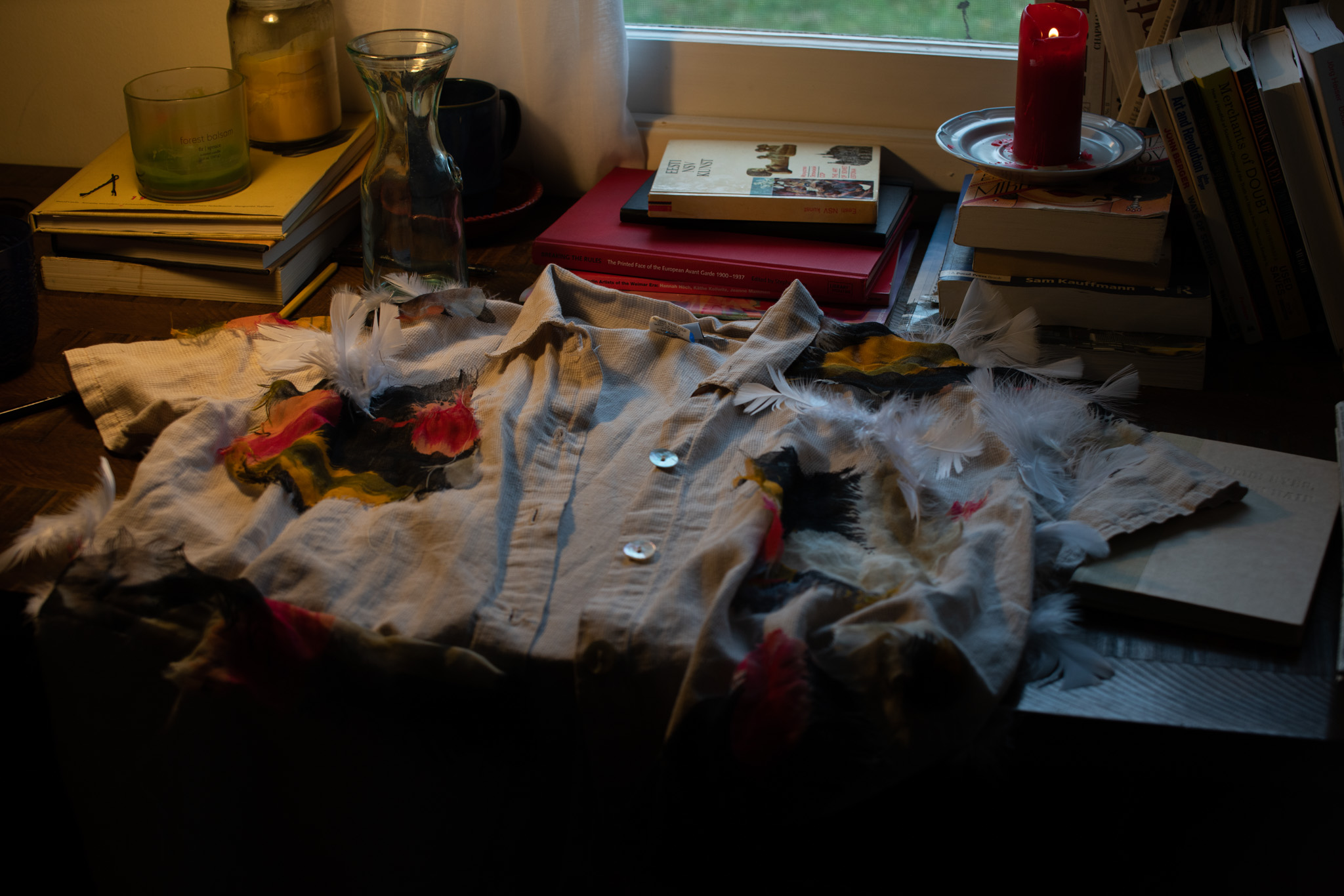
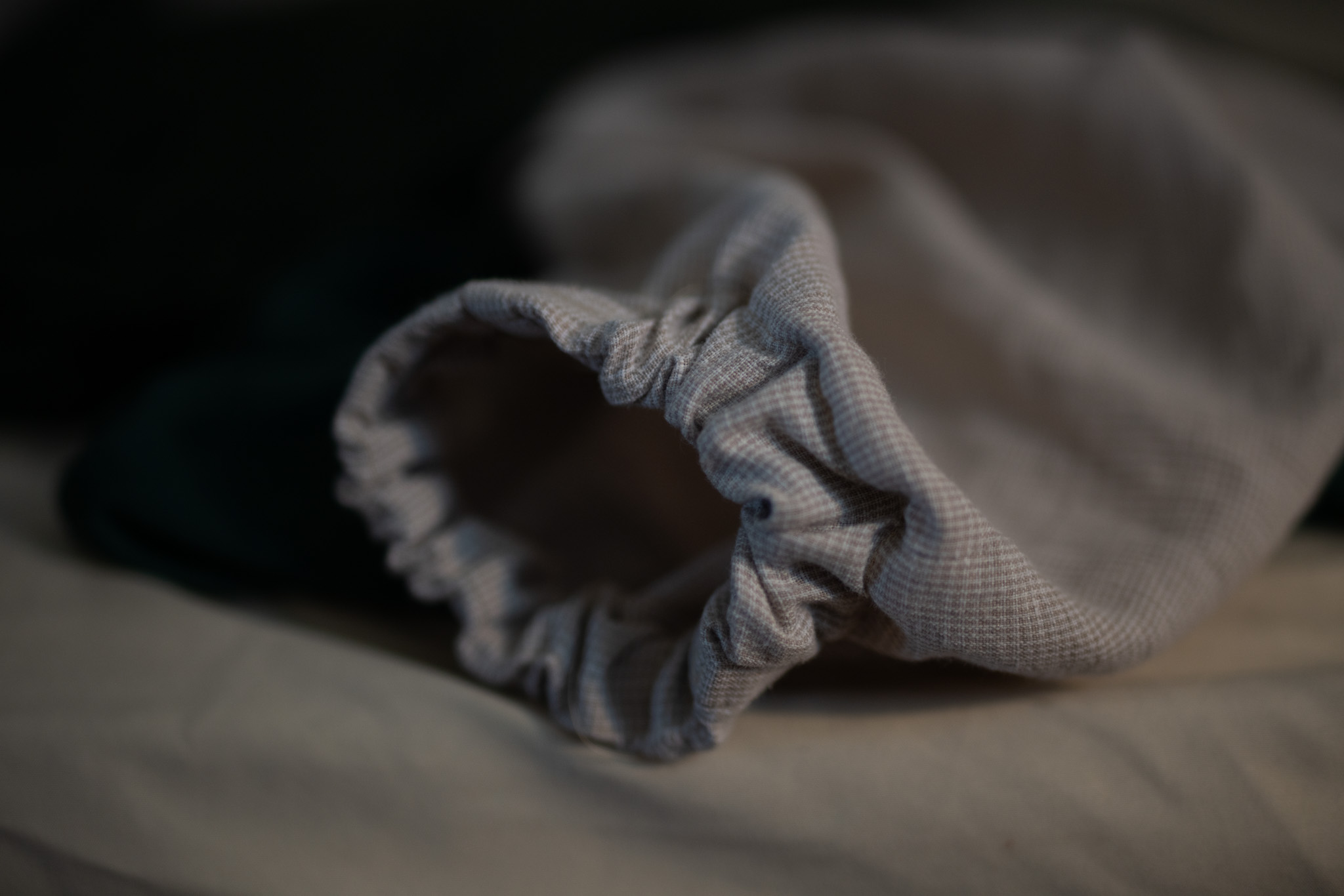
The materials I used were really whatever I could find. I have yet to attempt any sort of garment making before, so I had to get creative with how I would create my piece. I found the base of the piece at a thrift store for 5 dollars, a matching burlap shirt, and pants. To make the fit more ideal, I learned how to ruche the fabric with a sewing machine and elastic. I did this on both the bottom of the shirt and each pant leg bottom. After that, I created a prototype. It was too hastily put together and didn't work. I took apart the fabric I combined with the burlap and started again. For the final iteration, I incorporated feathers to contrast with the flesh of the person wearing it to emphasize the idea of a human-chicken hybrid.
When researching Mother Goose, you find a confusing and difficult to piece together timeline, mainly driven by anecdotes and speculation. As a character, she is a maternal figure. In some stories, she is a literal goose; in others, her human features are reminiscent of a goose. Her defining purpose is to show children good versus evil. In a more famous story involving Mother Goose, she is poor and tempted by the devil with money. Although she lacks wealth, she is content with her happy life and denies the money. While her legacy as a character is important, the author Mother Goose is fascinating. An anonymous author who goes by Mother Goose wrote collections of 17th-century children's stories and nursery rhymes. As the true identity of Mother Goose has never been uncovered, speculation has occurred for centuries about who the author is. Some speculate her origins begin with King Robert II of France. Others say it could go as far back as the biblical Queen of Sheba, with the author being lost to history. One theory even speculates Mother Goose is the wife of a Bostonian named Issac Goose in the 1700s. Experts place no stakes in any particular theory, leaving the truth uncovered.
I found the story of Mother Goose similar to the story of Marc Chagall’s piece ‘Visions of Paris.’ They both retain a childlike outlook on life. This in no way means a simple outlook. ‘Visions of Paris’ emphasizes good feelings and good memory. The piece doesn’t claim there is no suffering; it just decides not to focus on it for a moment. When the devil tempts Mother Goose, she sees evil and deliberately chooses good. Even though the identity of the author Mother Goose is forever obscured, the lack of ‘truth’ does not take away the impact of the work. It’s extremely similar to Chagall’s piece. The nonsensical situations depicted in his Paris, the swapping of grass and sky, the absence of gravity, and no clear reference of space. These factors seem insignificant to the feeling ‘Visions of Paris’ embodies. Both the mystery behind Mother Goose and the work of Marc Chagall invite you to say, “So what?” to facts once considered necessary to function. The truth is subjective; you are your own reality, and your memory may not always be ‘correct,’ but it is always right.