12021-05-20T20:16:15+00:00Alec Medene1e797c9a6d802de2c8135b843c32dd2b47f0d4f921Ted Merkle's headstone in Livermore, Californiaplain2021-05-20T20:16:15+00:00Alec Medene1e797c9a6d802de2c8135b843c32dd2b47f0d4f
This page is referenced by:
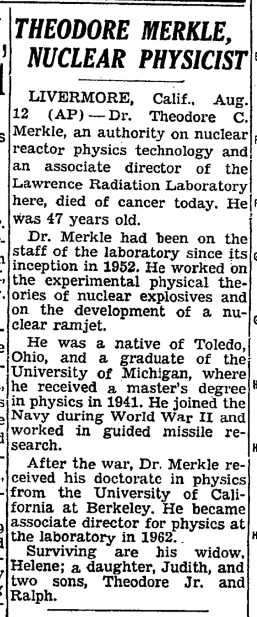
12021-04-16T04:07:09+00:00Ted Merkle: The Eccentric Project Head17plain2021-05-21T04:09:28+00:00Ted C. Merkle was technical director of Project Pluto. Working at Livermore lab, Ted Merkle was referred to as charismatic, impatient, and straightforward. He was described by a colleague, Jim Hadley, as a man who "wasn't interested in untying the Gordian knot. He cut it." Interestingly, according to an article in Air and Space Magazine, he developed a precursor to the CAT scan when he contracted Liver cancer. Frustrated with the care being provided by his doctors, Merkle and scientist Richard Werner developed a radiological device to create a map of his liver. He was aware at this point that the disease would be lethal. He simply wanted to see it.
This cancer would eventually kill Merkle in 1966, just two years after Project Pluto's cancellation.
One of his sons, Ralph Merkle, would grow to become a researcher in nanotechnology, with focus on Eric K. Drexler's hypothetical idea for a molecular assembler. He also married Carol Shaw, the first female professional video game designers. Notably, Ralph Merkle's personal website appears to contain the only publicly available copy of the text of the previously mentioned Air and Space Magazine article on Project Pluto and Theodore C. Merkle himself. The article is the only source on the man's personal life that appears to be available on the internet.