Tory II A Nuclear Ramjet Engine
1 2021-04-16T03:03:48+00:00 Alec Meden e1e797c9a6d802de2c8135b843c32dd2b47f0d4f 92 2 A Picture of A Tory II A Ramjet plain 2021-04-16T03:04:13+00:00 Alec Meden e1e797c9a6d802de2c8135b843c32dd2b47f0d4fThis page is referenced by:
-
1
2021-04-16T04:31:16+00:00
Nuclear Ramjets: What are they?
25
plain
2021-05-21T01:43:48+00:00
37.68715865871891, -121.70591811765112
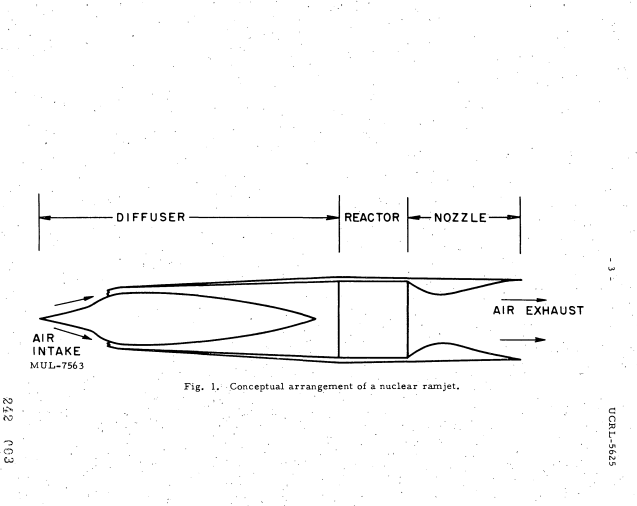
Project Pluto tested two nuclear ramjet engines Tory II A and Tory II C. Ramjets are a type of engine which use their immense speed to pressurize air coming into the inlet of their engines. In the case of this vehicle, the air entering the inlet would already be an astounding 1000 °F, just from friction caused by how fast the vehicle would be traveling. This air would then be heated to 2000 °F by the heat of the reactor, which it essentially passed directly through.
This rapid increase in thermal energy would create thrust. Superheated air would blast out the exhaust nozzles of this vehicle, keeping it at a speed of nearly Mach 3 for days or possibly even weeks at a time. It's important to understand that, other than rockets or missiles, there was no competitor in terms of speed at the time. No known engine could compare. In terms of longevity of flight, there still isn't. No gasoline or battery can yet match the sheer power density of nuclear fuel. The idea of a plane that can fly for weeks without refueling is amazing now...it is easy to imagine how tantalizing the possibility seemed to planners in the mid 20th century.
Because the ramjets needed high speed to operate, the SLAM would be accelerated initially by rockets, which would loft it up into the atmosphere and accelerate it to the correct speed.
The work on these nuclear ramjets fell under the control of the Lawrence Livermore National Laboratory, in Alameda County, California.
I've attached a link to a PDF from the program written by the head, Ted Merkle, assessing the capability of nuclear propulsion. This document was written early in the process of development and strongly influenced how the ramjets used in Project Pluto would be designed.
-
1
2021-05-20T23:08:23+00:00
Testing, Testing, Tory 2 A and C...
12
plain
2021-05-21T01:44:11+00:00
36.80163409391829, -116.31333256001302
Multiple tests were instituted from 1960 to 1964. The first of these involved a reactor called the Tory II A. At only 160 megawatts of power and weighed down with heavy shielding, this reactor wasn't meant to represent an engine that would realistically be placed on an aircraft. Rather, it was a test bed to learn how to create a reactor core design that was workable. This wasn't a simple task. Advanced materials and new techniques needed to be developed to create a reactor that could stand insane pressures, temperatures in excess of 2,500 F, high levels of radiation, and oxidation caused by ton after ton of chemically reactive oxygen being pushed through the tiny inlet.
The machinery needed to realize the tests was just as impressive as the weapon and reactor designs themselves. Remember, this device is a barely-shielded nuclear reactor. it wasn't safe for individuals to approach the device during operation. In his excellent article on the subject,
Barton C. Hacker explains the lengths they went to to ensure safe operation:"Because ramjets function only at high speed, ground-testing posed unique challenges. Simulating Mach 3 flight conditions required an air system able to deliver to the reactor test unit's intake roughly 2,000 pounds (900 kg) of air per second at upwards of 1,000°F (570°C) and almost 600 psi (40 kg/cm2). The air storage farm held 1.2 million pounds (550,000 kg) of air at 3,600 psi (250 kg/cm2), enough for a five minute test run at full power. Important data came from taking the reactor apart for study after testing. Highly radioactive, it required a purpose-built, heavily shielded building where the reactor could be disassembled with remote controls. Remote controls also directed the battery-powered railcar that carried the reactor over the two miles (3 km) of track between test pad and disassembly building. The static test facility ranked with the reactor itself as Project Pluto's 'two major technical accomplishments'."
Devices such as these would be impressive today, but this is all happening in the early 50's! At one point, nearly 300 people were working simultaneously on Project Pluto. These tests were conducted at Jackass Flats, at the Nevada Test Station by Lawrence Radiation Laboratory.