Conclusion
Anguissola’s role as an eligible woman for marriage is sealed with this portrait. In the end, she is presenting herself as domestic and womanly, confining herself to the spinet. It reads like an advertisement, one for Anguissola’s virginity and supposed docile nature even though her very talent of painting herself serves as a threat to the androcentric framework and beliefs of 16th century Italy.The very fact that Anguissola is able to craft such 1) realistic female forms, 2) clear and introspective lines that guide the viewer, and 3) accurate chiaroscuro should be cause for alarm, yet the portrait attempts to soothe that fear. The painting is overtly feminine, overwhelming with how many objects and tools used to construct a “safe” woman, an individual who does not threaten men.
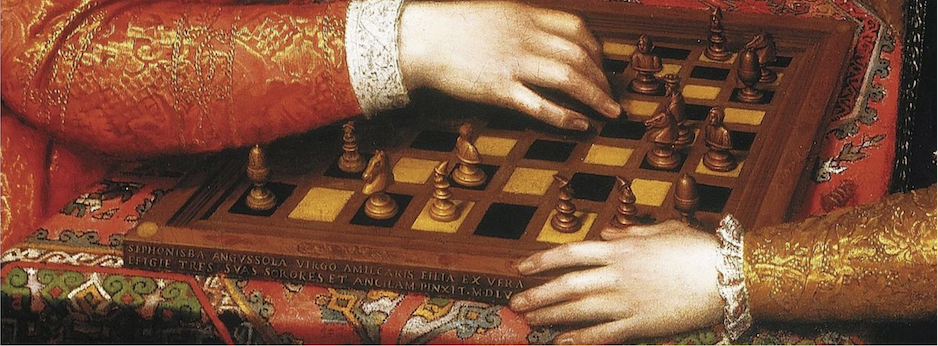
Sofoniba Anguissola very subtly creates and leaves messages of her beliefs within her work, that seems to only be for her female voyeurs. Anguissola’s work acts like an inside joke, in which she and female voyeurs are the only ones privy to the punchline. Her subtle protofeminism appears not only in her 1561 self portrait, but in her Chess Game, 1555, which she uses linear perspective but also carves her name into the chess board. Both of these together culminate into the idea that 1) Sofonisba can do linear perspective and does it well (again) and 2) she is capable of playing an extremely strategic game, so much so that this board is her’s. Due to the time period, Anguissola was heavily restricted on how much she was actually able to do. Despite that, the ways that Anguissola weaves and flexes her dominance and autonomy within her work through the arrangement of symbols and line-work, proves that she is conscious of how she is depicting herself.