Gazu Hyakki yagyō (畫圖百鬼夜行)
1 2020-04-13T17:49:48+00:00 Sam Risak de15aa325cf1a30890aaebf382bf4d5ee8842ca6 4 4 Toriyama, Sekien (鳥山石燕) Maekawa Yahei, 1805--Ubume on Page 20 plain 2020-04-13T18:56:16+00:00 Sam Risak de15aa325cf1a30890aaebf382bf4d5ee8842ca6This page is referenced by:
-
1
2020-03-14T03:39:15+00:00
The Ubume in the Konjaku Monogatarishū
19
Heian, Japan, roughly 1120
plain
2020-04-16T03:53:11+00:00
The first written appearance of the ubume comes around 1120 in the Konjaku Monogatarishūshū (The Tales of Times Now Past), a collection of setsuwa central to the defining the genre. Organized into books “Tales of India” (Tenjiku, 1-5), “Tales of China” (Shindan, 6-10), and “Tales of Japan” (Honcho 11-31), the Konjaku Monogatarishūshū contains roughly 1,040 tales, the majority of which appear in prior texts apart from those in “Tales of Japan.” While the identity of the compilers is unknown, due to the overtly Buddhist messages of most of the parable-style tales, they are assumed to be Buddhist monks (Li 18).
As many of the stories were used to enliven Buddhist sermons, initially the audience for such setsuwa would have been aristocrats. During the Heian period (794-1185), however, a more accessible strain of Buddhism rose in popularity known as Pure Land Buddhism. Rather than elaborate ritual or arduous study of doctrine, Pure Land stressed faith, its accessibility making it particularly appealing to the lower classes. During the time of the Konjaku Monogatarishūshū’s compilation, this sect of Buddhism would have believed the world to be entering Mappō—“ten thousand years of disorder, violence, and moral decay, rendering the attainment of enlightenment impossible for even very devout people” (Li 218). In this stage, the most one could wish for was rebirth in the Western Paradise or Pure Land where becoming a Buddha was relatively easy (Morton et al. 41). In response, Buddhist lessons began to shift, preaching advice on how to make it through this world's treacheries rather than stressing its beauties.
Despite the fantastic elements within many of the parables, the Konjaku Monogatarishūshū claims the events that unfold within its pages to be true; however, the passed-down nature of the tales do create some freedom for interpretation, each one beginning with the phrase that translates approximately to "now it is the past" and ending with “and such then is the story as it has been handed down” (Li 27). By setting the stories in an ambiguous past, the monks were able to present them with the authority of history while shaping the figures and plots to fit their agendas. In fact, many of the figures within the tales lack documentation outside of the setsuwa, an example of which can be seen in Taira no Suetake whose status as legendary warrior was informed by his roles in such tales as “Yorimitsu’s Retainer, Taira no Suetake, Meets an Ubume” (Reider 14-15). Through the setsuwa, Suetake becomes known as one of the Shitteno or Four Guardian Kings. a term that was initially used to describe pre-Buddhist deities incorporated into the pantheon to protect Buddha’s Law, Buddhists, and Buddhist countries, and was later applied to outstanding men of valor under a military commander (Reider 15).
The story in which Suetake and the ubume appear is located within Book XXVII, “Tales of Malevolent Supernatural Creatures,” in which the themes center around military honor and the supernatural. According to Komatsu Kazuhiko, from the seventh to seventeenth century, power and authority in Japan had “relied not only on the conquest of real enemies, but on the maintenance of symbolic control over surreal ‘demon’ enemies” (Figal 22-23). Such demonic conquest bolstered the heroism with which past warriors were regarded and helped the monks looking to maintain favoritism with the military that was emerging as the dominant class. It may not be of coincidence then that the other historical figure mentioned in the ubume's tale, Minamoto no Yorimitsu, was a general who fought for Fujiwara Michinaga—an adherent to Pure Land Buddhism. Michinaga was considered to be the most influential of all Fujiwaras, a family that dominated Japanese court life for centuries "without a rival in controlling the national destiny from 857 to 1160" (Morton et al 24). And out of all the aristocratic families who appear in setsuwa, it is the Fujiwaras who appear most (Li 150), perhaps unsurprising given yōkai’s tie to the land and the Fujiwara’s cultivation of it.
The first generation of the Fujiwara clan, Fujiwara no Kamatari helped construct one of the most significant impositions on the land during this time—the Taika Reform. An attempt at creating a centralized authority, the reform declared all land of Japan as belonging to the emperor and allotted rice land to farmers for the assessment of taxes by local headsmen and landowning nobles who were appointed to the court as provincial or lesser governors. To escape such taxes, many peasants would commend their land to a temple or official who had been granted tax exemption in order to pay them a rent far less than the tax amount required (Morton et. al. 46). This happened more and more until tax sources eventually dried up, and the centralized government broke down, the tax base falling onto those least able to pay it. This did not stop the Fujiwaras, however, as the family stepped in to assume government offices and maintain liaisons throughout the country (Morton et al. 46).
The failure of the Taiko Reform did not have such positive effects on the land, however. Without its centralized structure, humans began to spread across the archipelago, engaging in entrepreneurial commercial activity and increased agriculture and material output, both of which led to deforestation, land clearance, and greater power available for exploitation by the elite (Totman 101, 93). In their translation of the Konjaku Monogatarishūshū, Naoshi Koriyama and Bruce Allen note in the introduction:“Along with the decline of the nobility’s power and the spread of Buddhist teachings to the common folk in rural areas, major ecological changes were transforming nature and culture in the countryside. Forests—along with their resident gods, spirits, ogres, demons, and other supernatural beings-were being cut down and pushed away to clear the land for cultivation (19).
While it is clear the dominant classes were most responsible for the destruction of the land, that is not the narrative the setsuwa offers. Instead, warriors were presented as protecting the people from the land, a position evident in the term Shitteno's origin in the Golden Light Sutra, in which the Buddha commands the Four Heavenly Kings to protect the king who receives, respects, and spreads the teaching of the sutra: “the Four Heavenly Kings warn that if a king fails to uphold the sutra, they will abandon his kingdom, and it will suffer various natural calamities" (Sango 4). Not only does this title of Shitteno strengthen the tie between the military and Buddhism, but it presents nature as the antagonistic force that only they can subdue. And so, while Suetake's position as Yorimitsu's retainer means he was likely a “warrior of ability,” a person who accompanied provincial governors to prevent resistance and maximize tax collection (Friday 8-9), he is instead presented as the people's savoir.
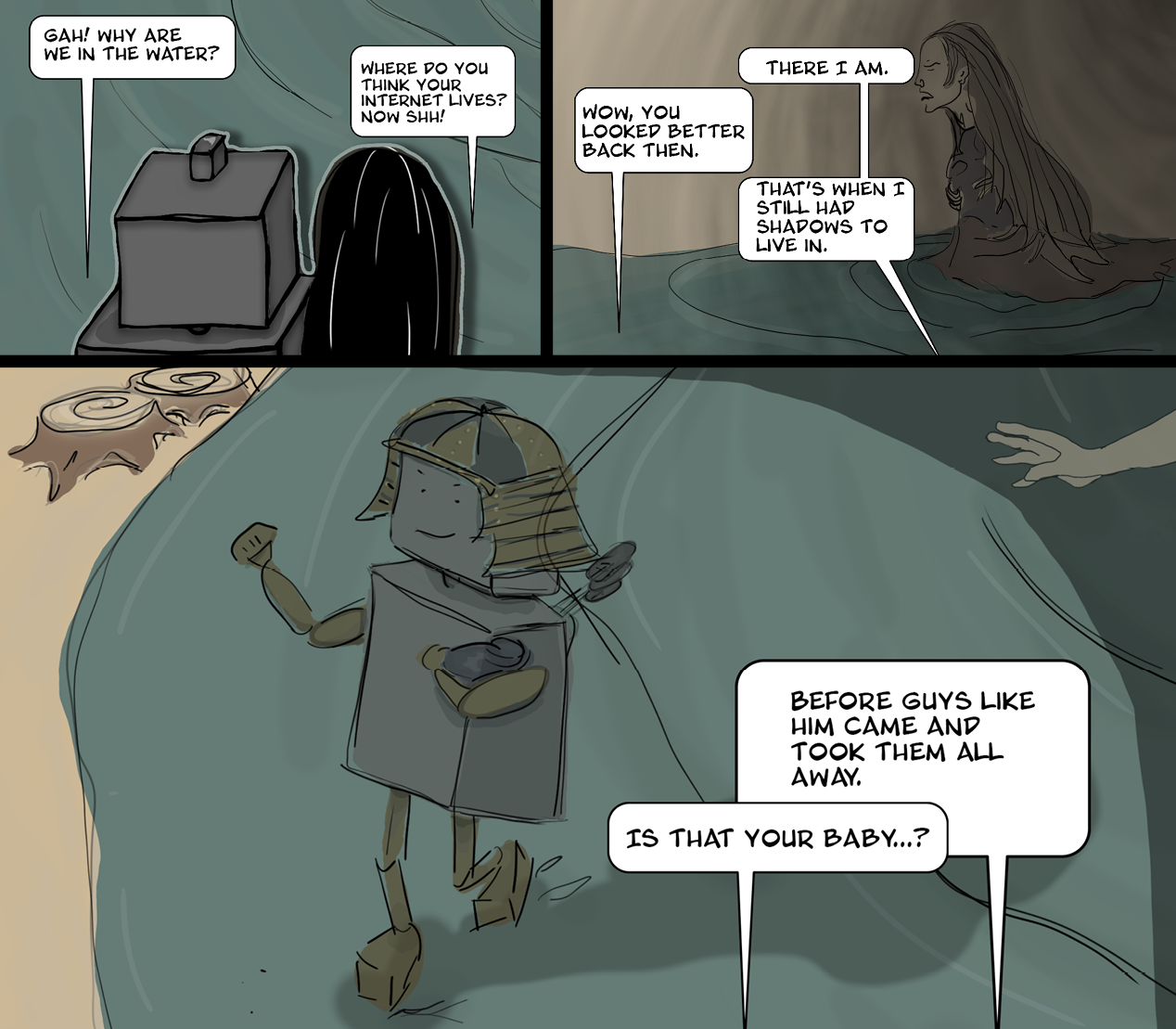
Turning to the tale itself, it is set within a town inside Mino Province where Yorimitsu serves as governor. When Yorimitsu takes a trip to the town, he hears samurai talk of a rumor in which a woman is said to appear in the river of Watari where she asks whomever is crossing to hold her baby. When one of the samurai questions whether anyone around is brave enough to cross the river, Suetake speaks up. A samurai responds: “No, you might be able to fight a thousand enemies, but you won’t be able to cross that river now.” Suetake insists, and the samurai follows with “No matter how brave you may be, you’ll never be able to get across that river,” such dialogue ensuring the reader or listener's focus remains on emphasizing Seutake’s bravery. Unperturbed, Suetake places a bet with the samurai, which, needless to say, he win. Suetake crosses the river and takes the ubume’s baby, his calm demeanor a sharp contrast to the other samurai who were “terribly frightened” by the ubume, as well as the people who heard of his feat and were “deeply impressed.” When Suetake arrives back, he does not even accept the men’s wagers, a final point to illustrate his noble character (Koriyama and Allen 60).
While Suetake may be portrayed as courageous within this setsuwa, when we understand the motives behind such a representation, we can begin to look at what else the tale is saying. As Michelle Li states: “Who encounters demons and what happens to them as a result often indicate privilege and power…monsters can be tamed or converted to serve the interests of authority” (153). And so, by shifting the focus off of the “authority,” which in this case would be Suetake, we can look to see what else is being said. Based on the samurai’s reactions and the “awful, fishy smell” ascribed to the ubume (Koriyama and Allen 60), it’s clear she is intended to be frightening. However, it is not the townspeople who complain about the ubume, but samurai who would have been outsiders to this land, their primary residences being in the capital. Because supernatural creatures “lived, or appeared, at certain fixed locations” and “did not, as a rule, leave their own grounds and appear at other places” (Mori 149-150), should humans had left the land undisturbed, they never would have encountered the ubume at all. She does not follow Suetake out of the river and even her child turns to a pile of leaves in his arms, the supernatural relegated to stay within its realm.
It becomes clear then that Suetake's journey across the river is not done to free the town of any dangers, but as a demonstration of his courage. To prevent any doubts over whether he completed the task, Suetake sticks one of his arrows on the other side of the bank, the raw materials for which—along with Suetake's “armor, a helmet, bows in a quiver” (Koriyama and Allen 60)—were often “collected countrywide as part of the handicraft and special products taxes (chōyō) requisitioned from state-managed forests, mines and pastures” (Friday 63). The common people often had their land depleted of resources to construct weapons that further enabled their exploitation by figures like Suetake and Yorimitsu.
And so, while the Konjaku Monogatarishūshū did not create the ubume any more than it created Taira no Suetake, it did help construct audiences' interpretation of them, populations accepting the narrative of the brave warrior who may never have believed it otherwise. As Li states, “people whose lifestyles and lives are threatened would find it less frightening to confront political and social struggles in terms of the extraordinary and the monstrous than to look hard at the true enemies: other people and time” (Li 241). In a time when the warrior class was rising and many believed the world to entering a time of disorder and decay, the ubume offered common people a monster they could defeat, and in so doing, distracted them from seeing who and what there really was to fear.