Introduction
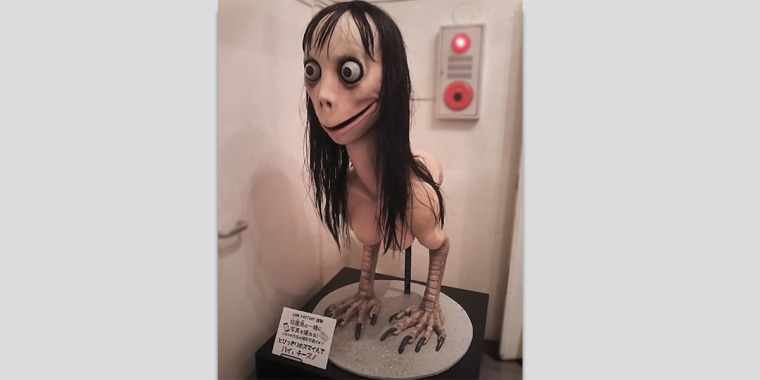
On February 26, 2019, Twitter user Wanda Maximoff posted “Warning! Please read, this is real. There is a thing called ‘Momo’ that’s instructing kids to kill themselves…INFORM EVERYONE YOU CAN.” Attached to the tweet was a screenshot of what would become known as “Momo,” a frightening figure with lidless eyes, an oversized smile and flattened nose, a body made up of nothing more than breasts attached to chicken legs.
The figure behind the “Momo Challenge,” however, was not born in 2019. Nor was it born in 2018 when the hoax swept across Latin America. It was not even born in 2006 when artist Keisuke Aiso created “Mother Bird,” the art-horror sculpture that starred in the photograph for Momo. No, this figure has roots that stretch back centuries, only known under a different name—the ubume.
A character in Japanese and Chinese folklore, the ubume translates to birthing-woman. Said to derive from a woman who died giving birth, it is not the woman herself, but her spiritual attachment to the child that becomes the ubume. While there are numerous iterations of the ubume, she is commonly presented as a woman who stands in rivers, drenched in blood from the waist down, holding what appears to be her child. If you come across her, she will ask you to hold the child, which you will soon find is no longer a child but perhaps—and this is where the versions tend to differ—a pile of leaves or a stone that grows heavier and heavier.
The ubume is one of many yōkai—or supernatural creatures—found in Japan, all of which are associated with the uncertainties of the land. Such yōkai have proliferated in popular culture for centuries, and recently, have also begun to feature in the critical works of several North American scholars, including Michael Dylan Foster (Pandemonium and Parade: Japanese Monsters and the Culture of Yôkai, 2009), Gerald Figal (Civilization and Monsters: Spirits of Modernity in Meiji Japan, 1999), and Michelle Osterfeld Li (Ambiguous Bodies: Reading the Grotesque in Japanese Setsuwa Tales, 2009). Each of these texts offers critical insight into the role the supernatural has played in Japan; however, given the scale of their subject matter, the specifics paid to the individual yôkai is minimal, and when the ubume is mentioned, she rarely receives more than a paragraph. Given the gender implications of the ubume, slightly more information is offered in texts like Hank Glassman’s The Religious Construction of Motherhood in Medieval Japan, but again, the text covers a large topic, in which the ubume serves as one example of many.
Rather than situate the ubume amongst other yôkai, I historicize three mediums in which she appears, such context proving particularly significant given how prone to exotification Japanese culture is in the United States. Unlike the violent stereotypes applied to many populations of color, once Japanese Americans—and Asian Americans more broadly—began to succeed economically and assimilate to the nuclear family, they became the “model minority”—a tool for the white dominant classes to “prove” the American Dream still exists. Under this supposed embrace, racist WWII depictions and their corresponding violence faded to make room for a new image of Japan, one filled with objects like the yôkai-descendant Pokémon
for Americans to collect. And many did so readily, our commodification of the country perhaps best signified by the invention—and prevalence—of the term "weeaboo," a (typically derogatory) name for a Western person "obsessed" with Japan.
Even as discussions of whitewashing and cultural appropriation arise in the United States, such conversations seem to hold less sway when applied to Japan, many Americans seemingly unsure as to whether one can be racist against Japanese Americans anymore, particularly when many participate in the commodification of their own culture. This "color-blind" perspective reflects a lack of historical awareness, one that makes Americans privileged to not experience such discrimination liable to support a society which encourages the very offenses they believe outdated. Similar to what Edward Said describes in Orientalism, the mainstream depiction of Japan in America is a narrative constructed to serve the dominant white power structure—a narrative that will therefore change as the needs change. And in the pandemic COVID-19, the needs changed. In search of an outlet to target their fears, too many Americans returned to the more violent positioning of Asian Americans as “other,” the sharp rise in hate crimes making obvious the racism that was there all along.
While this project is not analyzing race relations, it is looking to make a piece of Japanese history visible. No different than most in the United States, when I first came across “The Momo Challenge,” I was not aware of any background behind the figure I was seeing; Momo blended in with numerous faces that have filled the American horror scene (many of which—The Ring, The Grudge, etc.—also share origins in Japanese folklore). However, once I read about the “Mother Bird” sculpture being inspired by the ubume, I began to wonder about the figure’s history and whether the fears she provoked now bore any similarities to those she provoked in the past. In my research, I soon found stories of ubume had lived for centuries in Japan (and China), and is common in folklore, possessed no one author. Unlike many of such stories in the West, however, the ubume is framed as an authentic lived creature; none of the sources this project analyzes (the setsuwa collection Konjaku Monogatarishū, the illustrated encyclopedia Gazu Hyakki Yagyō, and the viral hoax “The Momo Challenge”) present as an adaptation of a fictionalized character, but as documentation of something that already exists. A true product of her environment. the ubume is reborn to fit each new technology, expanding from a regional to a national to an international figure.
But why the ubume? What about her has caused us to return to her again and again? As a framework to answer this, I turned to literary critic Frederick Jameson who references anthropologist Claude Levi Strauss's The Structural Study of Myth to argue that the myth functions as an imagined solution to "unresolvable social contradictions" (79). As “The Momo Challenge” was said to resonate with parents’ fear of technology, in particular, the ramifications it poses for their children, an “unresolvable social contradiction” arises in our correlation between technology and progress. While parents would not want to deny children access to the technology they are told is the way forward, we do not actually know where this “way forward” is leading, nor the environmental consequences of its trajectory. As children and younger generations are the populations to be most affected by technology and the world that inhabits it, the ubume's association with the land and reproduction offers parents an “imagined solution” in the distraction she offers; while parents may not understand what to do about the climate crisis their children are set to live in, they can, at the very least, protect them from Momo. In this way, such easy-to-avoid monsters create a false sense of agency that distracts from the larger social problems and perpetuates the cycle in which we need such distraction. Children safe from Momo, we can all return to our devices, getting lost in a world that avoids the pollution accumulating outside.
We cannot rely on the escape of technology forever, however, many populations unable to afford to do so even now. And while offering a solution remains beyond the scope of this—or any single—project, by identifying a pattern of distraction in the use of the ubume, I do hope to reassert some agency into readers for our concerns with technology are not new; they just haven't been held by those constructing our historical narrative. And so we must ask ourselves, is our concept of the future one we want to pass down? Or is it the one we are taught to want? As science philosopher Bruno Latour says: "Don't be fooled for a second by those who preach of wide-open spaces, of ‘risk-taking,’ those who abandon all protection and continue to point to the infinite horizon of modernization for all. Those good apostles take risks only if their own comfort is guaranteed. Instead of listening to what they are saying about what lies ahead, look instead at what lies behind them: you'll see the gleam of the carefully-folded golden parachutes, or everything that ensures them against the random hazards of existence" (11). History depends as much on where we position ourselves now as where we did in the past, and in this project, we look behind us to better understand the promises being made before us.