Elisabeth Vigee Lebrun, Marie Antoinette in a Chemise Dress, 1783, oil on canvas.
1 2023-04-18T00:21:39+00:00 Amie Fillet ea19f215a988933e409dbe3d7df2628fc004a781 302 1 Elisabeth Vigee Lebrun, Marie Antoinette in a Chemise Dress, 1783, oil on canvas. plain 2023-04-18T00:21:39+00:00 Amie Fillet ea19f215a988933e409dbe3d7df2628fc004a781This page is referenced by:
-
1
2023-04-18T00:35:16+00:00
The Power of Dress
13
plain
2023-04-24T23:32:57+00:00
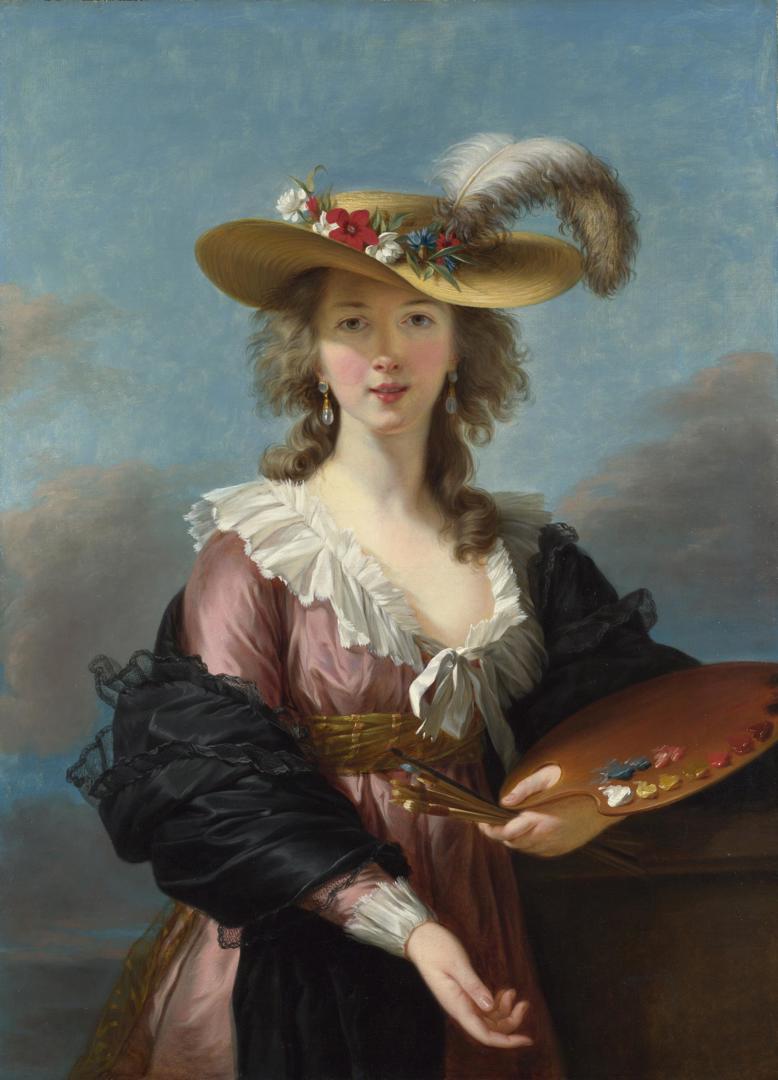
Th way in which Lebrun depicts both herself as well as Marie Antoinette illustrates her emphasis on the importance of dress.
-
1
2023-04-18T00:46:31+00:00
Introduction
5
plain
2023-04-24T23:39:05+00:00
Elisabeth Vigee Lebrun was born in Paris in 1755. During this time period, Louis XV ruled over France as part of the Ancien Regime. During the lifetime of Lebrun, France was both politically as well as socially shifting.[1] Her mother, Jeanne Maissin, was a hairdresser and daughter of a merchant farmer while her father, Louis Vigee was a Parisian portraitist who was fairly successful.[2] This was a time period wherein history painting was at the top of the pictorial hierarchy whereas portraiture, landscape, and still life were not as valued as it was perceived that these genres did not require as much imagination or intellectuality.[3] While Louis Vigee did not accomplish the level of recognition of other painters of his time, he garnered a substantial amount of success, becoming a member and professor at the Academy of Saint Luc. Louis Vigee hosted and attended dinners with many distinguished artists. The connections and success of her father no doubt aided Elisabeth Vigee Lebrun in her development as an artist herself.[4]
As a child, Elisabeth Vigee Lebrun was raised by a wet nurse for the first five years of her life as was the custom for children of the bourgeoisie under the Old Regime of France. At the age of six, Lebrun was moved into a convent where she would remain until she was eleven. In the convent, she learned skills such as reading, writing, counting, sewing, embroidery, and proper social behavior. Much like the use of wet nurses, it was common for daughters of the bourgeoisie to be placed into convents where they learned such curriculum. Of her time at the convent, Lebrun practiced drawing extensively.[5]
Lebrun’s father was instrumental in her development as an artist. He taught her principles of design as well as pastel drawing. He later sent her to painter Davesne to learn how to mix oil paints. Sadly, Lebrun’s father died when she was only twelve. For the next few years, Lebrun composed oil portraits to support her family financially.[6]
As women were not admitted into the Academy’s training program, Lebrun practiced and honed her artistic skills on her own and with the guidance of other artists including landscape artist Joseph Vernet and Jean Baptiste Greuze. Although she worked closely with these artists, she was never apprenticed and thus is considered a self-taught artist.[7]
By 1776, Lebrun had married art dealer and connoisseur Jean-Baptist LeBrun as well as gained acceptance into the Academy of Saint Luc. Later in 1778, Lebrun was commissioned by Marie Antoinette for her first royal commission. Particularly, in the time frame of the 1780s, Lebrun was able to garner even more success for herself through not only her admittance into the Academy, but through social connections such as her husband’s circle of painters and the favor of the Queen Marie Antoinette.[8][1]Evangelia Karvouni, "Elisabeth Louise Vigee Le Brun: a historical survey of a woman artist in the eighteenth century," Journal of International Women's Studies 15, no. 2 (2014): 249+, Gale Academic OneFile (accessed March 12, 2023).[2]Gita May, Elisabeth Vigée Le Brun: The Odyssey of an Artist in an Age of Revolution, Yale University Press, 2005, 7.[3] May, Elisabeth Vigee Le Brun, 9.[4] May, Elisabeth Vigee Le Brun, 8-9.[5] May, Elisabeth Vigee Le Brun, 11.[6] Karvouni, “Elisabeth Louise Vigee Le Brun.”[7] Karvouni, “Elisabeth Louise Vigee Le Brun.”[8] Karvouni, “Elisabeth Louise Vigee Le Brun.” -
1
2023-04-18T00:46:21+00:00
Marie Antoinette
2
plain
2023-05-16T23:36:56+00:00
Lebrun not only navigates the subtle art of dress through portraiture in her own self-portraits, but in her portraits of Marie Antoinette as well. In her portrait of Marie Antoinette, Marie Antoinette in a Chemise Dress circa 1783, Lebrun depicts Marie Antoinette in dress similar to Lebrun’s own in her self-portraits with her daughter Julie. Marie Antoinette’s dress is made of a thinner material and is loose fitting.[1] The semi-transparent dress which is made of muslin is based on a real style of dress owned by Marie Antoinette which she wore at her pleasure grounds in Versailles for leisurely activities. This portrait was received with much backlash after it made its debut in the Salon as it only reaffirmed the reputation Marie Antoinette had garnered for herself of rejecting court etiquette as this dress was deemed inappropriate.[2] Seemingly in response to such backlash, Lebrun composed another representation of Marie Antoinette titled, Marie Antoinette with a Rose in 1783. In this portrait, Lebrun carefully depicts Marie Antoinette in the lavish fabrics and clothing fit akin to the superfluous of French society in the eighteenth century.[3] When both images are viewed next to one another, it is clear that in Marie Antoinette in a Chemise Dress, Lebrun is emphasizing both natural femininity as well as a deconstruction of the self, whereas in Marie Antoinette with a Rose, Lebrun utilizes the subtleties of dress in order to portray Marie Antoinette as subscribing to the social norms and gendered expectations for a queen in eighteenth-century French society. Lebrun’s careful attention to the art of dress through portraiture in response to public reception illustrates Lebrun’s use of fashion for the purpose of crafting a specific notion of the self.
Lebrun’s use of dress in portraiture as it pertains to crafting a image of Marie Antoinette as an honorable mother and queen can furthermore be seen in her portrait, Marie Antoinette and her Children, composed in 1787. The work depicts Marie Antoinette in a tight and lavish red dress with her hair styled to incorporate an ornate head piece. Marie Antoinette is shown holding her youngest child while her daughter stands lovingly beside her and her son stands over a cradle.[4] The body language of Marie Antoinette around her children combined with her bourgeoisie dress functions to represent a moralistic, traditional, and ideal version of monarchical motherhood.[5] Had Lebrun decided to portray Marie Antoinette or her children in different fabrics akin to Marie Antoinette’s chemise dress or Lebrun’s Neoclassical reminiscent dress, the portrait would not subscribe to bourgeoisie ideals regarding fashion, motherhood, and politics. In this way, Lebrun is very aware to the power of dress and its ability to convey both social and political messages about the attitudes of an individual and uses this to try to improve the public perception of Marie Antoinette.[1] Elisabeth Vigee Lebrun, Marie Antoinette in a Chemise Dress, 1783, oil on canvas.[2] Heidi A. Strobel, “Royal ‘Matronage’ of Women Artists in the Late-18th Century,” Woman’s Art Journal 26, no. 2 (2005): 6.[3] Elisabeth Vigee Lebrun, Marie Antoinette with a Rose, 1783, oil on canvas.[4] Elisabeth Vigee Lebrun, Marie Antoinette and her Children, 1787, oil on canvas.[5] Gita, Elisabeth Vigée Le Brun: The Odyssey of an Artist in an Age of Revolution, 41.