Marie Antoinette
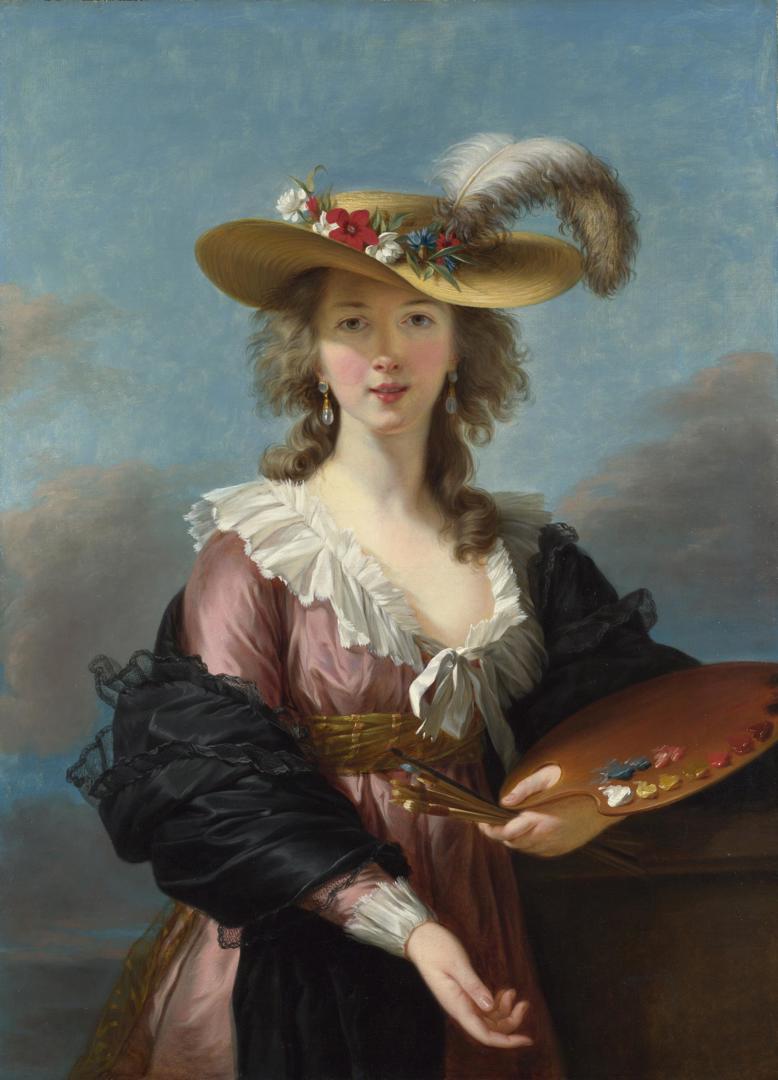
Lebrun not only navigates the subtle art of dress through portraiture in her own self-portraits, but in her portraits of Marie Antoinette as well. In her portrait of Marie Antoinette, Marie Antoinette in a Chemise Dress circa 1783, Lebrun depicts Marie Antoinette in dress similar to Lebrun’s own in her self-portraits with her daughter Julie. Marie Antoinette’s dress is made of a thinner material and is loose fitting.[1] The semi-transparent dress which is made of muslin is based on a real style of dress owned by Marie Antoinette which she wore at her pleasure grounds in Versailles for leisurely activities. This portrait was received with much backlash after it made its debut in the Salon as it only reaffirmed the reputation Marie Antoinette had garnered for herself of rejecting court etiquette as this dress was deemed inappropriate.[2] Seemingly in response to such backlash, Lebrun composed another representation of Marie Antoinette titled, Marie Antoinette with a Rose in 1783. In this portrait, Lebrun carefully depicts Marie Antoinette in the lavish fabrics and clothing fit akin to the superfluous of French society in the eighteenth century.[3] When both images are viewed next to one another, it is clear that in Marie Antoinette in a Chemise Dress, Lebrun is emphasizing both natural femininity as well as a deconstruction of the self, whereas in Marie Antoinette with a Rose, Lebrun utilizes the subtleties of dress in order to portray Marie Antoinette as subscribing to the social norms and gendered expectations for a queen in eighteenth-century French society. Lebrun’s careful attention to the art of dress through portraiture in response to public reception illustrates Lebrun’s use of fashion for the purpose of crafting a specific notion of the self.
Lebrun’s use of dress in portraiture as it pertains to crafting a image of Marie Antoinette as an honorable mother and queen can furthermore be seen in her portrait, Marie Antoinette and her Children, composed in 1787. The work depicts Marie Antoinette in a tight and lavish red dress with her hair styled to incorporate an ornate head piece. Marie Antoinette is shown holding her youngest child while her daughter stands lovingly beside her and her son stands over a cradle.[4] The body language of Marie Antoinette around her children combined with her bourgeoisie dress functions to represent a moralistic, traditional, and ideal version of monarchical motherhood.[5] Had Lebrun decided to portray Marie Antoinette or her children in different fabrics akin to Marie Antoinette’s chemise dress or Lebrun’s Neoclassical reminiscent dress, the portrait would not subscribe to bourgeoisie ideals regarding fashion, motherhood, and politics. In this way, Lebrun is very aware to the power of dress and its ability to convey both social and political messages about the attitudes of an individual and uses this to try to improve the public perception of Marie Antoinette.
[1] Elisabeth Vigee Lebrun, Marie Antoinette in a Chemise Dress, 1783, oil on canvas.
[2] Heidi A. Strobel, “Royal ‘Matronage’ of Women Artists in the Late-18th Century,” Woman’s Art Journal 26, no. 2 (2005): 6.
[3] Elisabeth Vigee Lebrun, Marie Antoinette with a Rose, 1783, oil on canvas.
[4] Elisabeth Vigee Lebrun, Marie Antoinette and her Children, 1787, oil on canvas.
[5] Gita, Elisabeth Vigée Le Brun: The Odyssey of an Artist in an Age of Revolution, 41.