Introduction
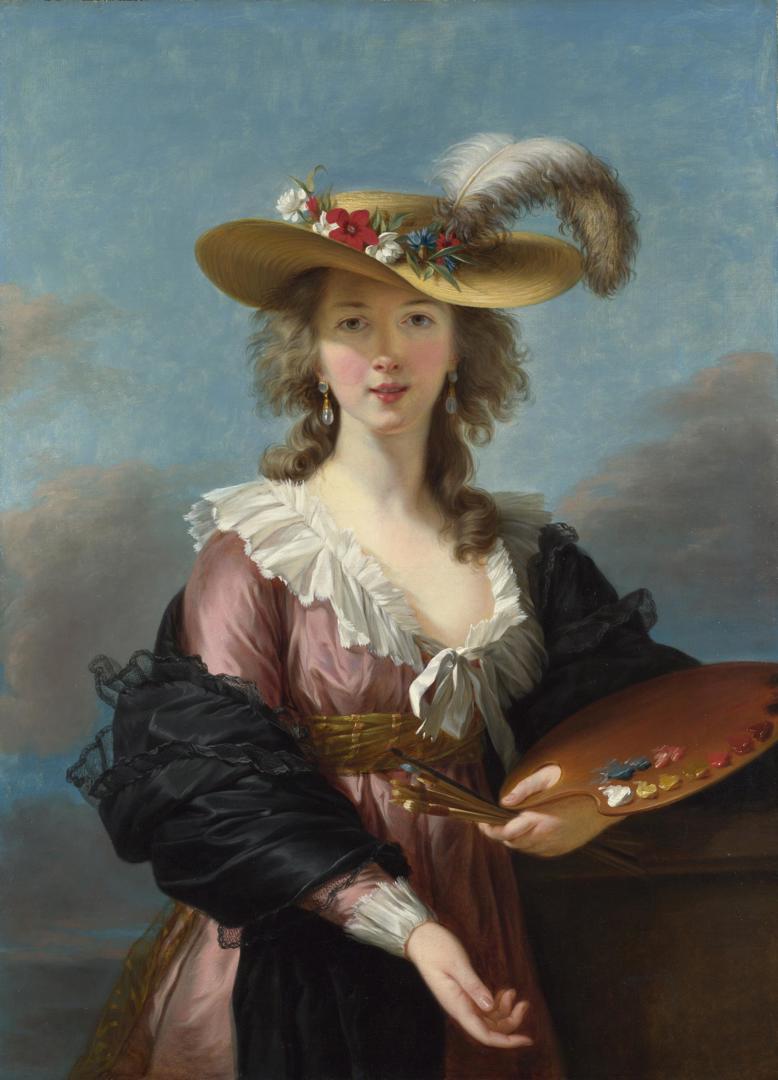
As a child, Elisabeth Vigee Lebrun was raised by a wet nurse for the first five years of her life as was the custom for children of the bourgeoisie under the Old Regime of France. At the age of six, Lebrun was moved into a convent where she would remain until she was eleven. In the convent, she learned skills such as reading, writing, counting, sewing, embroidery, and proper social behavior. Much like the use of wet nurses, it was common for daughters of the bourgeoisie to be placed into convents where they learned such curriculum. Of her time at the convent, Lebrun practiced drawing extensively.[5]
Lebrun’s father was instrumental in her development as an artist. He taught her principles of design as well as pastel drawing. He later sent her to painter Davesne to learn how to mix oil paints. Sadly, Lebrun’s father died when she was only twelve. For the next few years, Lebrun composed oil portraits to support her family financially.[6]
As women were not admitted into the Academy’s training program, Lebrun practiced and honed her artistic skills on her own and with the guidance of other artists including landscape artist Joseph Vernet and Jean Baptiste Greuze. Although she worked closely with these artists, she was never apprenticed and thus is considered a self-taught artist.[7]
By 1776, Lebrun had married art dealer and connoisseur Jean-Baptist LeBrun as well as gained acceptance into the Academy of Saint Luc. Later in 1778, Lebrun was commissioned by Marie Antoinette for her first royal commission. Particularly, in the time frame of the 1780s, Lebrun was able to garner even more success for herself through not only her admittance into the Academy, but through social connections such as her husband’s circle of painters and the favor of the Queen Marie Antoinette.[8]
[1]Evangelia Karvouni, "Elisabeth Louise Vigee Le Brun: a historical survey of a woman artist in the eighteenth century," Journal of International Women's Studies 15, no. 2 (2014): 249+, Gale Academic OneFile (accessed March 12, 2023).
[2]Gita May, Elisabeth Vigée Le Brun: The Odyssey of an Artist in an Age of Revolution, Yale University Press, 2005, 7.
[3] May, Elisabeth Vigee Le Brun, 9.
[4] May, Elisabeth Vigee Le Brun, 8-9.
[5] May, Elisabeth Vigee Le Brun, 11.
[6] Karvouni, “Elisabeth Louise Vigee Le Brun.”
[7] Karvouni, “Elisabeth Louise Vigee Le Brun.”
[8] Karvouni, “Elisabeth Louise Vigee Le Brun.”