Blake Hilton
@GLITTRRR
By Blake Hilton
It begins and ends like this: Beauty equates to Desire. Desire equates to Sex. Sex equates
to Love. Love equates to Happiness. What would you do if you could have all of this and more
for only $7.99 at Target? Buy it of course! Buy the damn razor and make yourself complete! Be
the Venus and the Fire and the Desire ! This is exactly the chain of transitive property that so
many companies attribute to their products to target female consumers. The pixels on the screen
manifest to resemble slender, bright-eyed, youthful women - effortlessly gorgeous,
excruciatingly cool, and hypnotizingly powerful. We know little more about them than this - they
are in essence, beautifully primed canvases for which the consumer projects themselves, their
wishes, and their insecurities onto. With anti-consumerist activism recently becoming a popular
topic to preach on twitter, in conversation, and in academia - these archetypes are sometimes
subject to ridicule and scrutiny. At once Subject and Object Objects of both love and hate, desire
and detest. Is anyone truly above it all? Emancipated from the iron grip of capitalist
manipulation? Even as I sit here in isolation pontificating on the woes of consumerist
gas-lighting, I don a pretty dress from Zara and wear a number of cosmetic products. It is easy to
resent the poster children of consumerist beauty and label them as shallow, unintelligent, bimbos.
It is difficult to realize that maybe we are the poster children too. It is dizzying to grapple with
the idea that we sometimes may actually enjoy it.
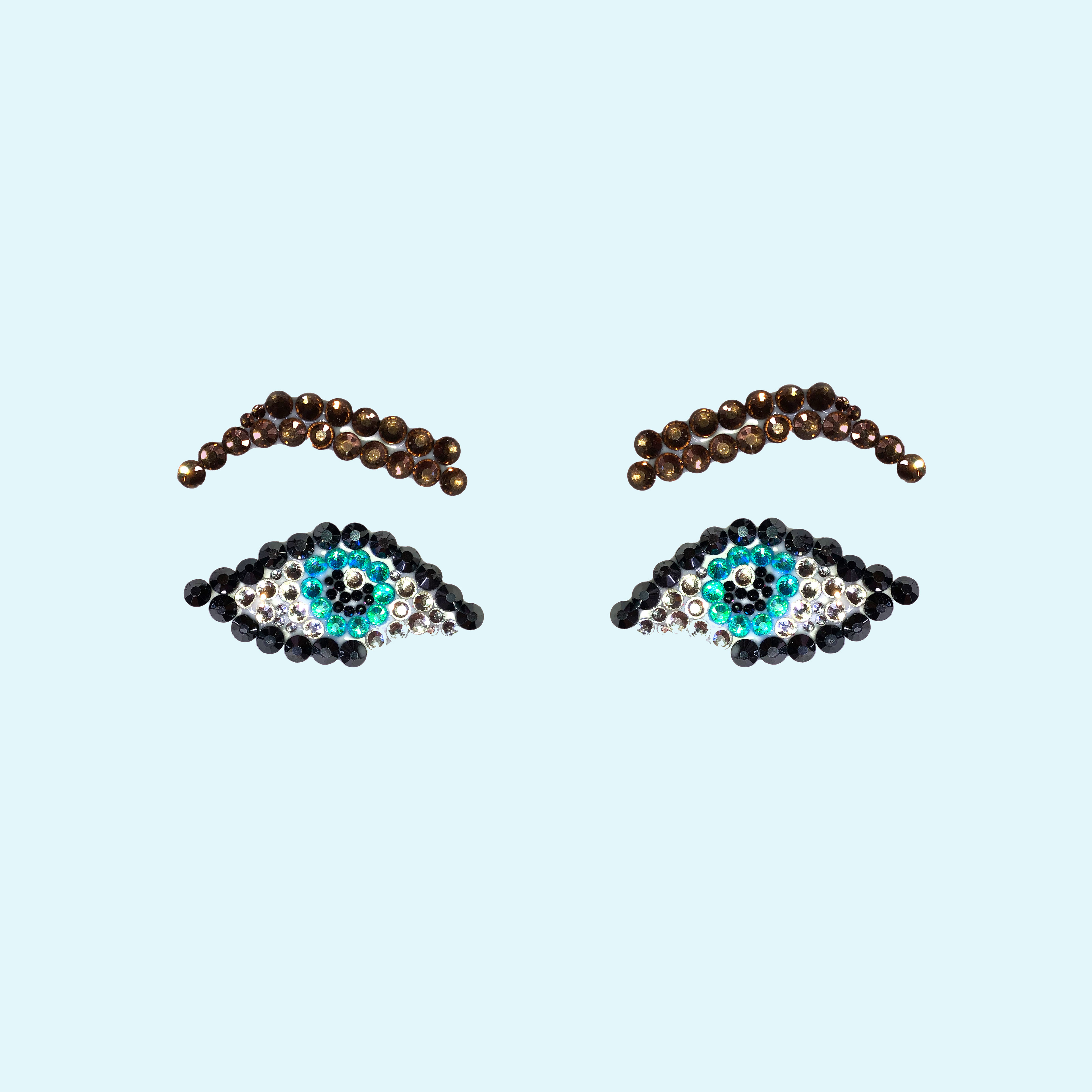
@GLITTRRR is a performance piece mediated through Instagram that wrestles with a
number of conflicting ideas. It critiques advertisements and products that manipulate women into
feeling inferior while also engaging in an earnest play with them. It calls out the western ideal of
beauty these products promise to create while developing an intelligent, thoughtful, and
humorous personality for the archetype. The character, Glitter, is always changing. She begins
her online presence with an interest in beauty, lifestyle, and vlogging. As time progresses she
moves away from that slightly and becomes engaged with art, philosophy, music, literature,
language, and any other topic that intrigues her. Her eyes are made of delicately placed
rhinestones that sit atop her eyelids - at once unblinking and closed. Glitter’s appearance changes
a few times during the duration of the performance - her role fulfilled by multiple women. The
videos and photographs that she posts are well contained but have a level of imperfection and
absurdity to them. A cat eye tutorial begins the way one would expect but proceeds to take over
her face. A video where Glitter talks about Clement Greenberg’s Avant-Garde and Kitsch while
getting ready maintains an earnest review on the essay while blindly applying Abstract
Expressionist inspired makeup. An Instagram livestream where Glitter is showing her viewers
how she puts on her rhinestone eyes is interrupted by the camera falling forward so that only the
floor is in view. Glitter’s online presence is not intimidating or pathetic, but rather genuine,
insightful, and curious.
Glitter at one point discovers Jean Baudrillard’s philosophy of the hyperreal, which
greatly impacts her perspective and has a lot to do with how I think about this project. Glitter
herself is hyperreal. She is a caricature of the idealized woman according to western beauty
standards. Today, there are so many different ways femininity enters the realm of hyperreality.
Lip fillers, cosmetic surgery, eyelash extensions, hair extensions, diet pills, colored contacts,
laser hair removal - all of these products and services create the hyperreal vision of Woman.
They accentuate or eliminate, they are Realer than the Real. The products she engages with -
razors, high heels, douching products, lip fillers, and perfume to name a few - help attain the
hyperreal vision of Woman. Glitter’s discovery of this concept causes her to question her role in
the world and consider how companies may be manipulating her. This causes an internal conflict
in Glitter as she genuinely loves being a part of the beauty community but is fearful about its
implications. She has a hard time digesting that everything she engages with is hyperreal and
finds herself despairing over the inescapable nature of it all.
Another philosopher that I am looking at in regards to this project is Jaques Lacan and his
thinking about the mirror-phase.
The mirror phase lays out the ways in which we perceive ourselves and looks at the ways we try
to attain the “idealized self”. In relation to this project I am looking at how certain
advertisements are intended to make women feel inadequate and incomplete so that we will buy
products we don’t need. They do this by creating an arbitrary relationship between product and
abstract concept. For instance in a Venus razor ad, there might be a slender, white woman gazing
out at a picturesque beach with the caption, “ Reveal the Goddess in You ”.
This ad communicates that a pink plastic razor is equal to beauty and power (via sex). It also
implies that there is something the consumer lacks that must be revealed . Even the name itself
references the Roman goddess of love, sex and fertility. Why not the Athena - the Greek goddess
of wisdom and war? I aim to gently point that out and reveal how ludicrous yet incredibly
effective this tactic is. Glitter’s main product that she advertises is a rhinestoned razor from a
company called Super Sexy Razor Company. When she advertises this company on her
Instagram, the viewer may click the handle and will end up at their Instagram page, but find that
it is almost completely empty. The website link doesn’t work and they have no posts. Their bio
indicates that they have a sister store and the viewer may follow these links until they end up
back at Super Sexy Razor Company’s page, illustrating the circular and inescapable nature of
this insecurity based consumerist manipulation.
The awkwardness of Glitter’s videos are because of the performer’s inability to see.
While I have experience performing as an artist, a lot of the women who were involved in this
project do not. The caricature of Glitter is a thin shell of femininity that all women dip their toes
into everyday but is rarely a perfect fit. I also see this caricature as a visibility standard that
women are held to. What type of woman is awarded a platform and an audience to speak? What
must she talk about to be heard? What hoops must she jump through to be seen and taken
seriously? Looking at the demographic of “Instagram famous” influencers, it is clear that
conventional beauty is a form of social and economic currency. If you have that, people will
undoubtedly be willing to listen to you.
Artists that I am looking at in regards to this project are Liza Lou, Mickalene Thomas,
and Martha Rosler. Other literary and online influences include Judith Butler’s Gender Troubles ,
Laura Mulvey’s Visual Pleasure in Narrative Cinema , Susan Sontag’s Notes on Camp , Rosalind
Krauss’ The Originality of the Avant-Garde and Other Modernist Myths , and the CGI Instagram
personality @lilmiquela. I am interested in the materiality of Liza Lou’s beaded Kitchen and
Mickalene Thomas’s glitter paintings. The tedious nature of applying glitter and rhinestones to
surfaces is an action that contains both pain and love - another contradiction within the scope of
the work. Martha Rosler’s critiques on the patriarchy and male gaze resonate strongly with me
and Semiotics of the Kitchen is one of the first art performance videos I was introduced to. The
other writings I mentioned before have informed the way I consider gender, performativity,
camp versus drag, and the exclusionary standards of the modernist avant-garde. @lilmiquela is
an uncanny, hyperreal Instagram personality that I have drawn inspiration from but I believe is
the antithesis of this project.
What I hope the viewer will take away from this project is not a condemnation of beauty
products and women who engage with them, but rather a critical ambiguity with them. While
companies certainly aim to make their consumers feel insecure and incomplete in order to sell
their products, Glitter herself is undeniably whole and complex. She is intelligent, funny, and
empathetic. She also happens to love shiny things and beauty products. She suffers from
insecurity and self-doubt like everyone else. It is not her fault, nor is it the fault of any other
woman, if we are socialized to love some of the patriarchal structures that pervade every facet of
our society. It is possible to enjoy things like makeup, perfume, high heels, or fashion while also
being critical of them. Whether we like it or not, most of us are dipping our toes into consumerist
femininity daily. So, while we are here, we may as well allow ourselves to have some play with
it - @GLITTRRR is a manifestation of that.