Maya Freelon
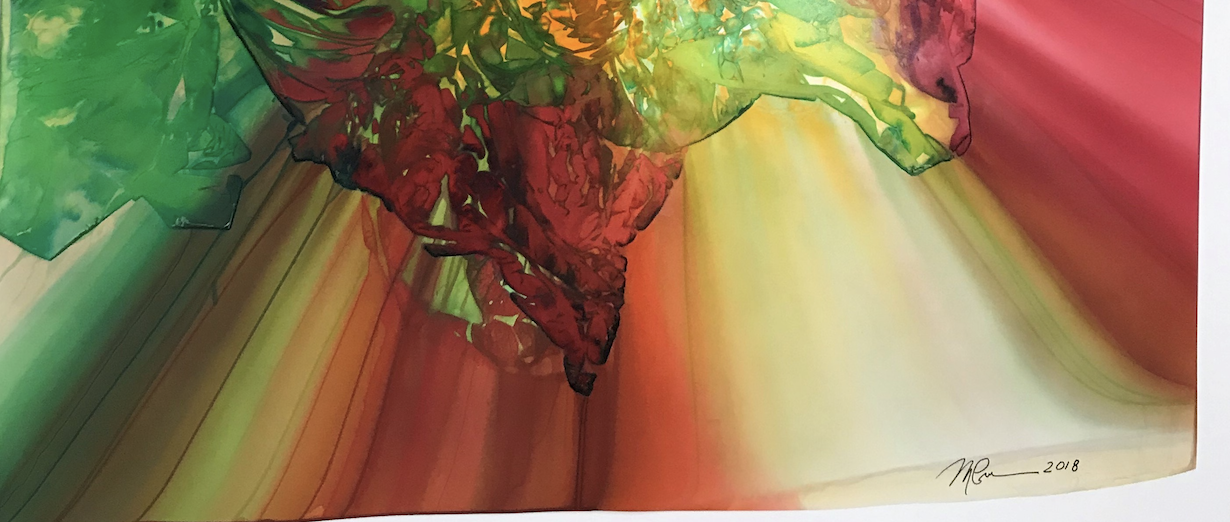
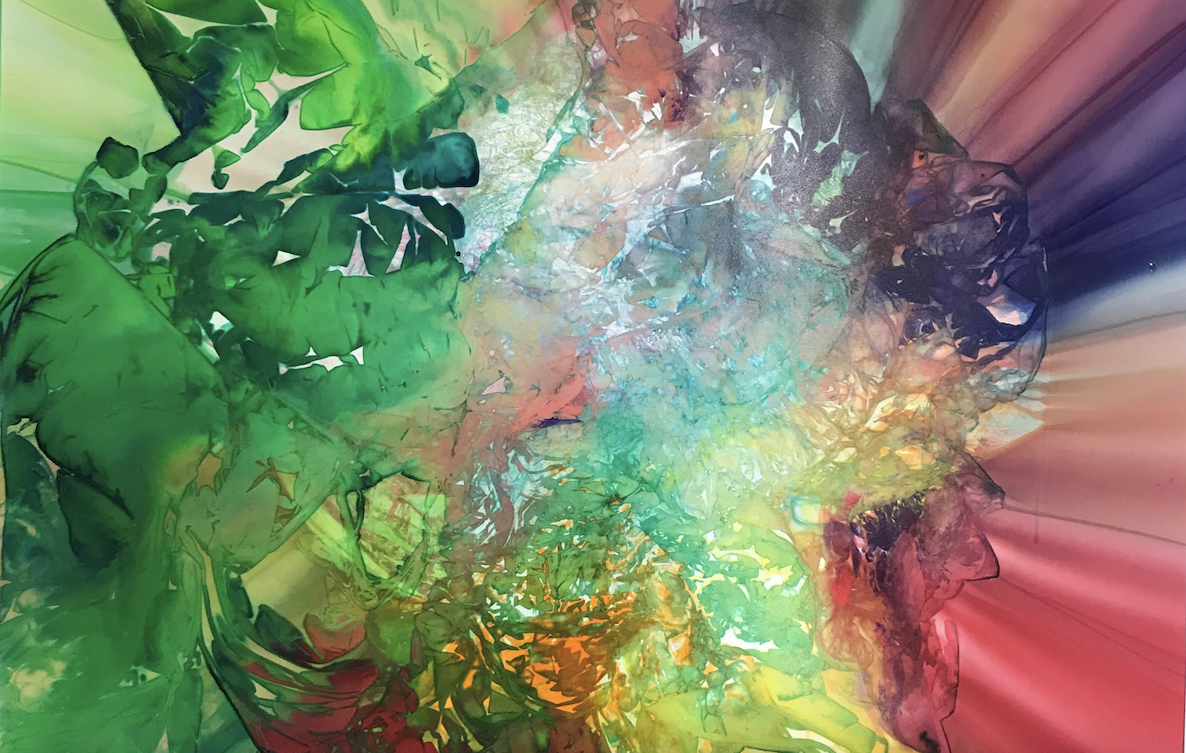
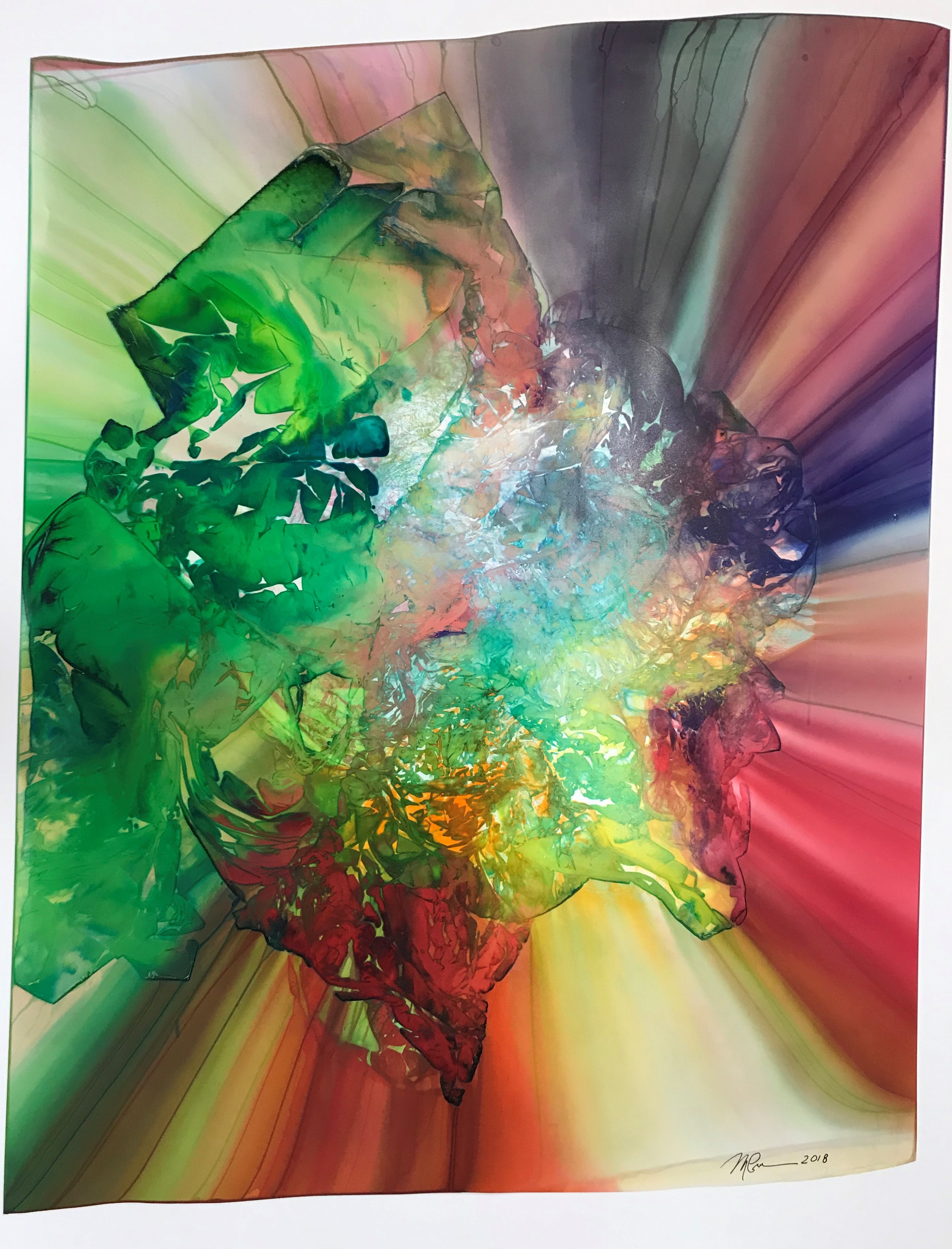
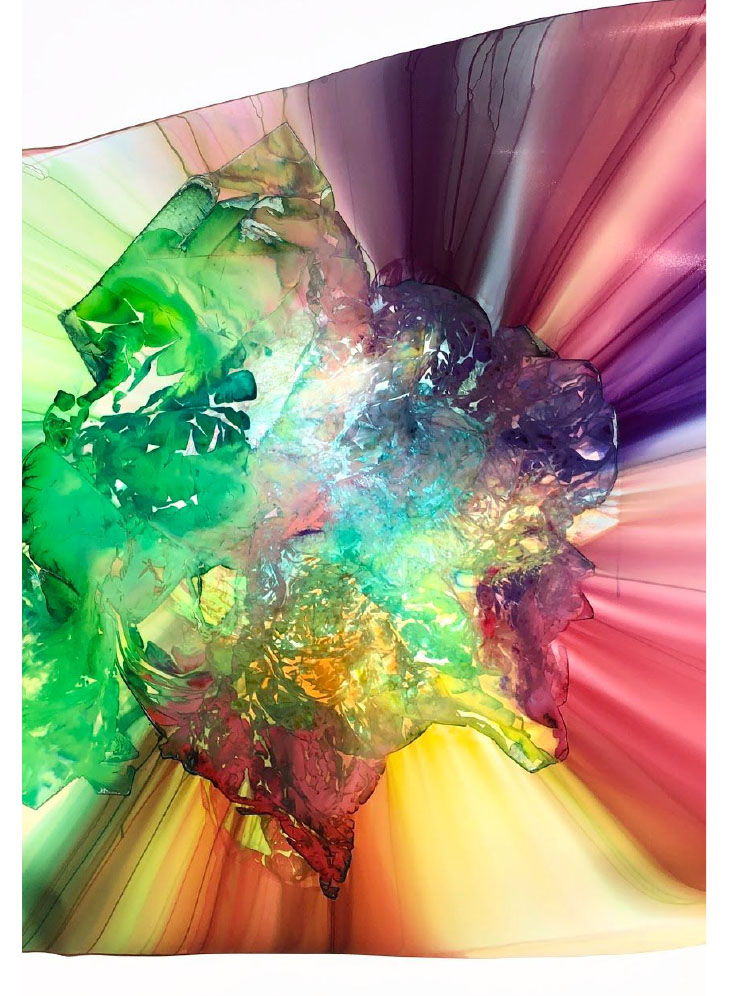
1 media/Maya Freelon.jpg media/Screen Shot 2020-08-28 at 12.14.08 PM.png 2020-08-12T03:14:32+00:00 Jessica Bocinski a602570e86f7a6936e40ab07e0fddca6eccf4e9b 31 67 Begin/Again, spinning tissue ink monoprint, 2018 image_header 2020-08-28T23:56:01+00:00 Jessica Bocinski a602570e86f7a6936e40ab07e0fddca6eccf4e9bPage
| resource | rdf:resource | https://scalar.chapman.edu/scalar/beginagain/maya-freelon-1 |
| type | rdf:type | http://scalar.usc.edu/2012/01/scalar-ns#Composite |
| is live | scalar:isLive | 1 |
| background | scalar:background | media/Maya Freelon.jpg |
| banner | scalar:banner | media/Screen Shot 2020-08-28 at 12.14.08 PM.png |
| was attributed to | prov:wasAttributedTo | https://scalar.chapman.edu/scalar/beginagain/users/3 |
| created | dcterms:created | 2020-08-12T03:14:32+00:00 |
Version 67
| resource | rdf:resource | https://scalar.chapman.edu/scalar/beginagain/maya-freelon-1.67 |
| versionnumber | ov:versionnumber | 67 |
| title | dcterms:title | Maya Freelon |
| description | dcterms:description | Begin/Again, spinning tissue ink monoprint, 2018 |
| content | sioc:content | Maya Freelon is an award-winning artist best known for her lively, colorful paper sculptures, made primarily from tissue paper. Her godmother, Maya Angelou, described her work as “visualizing the truth about the vulnerability and power of the human being." For the past decade, Freelon has experimented with familiar, inexpensive materials such as tissue paper and glue as part of her dedication to making “art that’s inclusive, art that’s accessible and art that builds bridges.” As the daughter of an architect father and jazz singing mother, she learned skill, focus, and wild improvisation, as well as art’s potential to make our everyday lives more joyful. She values venues and commissions that expose her work to large, diverse audiences, and believes an internet router is as deserving of artistic attention as a gallery wall. In addition to museum exhibitions, she has produced work for Google and Cadillac, and the Smithsonian, as well as for hotels, healthcare facilities, and government embassies. Her art has a wide, popular appeal and been featured in Cosmopolitan Magazine, Ebony Magazine, the Washington Post, Huffington Post, and Modern Luxury Magazine. Artist's WebsiteAbout the WorkFreelon discovered her favorite medium of tissue paper monoprint by a happy accident. While she was an art student she lived with her grandmother, Frances J. Pierce, and one day came across some tissue paper tucked away in the basement. Influenced by her grandmother, who came from a family of sharecroppers ("who never got their fair share") and had been an elementary school teacher for thirty years, she never wasted anything. A water leak had caused the colors in the tissue paper to bleed."It was a metaphor for finding beauty in the simplest form, the fragility of life," reflects Freelon. It is also a way to honor her grandmother, who has been a constant source of inspiration and support, and whose favorite sayings often provide Freelon with the titles for her artwork. Since that day, Freelon has mined the creative possibilities of tissue paper. It’s a choice guided by politics as well as aesthetics. When Freelon uses this humble material in the high art context of museums and galleries, she challenges paradigms of power and honors the creative potential of every member of a community. "I am because we are," she insists, and has worked with groups of people to create collaborative "tissue quilts" in homage to African American quilting bees. To create Begin/Again, Freelon started with vibrantly dyed tissue paper. While the tissue was still wet, it was pressed into an absorbent paper then spun on a pottery wheel, creating a visual vortex of braided colors. From the ArtistHave a question or thought? Share by clicking the comment bubble icon below. "> About the ArtistMaya Freelon is an award-winning artist best known for her lively, colorful paper sculptures, made primarily from tissue paper. Her godmother, Maya Angelou, described her work as “visualizing the truth about the vulnerability and power of the human being."For the past decade, Freelon has experimented with familiar, inexpensive materials such as tissue paper and glue as part of her dedication to making “art that’s inclusive, art that’s accessible and art that builds bridges.” As the daughter of an architect father and jazz singing mother, she learned skill, focus, and wild improvisation, as well as art’s potential to make our everyday lives more joyful. She values venues and commissions that expose her work to large, diverse audiences, and believes an internet router is as deserving of artistic attention as a gallery wall. In addition to museum exhibitions, she has produced work for Google and Cadillac, and the Smithsonian, as well as for hotels, healthcare facilities, and government embassies. Her art has a wide, popular appeal and been featured in Cosmopolitan Magazine, Ebony Magazine, the Washington Post, Huffington Post, and Modern Luxury Magazine. Artist's WebsiteAbout the WorkFreelon discovered her favorite medium of tissue paper monoprint by a happy accident. While she was an art student she lived with her grandmother, Frances J. Pierce, and one day came across some tissue paper tucked away in the basement. Influenced by her grandmother, who came from a family of sharecroppers ("who never got their fair share") and had been an elementary school teacher for thirty years, she never wasted anything. A water leak had caused the colors in the tissue paper to bleed."It was a metaphor for finding beauty in the simplest form, the fragility of life," reflects Freelon. It is also a way to honor her grandmother, who has been a constant source of inspiration and support, and whose favorite sayings often provide Freelon with the titles for her artwork. Since that day, Freelon has mined the creative possibilities of tissue paper. It’s a choice guided by politics as well as aesthetics. When Freelon uses this humble material in the high art context of museums and galleries, she challenges paradigms of power and honors the creative potential of every member of a community. "I am because we are," she insists, and has worked with groups of people to create collaborative "tissue quilts" in homage to African American quilting bees. To create Begin/Again, Freelon started with vibrantly dyed tissue paper. While the tissue was still wet, it was pressed into an absorbent paper then spun on a pottery wheel, creating a visual vortex of braided colors. From the ArtistHave a question or thought? Share by clicking the comment bubble icon below. |
| default view | scalar:defaultView | image_header |
| was attributed to | prov:wasAttributedTo | https://scalar.chapman.edu/scalar/beginagain/users/3 |
| created | dcterms:created | 2020-08-28T23:56:01+00:00 |
| type | rdf:type | http://scalar.usc.edu/2012/01/scalar-ns#Version |



Version 66
| resource | rdf:resource | https://scalar.chapman.edu/scalar/beginagain/maya-freelon-1.66 |
| versionnumber | ov:versionnumber | 66 |
| title | dcterms:title | Maya Freelon |
| description | dcterms:description | Begin/Again, spinning tissue ink monoprint, 2018 |
| content | sioc:content | Maya Freelon is an award-winning artist best known for her lively, colorful paper sculptures, made primarily from tissue paper. Her godmother, Maya Angelou, described her work as “visualizing the truth about the vulnerability and power of the human being." For the past decade, Freelon has experimented with familiar, inexpensive materials such as tissue paper and glue as part of her dedication to making “art that’s inclusive, art that’s accessible and art that helps bridges.” As the daughter of an architect father and jazz singing mother, she learned skill, focus, and wild improvisation, as well as art’s potential to make our everyday lives more joyful. She values venues and commissions that expose her work to large, diverse audiences, and believes an internet router is as deserving of artistic attention as a gallery wall. In addition to museum exhibitions, she has produced work for Google and Cadillac, and the Smithsonian, as well as for hotels, healthcare facilities, and government embassies. Her art has a wide, popular appeal and been featured in Cosmopolitan Magazine, Ebony Magazine, the Washington Post, Huffington Post, and Modern Luxury Magazine. Artist's WebsiteAbout the WorkFreelon discovered her favorite medium of tissue paper monoprint by a happy accident. While she was an art student she lived with her grandmother, Queen Mother Frances J. Pierce, and one day came across some tissue paper tucked away in the basement. Influenced by her grandmother, who came from a family of sharecroppers ("who never got their fair share") and had been an elementary school teacher for thirty years, she never wasted anything. A water leak had caused the colors in the tissue paper to bleed."It was a metaphor for finding beauty in the simplest form, the fragility of life," reflects Freelon. It is also a way to honor her grandmother, who has been a constant source of inspiration and support, and whose favorite sayings often provide Freelon with the titles for her artwork. Since that day, Freelon has mined the creative possibilities of tissue paper. It’s a choice guided by politics as well as aesthetics. When Freelon uses this humble material in the high art context of museums and galleries, she challenges paradigms of power and honors the creative potential of every member of a community. "I am because we are," she insists, and has worked with groups of people to create collaborative "tissue quilts" in homage to African American quilting bees. To create Begin/Again, Freelon started with vibrantly dyed tissue paper. While the tissue was still wet, it was pressed into an absorbent paper then spun on a pottery wheel, creating a visual vortex of braided colors. From the ArtistHave a question or thought? Share by clicking the comment bubble icon below. "> About the ArtistMaya Freelon is an award-winning artist best known for her lively, colorful paper sculptures, made primarily from tissue paper. Her godmother, Maya Angelou, described her work as “visualizing the truth about the vulnerability and power of the human being."For the past decade, Freelon has experimented with familiar, inexpensive materials such as tissue paper and glue as part of her dedication to making “art that’s inclusive, art that’s accessible and art that helps bridges.” As the daughter of an architect father and jazz singing mother, she learned skill, focus, and wild improvisation, as well as art’s potential to make our everyday lives more joyful. She values venues and commissions that expose her work to large, diverse audiences, and believes an internet router is as deserving of artistic attention as a gallery wall. In addition to museum exhibitions, she has produced work for Google and Cadillac, and the Smithsonian, as well as for hotels, healthcare facilities, and government embassies. Her art has a wide, popular appeal and been featured in Cosmopolitan Magazine, Ebony Magazine, the Washington Post, Huffington Post, and Modern Luxury Magazine. Artist's WebsiteAbout the WorkFreelon discovered her favorite medium of tissue paper monoprint by a happy accident. While she was an art student she lived with her grandmother, Queen Mother Frances J. Pierce, and one day came across some tissue paper tucked away in the basement. Influenced by her grandmother, who came from a family of sharecroppers ("who never got their fair share") and had been an elementary school teacher for thirty years, she never wasted anything. A water leak had caused the colors in the tissue paper to bleed."It was a metaphor for finding beauty in the simplest form, the fragility of life," reflects Freelon. It is also a way to honor her grandmother, who has been a constant source of inspiration and support, and whose favorite sayings often provide Freelon with the titles for her artwork. Since that day, Freelon has mined the creative possibilities of tissue paper. It’s a choice guided by politics as well as aesthetics. When Freelon uses this humble material in the high art context of museums and galleries, she challenges paradigms of power and honors the creative potential of every member of a community. "I am because we are," she insists, and has worked with groups of people to create collaborative "tissue quilts" in homage to African American quilting bees. To create Begin/Again, Freelon started with vibrantly dyed tissue paper. While the tissue was still wet, it was pressed into an absorbent paper then spun on a pottery wheel, creating a visual vortex of braided colors. From the ArtistHave a question or thought? Share by clicking the comment bubble icon below. |
| default view | scalar:defaultView | image_header |
| was attributed to | prov:wasAttributedTo | https://scalar.chapman.edu/scalar/beginagain/users/3 |
| created | dcterms:created | 2020-08-28T19:23:03+00:00 |
| type | rdf:type | http://scalar.usc.edu/2012/01/scalar-ns#Version |
Version 65
| resource | rdf:resource | https://scalar.chapman.edu/scalar/beginagain/maya-freelon-1.65 |
| versionnumber | ov:versionnumber | 65 |
| title | dcterms:title | Maya Freelon |
| description | dcterms:description | Begin/Again, spinning tissue ink monoprint, 2018 |
| content | sioc:content | Maya Freelon is an award-winning artist best known for her lively, colorful paper sculptures, made primarily from tissue paper. Her godmother, Maya Angelou, described her work as “visualizing the truth about the vulnerability and power of the human being." For the past decade, Freelon has experimented with familiar, inexpensive materials such as tissue paper and glue as part of her dedication to making “art that’s inclusive, art that’s accessible and art that helps bridges.” As the daughter of an architect father and jazz singing mother, she learned skill, focus, and wild improvisation, as well as art’s potential to make our everyday lives more joyful. She values venues and commissions that expose her work to large, diverse audiences, and believes an internet router is as deserving of artistic attention as a gallery wall. In addition to museum exhibitions, she has produced work for Google and Cadillac, and the Smithsonian, as well as for hotels, healthcare facilities, and government embassies. Her art has a wide, popular appeal and been featured in Cosmopolitan Magazine, Ebony Magazine, the Washington Post, Huffington Post, and Modern Luxury Magazine. Artist's Website
Freelon discovered her favorite medium of tissue paper monoprint by a happy accident. While she was an art student she lived with her grandmother, Queen Mother Frances J. Pierce, and one day came across some tissue paper tucked away in the basement. Influenced by her grandmother, who came from a family of sharecroppers ("who never got their fair share") and had been an elementary school teacher for thirty years, she never wasted anything. A water leak had caused the colors in the tissue paper to bleed. |
| default view | scalar:defaultView | image_header |
| was attributed to | prov:wasAttributedTo | https://scalar.chapman.edu/scalar/beginagain/users/3 |
| created | dcterms:created | 2020-08-28T19:22:43+00:00 |
| type | rdf:type | http://scalar.usc.edu/2012/01/scalar-ns#Version |
Version 64
| resource | rdf:resource | https://scalar.chapman.edu/scalar/beginagain/maya-freelon-1.64 |
| versionnumber | ov:versionnumber | 64 |
| title | dcterms:title | Maya Freelon |
| description | dcterms:description | Begin/Again, spinning tissue ink monoprint, 2018 |
| content | sioc:content | Maya Freelon is an award-winning artist best known for her lively, colorful paper sculptures, made primarily from tissue paper. Her godmother, Maya Angelou, described her work as “visualizing the truth about the vulnerability and power of the human being." For the past decade, Freelon has experimented with familiar, inexpensive materials such as tissue paper and glue as part of her dedication to making “art that’s inclusive, art that’s accessible and art that helps bridges.” As the daughter of an architect father and jazz singing mother, she learned skill, focus, and wild improvisation, as well as art’s potential to make our everyday lives more joyful. She values venues and commissions that expose her work to large, diverse audiences, and believes an internet router is as deserving of artistic attention as a gallery wall. In addition to museum exhibitions, she has produced work for Google and Cadillac, and the Smithsonian, as well as for hotels, healthcare facilities, and government embassies. Her art has a wide, popular appeal and been featured in Cosmopolitan Magazine, Ebony Magazine, the Washington Post, Huffington Post, and Modern Luxury Magazine. Artist's Website
Freelon discovered her favorite medium of tissue paper monoprint by a happy accident. While she was an art student she lived with her grandmother, Queen Mother Frances J. Pierce, and one day came across some tissue paper tucked away in the basement. Influenced by her grandmother, who came from a family of sharecroppers ("who never got their fair share") and had been an elementary school teacher for thirty years, she never wasted anything. A water leak had caused the colors in the tissue paper to bleed. |
| default view | scalar:defaultView | image_header |
| was attributed to | prov:wasAttributedTo | https://scalar.chapman.edu/scalar/beginagain/users/3 |
| created | dcterms:created | 2020-08-28T19:21:41+00:00 |
| type | rdf:type | http://scalar.usc.edu/2012/01/scalar-ns#Version |
Version 63
| resource | rdf:resource | https://scalar.chapman.edu/scalar/beginagain/maya-freelon-1.63 |
| versionnumber | ov:versionnumber | 63 |
| title | dcterms:title | Maya Freelon |
| description | dcterms:description | Begin/Again, spinning tissue ink monoprint, 2018 |
| content | sioc:content | Maya Freelon is an award-winning artist best known for her lively, colorful paper sculptures, made primarily from tissue paper. Her godmother, Maya Angelou, described her work as “visualizing the truth about the vulnerability and power of the human being." For the past decade, Freelon has experimented with familiar, inexpensive materials such as tissue paper and glue as part of her dedication to making “art that’s inclusive, art that’s accessible and art that helps bridges.” As the daughter of an architect father and jazz singing mother, she learned skill, focus, and wild improvisation, as well as art’s potential to make our everyday lives more joyful. She values venues and commissions that expose her work to large, diverse audiences, and believes an internet router is as deserving of artistic attention as a gallery wall. In addition to museum exhibitions, she has produced work for Google and Cadillac, and the Smithsonian, as well as for hotels, healthcare facilities, and government embassies. Her art has a wide, popular appeal and been featured in Cosmopolitan Magazine, Ebony Magazine, the Washington Post, Huffington Post, and Modern Luxury Magazine. Artist's Website
Freelon discovered her favorite medium of tissue paper monoprint by a happy accident. While she was an art student she lived with her grandmother, Queen Mother Frances J. Pierce, and one day came across some tissue paper tucked away in the basement. Influenced by her grandmother, who came from a family of sharecroppers ("who never got their fair share") and had been an elementary school teacher for thirty years, she never wasted anything. A water leak had caused the colors in the tissue paper to bleed. |
| default view | scalar:defaultView | image_header |
| was attributed to | prov:wasAttributedTo | https://scalar.chapman.edu/scalar/beginagain/users/3 |
| created | dcterms:created | 2020-08-28T19:20:55+00:00 |
| type | rdf:type | http://scalar.usc.edu/2012/01/scalar-ns#Version |
Version 62
| resource | rdf:resource | https://scalar.chapman.edu/scalar/beginagain/maya-freelon-1.62 |
| versionnumber | ov:versionnumber | 62 |
| title | dcterms:title | Maya Freelon |
| description | dcterms:description | Begin/Again, spinning tissue ink monoprint, 2018 |
| content | sioc:content | Maya Freelon is an award-winning artist best known for her lively, colorful paper sculptures, made primarily from tissue paper. Her godmother, Maya Angelou, described her work as “visualizing the truth about the vulnerability and power of the human being." For the past decade, Freelon has experimented with familiar, inexpensive materials such as tissue paper and glue as part of her dedication to making “art that’s inclusive, art that’s accessible and art that helps bridges.” As the daughter of an architect father and jazz singing mother, she learned skill, focus, and wild improvisation, as well as art’s potential to make our everyday lives more joyful. She values venues and commissions that expose her work to large, diverse audiences, and believes an internet router is as deserving of artistic attention as a gallery wall. In addition to museum exhibitions, she has produced work for Google and Cadillac, and the Smithsonian, as well as for hotels, healthcare facilities, and government embassies. Her art has a wide, popular appeal and been featured in Cosmopolitan Magazine, Ebony Magazine, the Washington Post, Huffington Post, and Modern Luxury Magazine. Artist's WebsiteAbout the WorkFreelon discovered her favorite medium of tissue paper monoprint by a happy accident. While she was an art student she lived with her grandmother, Queen Mother Frances J. Pierce, and one day came across some tissue paper tucked away in the basement. Influenced by her grandmother, who came from a family of sharecroppers ("who never got their fair share") and had been an elementary school teacher for thirty years, she never wasted anything. A water leak had caused the colors in the tissue paper to bleed."It was a metaphor for finding beauty in the simplest form, the fragility of life," reflects Freelon. It is also a way to honor her grandmother, who has been a constant source of inspiration and support, and whose favorite sayings often provide Freelon with the titles for her artwork. Since that day, Freelon has mined the creative possibilities of tissue paper. It’s a choice guided by politics as well as aesthetics. When Freelon uses this humble material in the high art context of museums and galleries, she challenges paradigms of power and honors the creative potential of every member of a community. "I am because we are," she insists, and has worked with groups of people to create collaborative "tissue quilts" in homage to African American quilting bees. To create Begin/Again, Freelon started with vibrantly dyed tissue paper. While the tissue was still wet, it was pressed into an absorbent paper then spun on a pottery wheel, creating a visual vortex of braided colors. From the ArtistHave a question or thought? Share by clicking the comment bubble icon below. "> About the ArtistMaya Freelon is an award-winning artist best known for her lively, colorful paper sculptures, made primarily from tissue paper. Her godmother, Maya Angelou, described her work as “visualizing the truth about the vulnerability and power of the human being."For the past decade, Freelon has experimented with familiar, inexpensive materials such as tissue paper and glue as part of her dedication to making “art that’s inclusive, art that’s accessible and art that helps bridges.” As the daughter of an architect father and jazz singing mother, she learned skill, focus, and wild improvisation, as well as art’s potential to make our everyday lives more joyful. She values venues and commissions that expose her work to large, diverse audiences, and believes an internet router is as deserving of artistic attention as a gallery wall. In addition to museum exhibitions, she has produced work for Google and Cadillac, and the Smithsonian, as well as for hotels, healthcare facilities, and government embassies. Her art has a wide, popular appeal and been featured in Cosmopolitan Magazine, Ebony Magazine, the Washington Post, Huffington Post, and Modern Luxury Magazine. Artist's WebsiteAbout the WorkFreelon discovered her favorite medium of tissue paper monoprint by a happy accident. While she was an art student she lived with her grandmother, Queen Mother Frances J. Pierce, and one day came across some tissue paper tucked away in the basement. Influenced by her grandmother, who came from a family of sharecroppers ("who never got their fair share") and had been an elementary school teacher for thirty years, she never wasted anything. A water leak had caused the colors in the tissue paper to bleed."It was a metaphor for finding beauty in the simplest form, the fragility of life," reflects Freelon. It is also a way to honor her grandmother, who has been a constant source of inspiration and support, and whose favorite sayings often provide Freelon with the titles for her artwork. Since that day, Freelon has mined the creative possibilities of tissue paper. It’s a choice guided by politics as well as aesthetics. When Freelon uses this humble material in the high art context of museums and galleries, she challenges paradigms of power and honors the creative potential of every member of a community. "I am because we are," she insists, and has worked with groups of people to create collaborative "tissue quilts" in homage to African American quilting bees. To create Begin/Again, Freelon started with vibrantly dyed tissue paper. While the tissue was still wet, it was pressed into an absorbent paper then spun on a pottery wheel, creating a visual vortex of braided colors. From the ArtistHave a question or thought? Share by clicking the comment bubble icon below. |
| default view | scalar:defaultView | image_header |
| was attributed to | prov:wasAttributedTo | https://scalar.chapman.edu/scalar/beginagain/users/3 |
| created | dcterms:created | 2020-08-28T19:19:54+00:00 |
| type | rdf:type | http://scalar.usc.edu/2012/01/scalar-ns#Version |
Version 61
| resource | rdf:resource | https://scalar.chapman.edu/scalar/beginagain/maya-freelon-1.61 |
| versionnumber | ov:versionnumber | 61 |
| title | dcterms:title | Maya Freelon |
| description | dcterms:description | Begin/Again, spinning tissue ink monoprint, 2018 |
| content | sioc:content | Maya Freelon is an award-winning artist best known for her lively, colorful paper sculptures, made primarily from tissue paper. Her godmother, Maya Angelou, described her work as “visualizing the truth about the vulnerability and power of the human being." For the past decade, Freelon has experimented with familiar, inexpensive materials such as tissue paper and glue as part of her dedication to making “art that’s inclusive, art that’s accessible and art that helps bridges.” As the daughter of an architect father and jazz singing mother, she learned skill, focus, and wild improvisation, as well as art’s potential to make our everyday lives more joyful. She values venues and commissions that expose her work to large, diverse audiences, and believes an internet router is as deserving of artistic attention as a gallery wall. In addition to museum exhibitions, she has produced work for Google and Cadillac, and the Smithsonian, as well as for hotels, healthcare facilities, and government embassies. Her art has a wide, popular appeal and been featured in Cosmopolitan Magazine, Ebony Magazine, the Washington Post, Huffington Post, and Modern Luxury Magazine. Artist's WebsiteAbout the WorkFreelon discovered her favorite medium of tissue paper monoprint by a happy accident. While she was an art student she lived with her grandmother, Queen Mother Frances J. Pierce, and one day came across some tissue paper tucked away in the basement. Influenced by her grandmother, who came from a family of sharecroppers ("who never got their fair share") and had been an elementary school teacher for thirty years, she never wasted anything. A water leak had caused the colors in the tissue paper to bleed."It was a metaphor for finding beauty in the simplest form, the fragility of life," reflects Freelon. It is also a way to honor her grandmother, who has been a constant source of inspiration and support, and whose favorite sayings often provide Freelon with the titles for her artwork. Since that day, Freelon has mined the creative possibilities of tissue paper. It’s a choice guided by politics as well as aesthetics. When Freelon uses this humble material in the high art context of museums and galleries, she challenges paradigms of power and honors the creative potential of every member of a community. "I am because we are," she insists, and has worked with groups of people to create collaborative "tissue quilts" in homage to African American quilting bees. To create Begin/Again, Freelon started with vibrantly dyed tissue paper. While the tissue was still wet, it was pressed into an absorbent paper then spun on a pottery wheel, creating a visual vortex of braided colors. From the ArtistHave a question or thought? Share by clicking the comment bubble icon below. "> About the ArtistMaya Freelon is an award-winning artist best known for her lively, colorful paper sculptures, made primarily from tissue paper. Her godmother, Maya Angelou, described her work as “visualizing the truth about the vulnerability and power of the human being."For the past decade, Freelon has experimented with familiar, inexpensive materials such as tissue paper and glue as part of her dedication to making “art that’s inclusive, art that’s accessible and art that helps bridges.” As the daughter of an architect father and jazz singing mother, she learned skill, focus, and wild improvisation, as well as art’s potential to make our everyday lives more joyful. She values venues and commissions that expose her work to large, diverse audiences, and believes an internet router is as deserving of artistic attention as a gallery wall. In addition to museum exhibitions, she has produced work for Google and Cadillac, and the Smithsonian, as well as for hotels, healthcare facilities, and government embassies. Her art has a wide, popular appeal and been featured in Cosmopolitan Magazine, Ebony Magazine, the Washington Post, Huffington Post, and Modern Luxury Magazine. Artist's WebsiteAbout the WorkFreelon discovered her favorite medium of tissue paper monoprint by a happy accident. While she was an art student she lived with her grandmother, Queen Mother Frances J. Pierce, and one day came across some tissue paper tucked away in the basement. Influenced by her grandmother, who came from a family of sharecroppers ("who never got their fair share") and had been an elementary school teacher for thirty years, she never wasted anything. A water leak had caused the colors in the tissue paper to bleed."It was a metaphor for finding beauty in the simplest form, the fragility of life," reflects Freelon. It is also a way to honor her grandmother, who has been a constant source of inspiration and support, and whose favorite sayings often provide Freelon with the titles for her artwork. Since that day, Freelon has mined the creative possibilities of tissue paper. It’s a choice guided by politics as well as aesthetics. When Freelon uses this humble material in the high art context of museums and galleries, she challenges paradigms of power and honors the creative potential of every member of a community. "I am because we are," she insists, and has worked with groups of people to create collaborative "tissue quilts" in homage to African American quilting bees. To create Begin/Again, Freelon started with vibrantly dyed tissue paper. While the tissue was still wet, it was pressed into an absorbent paper then spun on a pottery wheel, creating a visual vortex of braided colors. From the ArtistHave a question or thought? Share by clicking the comment bubble icon below. |
| default view | scalar:defaultView | image_header |
| was attributed to | prov:wasAttributedTo | https://scalar.chapman.edu/scalar/beginagain/users/3 |
| created | dcterms:created | 2020-08-28T19:19:32+00:00 |
| type | rdf:type | http://scalar.usc.edu/2012/01/scalar-ns#Version |
Version 60
| resource | rdf:resource | https://scalar.chapman.edu/scalar/beginagain/maya-freelon-1.60 |
| versionnumber | ov:versionnumber | 60 |
| title | dcterms:title | Maya Freelon |
| description | dcterms:description | Begin/Again, spinning tissue ink monoprint, 2018 |
| content | sioc:content | Maya Freelon is an award-winning artist best known for her lively, colorful paper sculptures, made primarily from tissue paper. Her godmother, Maya Angelou, described her work as “visualizing the truth about the vulnerability and power of the human being." For the past decade, Freelon has experimented with familiar, inexpensive materials such as tissue paper and glue as part of her dedication to making “art that’s inclusive, art that’s accessible and art that helps bridges.” As the daughter of an architect father and jazz singing mother, she learned skill, focus, and wild improvisation, as well as art’s potential to make our everyday lives more joyful. She values venues and commissions that expose her work to large, diverse audiences, and believes an internet router is as deserving of artistic attention as a gallery wall. In addition to museum exhibitions, she has produced work for Google and Cadillac, and the Smithsonian, as well as for hotels, healthcare facilities, and government embassies. Her art has a wide, popular appeal and been featured in Cosmopolitan Magazine, Ebony Magazine, the Washington Post, Huffington Post, and Modern Luxury Magazine. Artist's WebsiteAbout the WorkFreelon discovered her favorite medium of tissue paper monoprint by a happy accident. While she was an art student she lived with her grandmother, Queen Mother Frances J. Pierce, and one day came across some tissue paper tucked away in the basement. Influenced by her grandmother, who came from a family of sharecroppers ("who never got their fair share") and had been an elementary school teacher for thirty years, she never wasted anything. A water leak had caused the colors in the tissue paper to bleed."It was a metaphor for finding beauty in the simplest form, the fragility of life," reflects Freelon. It is also a way to honor her grandmother, who has been a constant source of inspiration and support, and whose favorite sayings often provide Freelon with the titles for her artwork. Since that day, Freelon has mined the creative possibilities of tissue paper. It’s a choice guided by politics as well as aesthetics. When Freelon uses this humble material in the high art context of museums and galleries, she challenges paradigms of power and honors the creative potential of every member of a community. "I am because we are," she insists, and has worked with groups of people to create collaborative "tissue quilts" in homage to African American quilting bees. To create Begin/Again, Freelon started with vibrantly dyed tissue paper. While the tissue was still wet, it was pressed into an absorbent paper then spun on a pottery wheel, creating a visual vortex of braided colors. From the ArtistHave a question or thought? Share by clicking the comment bubble icon below. "> About the ArtistMaya Freelon is an award-winning artist best known for her lively, colorful paper sculptures, made primarily from tissue paper. Her godmother, Maya Angelou, described her work as “visualizing the truth about the vulnerability and power of the human being."For the past decade, Freelon has experimented with familiar, inexpensive materials such as tissue paper and glue as part of her dedication to making “art that’s inclusive, art that’s accessible and art that helps bridges.” As the daughter of an architect father and jazz singing mother, she learned skill, focus, and wild improvisation, as well as art’s potential to make our everyday lives more joyful. She values venues and commissions that expose her work to large, diverse audiences, and believes an internet router is as deserving of artistic attention as a gallery wall. In addition to museum exhibitions, she has produced work for Google and Cadillac, and the Smithsonian, as well as for hotels, healthcare facilities, and government embassies. Her art has a wide, popular appeal and been featured in Cosmopolitan Magazine, Ebony Magazine, the Washington Post, Huffington Post, and Modern Luxury Magazine. Artist's WebsiteAbout the WorkFreelon discovered her favorite medium of tissue paper monoprint by a happy accident. While she was an art student she lived with her grandmother, Queen Mother Frances J. Pierce, and one day came across some tissue paper tucked away in the basement. Influenced by her grandmother, who came from a family of sharecroppers ("who never got their fair share") and had been an elementary school teacher for thirty years, she never wasted anything. A water leak had caused the colors in the tissue paper to bleed."It was a metaphor for finding beauty in the simplest form, the fragility of life," reflects Freelon. It is also a way to honor her grandmother, who has been a constant source of inspiration and support, and whose favorite sayings often provide Freelon with the titles for her artwork. Since that day, Freelon has mined the creative possibilities of tissue paper. It’s a choice guided by politics as well as aesthetics. When Freelon uses this humble material in the high art context of museums and galleries, she challenges paradigms of power and honors the creative potential of every member of a community. "I am because we are," she insists, and has worked with groups of people to create collaborative "tissue quilts" in homage to African American quilting bees. To create Begin/Again, Freelon started with vibrantly dyed tissue paper. While the tissue was still wet, it was pressed into an absorbent paper then spun on a pottery wheel, creating a visual vortex of braided colors. From the ArtistHave a question or thought? Share by clicking the comment bubble icon below. |
| default view | scalar:defaultView | image_header |
| was attributed to | prov:wasAttributedTo | https://scalar.chapman.edu/scalar/beginagain/users/3 |
| created | dcterms:created | 2020-08-28T19:17:47+00:00 |
| type | rdf:type | http://scalar.usc.edu/2012/01/scalar-ns#Version |
Version 59
| resource | rdf:resource | https://scalar.chapman.edu/scalar/beginagain/maya-freelon-1.59 |
| versionnumber | ov:versionnumber | 59 |
| title | dcterms:title | Maya Freelon |
| description | dcterms:description | Begin/Again, spinning tissue ink monoprint, 2018 |
| content | sioc:content | Maya Freelon is an award-winning artist best known for her lively, colorful paper sculptures, made primarily from tissue paper. Her godmother, Maya Angelou, described her work as “visualizing the truth about the vulnerability and power of the human being." For the past decade, Freelon has experimented with familiar, inexpensive materials such as tissue paper and glue as part of her dedication to making “art that’s inclusive, art that’s accessible and art that helps bridges.” As the daughter of an architect father and jazz singing mother, she learned skill, focus, and wild improvisation, as well as art’s potential to make our everyday lives more joyful. She values venues and commissions that expose her work to large, diverse audiences, and believes an internet router is as deserving of artistic attention as a gallery wall. In addition to museum exhibitions, she has produced work for Google and Cadillac, and the Smithsonian, as well as for hotels, healthcare facilities, and government embassies. Her art has a wide, popular appeal and been featured in Cosmopolitan Magazine, Ebony Magazine, the Washington Post, Huffington Post, and Modern Luxury Magazine. Artist's WebsiteAbout the WorkFreelon discovered her favorite medium of tissue paper monoprint by a happy accident. While she was an art student she lived with her grandmother, Queen Mother Frances J. Pierce, and one day came across some tissue paper tucked away in the basement. Influenced by her grandmother, who came from a family of sharecroppers ("who never got their fair share") and had been an elementary school teacher for thirty years, she never wasted anything. A water leak had caused the colors in the tissue paper to bleed."It was a metaphor for finding beauty in the simplest form, the fragility of life," reflects Freelon. It is also a way to honor her grandmother, who has been a constant source of inspiration and support, and whose favorite sayings often provide Freelon with the titles for her artwork. Since that day, Freelon has mined the creative possibilities of tissue paper. It’s a choice guided by politics as well as aesthetics. When Freelon uses this humble material in the high art context of museums and galleries, she challenges paradigms of power and honors the creative potential of every member of a community. "I am because we are," she insists, and has worked with groups of people to create collaborative "tissue quilts" in homage to African American quilting bees. To create Begin/Again, Freelon started with vibrantly dyed tissue paper. While the tissue was still wet, it was pressed into an absorbent paper then spun on a pottery wheel, creating a visual vortex of braided colors. From the ArtistHave a question or thought? Share by clicking the comment bubble icon below. "> About the ArtistMaya Freelon is an award-winning artist best known for her lively, colorful paper sculptures, made primarily from tissue paper. Her godmother, Maya Angelou, described her work as “visualizing the truth about the vulnerability and power of the human being."For the past decade, Freelon has experimented with familiar, inexpensive materials such as tissue paper and glue as part of her dedication to making “art that’s inclusive, art that’s accessible and art that helps bridges.” As the daughter of an architect father and jazz singing mother, she learned skill, focus, and wild improvisation, as well as art’s potential to make our everyday lives more joyful. She values venues and commissions that expose her work to large, diverse audiences, and believes an internet router is as deserving of artistic attention as a gallery wall. In addition to museum exhibitions, she has produced work for Google and Cadillac, and the Smithsonian, as well as for hotels, healthcare facilities, and government embassies. Her art has a wide, popular appeal and been featured in Cosmopolitan Magazine, Ebony Magazine, the Washington Post, Huffington Post, and Modern Luxury Magazine. Artist's WebsiteAbout the WorkFreelon discovered her favorite medium of tissue paper monoprint by a happy accident. While she was an art student she lived with her grandmother, Queen Mother Frances J. Pierce, and one day came across some tissue paper tucked away in the basement. Influenced by her grandmother, who came from a family of sharecroppers ("who never got their fair share") and had been an elementary school teacher for thirty years, she never wasted anything. A water leak had caused the colors in the tissue paper to bleed."It was a metaphor for finding beauty in the simplest form, the fragility of life," reflects Freelon. It is also a way to honor her grandmother, who has been a constant source of inspiration and support, and whose favorite sayings often provide Freelon with the titles for her artwork. Since that day, Freelon has mined the creative possibilities of tissue paper. It’s a choice guided by politics as well as aesthetics. When Freelon uses this humble material in the high art context of museums and galleries, she challenges paradigms of power and honors the creative potential of every member of a community. "I am because we are," she insists, and has worked with groups of people to create collaborative "tissue quilts" in homage to African American quilting bees. To create Begin/Again, Freelon started with vibrantly dyed tissue paper. While the tissue was still wet, it was pressed into an absorbent paper then spun on a pottery wheel, creating a visual vortex of braided colors. From the ArtistHave a question or thought? Share by clicking the comment bubble icon below. |
| default view | scalar:defaultView | image_header |
| was attributed to | prov:wasAttributedTo | https://scalar.chapman.edu/scalar/beginagain/users/3 |
| created | dcterms:created | 2020-08-28T19:14:27+00:00 |
| type | rdf:type | http://scalar.usc.edu/2012/01/scalar-ns#Version |
Version 58
| resource | rdf:resource | https://scalar.chapman.edu/scalar/beginagain/maya-freelon-1.58 |
| versionnumber | ov:versionnumber | 58 |
| title | dcterms:title | Maya Freelon |
| description | dcterms:description | Begin/Again, spinning tissue ink monoprint, 2018 |
| content | sioc:content | Maya Freelon is an award-winning artist best known for her lively, colorful paper sculptures, made primarily from tissue paper. Her godmother, Maya Angelou, described her work as “visualizing the truth about the vulnerability and power of the human being." For the past decade, Freelon has experimented with familiar, inexpensive materials such as tissue paper and glue as part of her dedication to making “art that’s inclusive, art that’s accessible and art that helps bridges.” As the daughter of an architect father and jazz singing mother, she learned skill, focus, and wild improvisation, as well as art’s potential to make our everyday lives more joyful. She values venues and commissions that expose her work to large, diverse audiences, and believes an internet router is as deserving of artistic attention as a gallery wall. In addition to museum exhibitions, she has produced work for Google and Cadillac, and the Smithsonian, as well as for hotels, healthcare facilities, and government embassies. Her art has a wide, popular appeal and been featured in Cosmopolitan Magazine, Ebony Magazine, the Washington Post, Huffington Post, and Modern Luxury Magazine. Artist's WebsiteAbout the WorkFreelon discovered her favorite medium of tissue paper monoprint by a happy accident. While she was an art student she lived with her grandmother, Queen Mother Frances J. Pierce, and one day came across some tissue paper tucked away in the basement. Influenced by her grandmother, who came from a family of sharecroppers ("who never got their fair share") and had been an elementary school teacher for thirty years, she never wasted anything. A water leak had caused the colors in the tissue paper to bleed."It was a metaphor for finding beauty in the simplest form, the fragility of life," reflects Freelon. It is also a way to honor her grandmother, who has been a constant source of inspiration and support, and whose favorite sayings often provide Freelon with the titles for her artwork. Since that day, Freelon has mined the creative possibilities of tissue paper. It’s a choice guided by politics as well as aesthetics. When Freelon uses this humble material in the high art context of museums and galleries, she challenges paradigms of power and honors the creative potential of every member of a community. "I am because we are," she insists, and has worked with groups of people to create collaborative "tissue quilts" in homage to African American quilting bees. To create Begin/Again, Freelon started with vibrantly dyed tissue paper. While the tissue was still wet, it was pressed into an absorbent paper then spun on a pottery wheel, creating a visual vortex of braided colors. From the ArtistHave a question or thought? Share by clicking the comment bubble icon below. "> About the ArtistMaya Freelon is an award-winning artist best known for her lively, colorful paper sculptures, made primarily from tissue paper. Her godmother, Maya Angelou, described her work as “visualizing the truth about the vulnerability and power of the human being."For the past decade, Freelon has experimented with familiar, inexpensive materials such as tissue paper and glue as part of her dedication to making “art that’s inclusive, art that’s accessible and art that helps bridges.” As the daughter of an architect father and jazz singing mother, she learned skill, focus, and wild improvisation, as well as art’s potential to make our everyday lives more joyful. She values venues and commissions that expose her work to large, diverse audiences, and believes an internet router is as deserving of artistic attention as a gallery wall. In addition to museum exhibitions, she has produced work for Google and Cadillac, and the Smithsonian, as well as for hotels, healthcare facilities, and government embassies. Her art has a wide, popular appeal and been featured in Cosmopolitan Magazine, Ebony Magazine, the Washington Post, Huffington Post, and Modern Luxury Magazine. Artist's WebsiteAbout the WorkFreelon discovered her favorite medium of tissue paper monoprint by a happy accident. While she was an art student she lived with her grandmother, Queen Mother Frances J. Pierce, and one day came across some tissue paper tucked away in the basement. Influenced by her grandmother, who came from a family of sharecroppers ("who never got their fair share") and had been an elementary school teacher for thirty years, she never wasted anything. A water leak had caused the colors in the tissue paper to bleed."It was a metaphor for finding beauty in the simplest form, the fragility of life," reflects Freelon. It is also a way to honor her grandmother, who has been a constant source of inspiration and support, and whose favorite sayings often provide Freelon with the titles for her artwork. Since that day, Freelon has mined the creative possibilities of tissue paper. It’s a choice guided by politics as well as aesthetics. When Freelon uses this humble material in the high art context of museums and galleries, she challenges paradigms of power and honors the creative potential of every member of a community. "I am because we are," she insists, and has worked with groups of people to create collaborative "tissue quilts" in homage to African American quilting bees. To create Begin/Again, Freelon started with vibrantly dyed tissue paper. While the tissue was still wet, it was pressed into an absorbent paper then spun on a pottery wheel, creating a visual vortex of braided colors. From the ArtistHave a question or thought? Share by clicking the comment bubble icon below. |
| default view | scalar:defaultView | image_header |
| was attributed to | prov:wasAttributedTo | https://scalar.chapman.edu/scalar/beginagain/users/3 |
| created | dcterms:created | 2020-08-28T19:13:32+00:00 |
| type | rdf:type | http://scalar.usc.edu/2012/01/scalar-ns#Version |
Version 57
| resource | rdf:resource | https://scalar.chapman.edu/scalar/beginagain/maya-freelon-1.57 |
| versionnumber | ov:versionnumber | 57 |
| title | dcterms:title | Maya Freelon |
| description | dcterms:description | Begin/Again, spinning tissue ink monoprint, 2018 |
| content | sioc:content | Maya Freelon is an award-winning artist best known for her lively, colorful paper sculptures, made primarily from tissue paper. Her godmother, Maya Angelou, described her work as “visualizing the truth about the vulnerability and power of the human being." For the past decade, Freelon has experimented with familiar, inexpensive materials such as tissue paper and glue as part of her dedication to making “art that’s inclusive, art that’s accessible and art that helps bridges.” As the daughter of an architect father and jazz singing mother, she learned skill, focus, and wild improvisation, as well as art’s potential to make our everyday lives more joyful. She values venues and commissions that expose her work to large, diverse audiences, and believes an internet router is as deserving of artistic attention as a gallery wall. In addition to museum exhibitions, she has produced work for Google and Cadillac, and the Smithsonian, as well as for hotels, healthcare facilities, and government embassies. Her art has a wide, popular appeal and been featured in Cosmopolitan Magazine, Ebony Magazine, the Washington Post, Huffington Post, and Modern Luxury Magazine. Artist's WebsiteAbout the WorkFreelon discovered her favorite medium of tissue paper monoprint by a happy accident. While she was an art student she lived with her grandmother, Queen Mother Frances J. Pierce, and one day came across some tissue paper tucked away in the basement. Influenced by her grandmother, who came from a family of sharecroppers ("who never got their fair share") and had been an elementary school teacher for thirty years, she never wasted anything. A water leak had caused the colors in the tissue paper to bleed."It was a metaphor for finding beauty in the simplest form, the fragility of life," reflects Freelon. It is also a way to honor her grandmother, who has been a constant source of inspiration and support, and whose favorite sayings often provide Freelon with the titles for her artwork. Since that day, Freelon has mined the creative possibilities of tissue paper. It’s a choice guided by politics as well as aesthetics. When Freelon uses this humble material in the high art context of museums and galleries, she challenges paradigms of power and honors the creative potential of every member of a community. "I am because we are," she insists, and has worked with groups of people to create collaborative "tissue quilts" in homage to African American quilting bees. To create Begin/Again, Freelon started with vibrantly dyed tissue paper. While the tissue was still wet, it was pressed into an absorbent paper then spun on a pottery wheel, creating a visual vortex of braided colors. From the ArtistHave a question or thought? Share by clicking the comment bubble icon below. "> About the ArtistMaya Freelon is an award-winning artist best known for her lively, colorful paper sculptures, made primarily from tissue paper. Her godmother, Maya Angelou, described her work as “visualizing the truth about the vulnerability and power of the human being."For the past decade, Freelon has experimented with familiar, inexpensive materials such as tissue paper and glue as part of her dedication to making “art that’s inclusive, art that’s accessible and art that helps bridges.” As the daughter of an architect father and jazz singing mother, she learned skill, focus, and wild improvisation, as well as art’s potential to make our everyday lives more joyful. She values venues and commissions that expose her work to large, diverse audiences, and believes an internet router is as deserving of artistic attention as a gallery wall. In addition to museum exhibitions, she has produced work for Google and Cadillac, and the Smithsonian, as well as for hotels, healthcare facilities, and government embassies. Her art has a wide, popular appeal and been featured in Cosmopolitan Magazine, Ebony Magazine, the Washington Post, Huffington Post, and Modern Luxury Magazine. Artist's WebsiteAbout the WorkFreelon discovered her favorite medium of tissue paper monoprint by a happy accident. While she was an art student she lived with her grandmother, Queen Mother Frances J. Pierce, and one day came across some tissue paper tucked away in the basement. Influenced by her grandmother, who came from a family of sharecroppers ("who never got their fair share") and had been an elementary school teacher for thirty years, she never wasted anything. A water leak had caused the colors in the tissue paper to bleed."It was a metaphor for finding beauty in the simplest form, the fragility of life," reflects Freelon. It is also a way to honor her grandmother, who has been a constant source of inspiration and support, and whose favorite sayings often provide Freelon with the titles for her artwork. Since that day, Freelon has mined the creative possibilities of tissue paper. It’s a choice guided by politics as well as aesthetics. When Freelon uses this humble material in the high art context of museums and galleries, she challenges paradigms of power and honors the creative potential of every member of a community. "I am because we are," she insists, and has worked with groups of people to create collaborative "tissue quilts" in homage to African American quilting bees. To create Begin/Again, Freelon started with vibrantly dyed tissue paper. While the tissue was still wet, it was pressed into an absorbent paper then spun on a pottery wheel, creating a visual vortex of braided colors. From the ArtistHave a question or thought? Share by clicking the comment bubble icon below. |
| default view | scalar:defaultView | image_header |
| was attributed to | prov:wasAttributedTo | https://scalar.chapman.edu/scalar/beginagain/users/3 |
| created | dcterms:created | 2020-08-28T18:58:34+00:00 |
| type | rdf:type | http://scalar.usc.edu/2012/01/scalar-ns#Version |
Version 56
| resource | rdf:resource | https://scalar.chapman.edu/scalar/beginagain/maya-freelon-1.56 |
| versionnumber | ov:versionnumber | 56 |
| title | dcterms:title | Maya Freelon |
| description | dcterms:description | Begin/Again, spinning tissue ink monoprint, 2018 |
| content | sioc:content | Maya Freelon is an award-winning artist best known for her lively, colorful paper sculptures, made primarily from tissue paper. Her godmother, Maya Angelou, described her work as “visualizing the truth about the vulnerability and power of the human being." For the past decade, Freelon has experimented with familiar, inexpensive materials such as tissue paper and glue as part of her dedication to making “art that’s inclusive, art that’s accessible and art that helps bridges.” As the daughter of an architect father and jazz singing mother, she learned skill, focus, and wild improvisation, as well as art’s potential to make our everyday lives more joyful. She values venues and commissions that expose her work to large, diverse audiences, and believes an internet router is as deserving of artistic attention as a gallery wall. In addition to museum exhibitions, she has produced work for Google and Cadillac, and the Smithsonian, as well as for hotels, healthcare facilities, and government embassies. Her art has a wide, popular appeal and been featured in Cosmopolitan Magazine, Ebony Magazine, the Washington Post, Huffington Post, and Modern Luxury Magazine. Artist's WebsiteAbout the WorkFreelon discovered her favorite medium of tissue paper monoprint by a happy accident. While she was an art student she lived with her grandmother, Queen Mother Frances J. Pierce, and one day came across some tissue paper tucked away in the basement. Influenced by her grandmother, who came from a family of sharecroppers ("who never got their fair share") and had been an elementary school teacher for thirty years, she never wasted anything. A water leak had caused the colors in the tissue paper to bleed."It was a metaphor for finding beauty in the simplest form, the fragility of life," reflects Freelon. It is also a way to honor her grandmother, who has been a constant source of inspiration and support, and whose favorite sayings often provide Freelon with the titles for her artwork. Since that day, Freelon has mined the creative possibilities of tissue paper. It’s a choice guided by politics as well as aesthetics. When Freelon uses this humble material in the high art context of museums and galleries, she challenges paradigms of power and honors the creative potential of every member of a community. "I am because we are," she insists, and has worked with groups of people to create collaborative "tissue quilts" in homage to African American quilting bees. To create Begin/Again, Freelon started with vibrantly dyed tissue paper. While the tissue was still wet, it was pressed into an absorbent paper then spun on a pottery wheel, creating a visual vortex of braided colors. From the ArtistHave a question or thought? Share by clicking the comment bubble icon below. "> About the ArtistMaya Freelon is an award-winning artist best known for her lively, colorful paper sculptures, made primarily from tissue paper. Her godmother, Maya Angelou, described her work as “visualizing the truth about the vulnerability and power of the human being."For the past decade, Freelon has experimented with familiar, inexpensive materials such as tissue paper and glue as part of her dedication to making “art that’s inclusive, art that’s accessible and art that helps bridges.” As the daughter of an architect father and jazz singing mother, she learned skill, focus, and wild improvisation, as well as art’s potential to make our everyday lives more joyful. She values venues and commissions that expose her work to large, diverse audiences, and believes an internet router is as deserving of artistic attention as a gallery wall. In addition to museum exhibitions, she has produced work for Google and Cadillac, and the Smithsonian, as well as for hotels, healthcare facilities, and government embassies. Her art has a wide, popular appeal and been featured in Cosmopolitan Magazine, Ebony Magazine, the Washington Post, Huffington Post, and Modern Luxury Magazine. Artist's WebsiteAbout the WorkFreelon discovered her favorite medium of tissue paper monoprint by a happy accident. While she was an art student she lived with her grandmother, Queen Mother Frances J. Pierce, and one day came across some tissue paper tucked away in the basement. Influenced by her grandmother, who came from a family of sharecroppers ("who never got their fair share") and had been an elementary school teacher for thirty years, she never wasted anything. A water leak had caused the colors in the tissue paper to bleed."It was a metaphor for finding beauty in the simplest form, the fragility of life," reflects Freelon. It is also a way to honor her grandmother, who has been a constant source of inspiration and support, and whose favorite sayings often provide Freelon with the titles for her artwork. Since that day, Freelon has mined the creative possibilities of tissue paper. It’s a choice guided by politics as well as aesthetics. When Freelon uses this humble material in the high art context of museums and galleries, she challenges paradigms of power and honors the creative potential of every member of a community. "I am because we are," she insists, and has worked with groups of people to create collaborative "tissue quilts" in homage to African American quilting bees. To create Begin/Again, Freelon started with vibrantly dyed tissue paper. While the tissue was still wet, it was pressed into an absorbent paper then spun on a pottery wheel, creating a visual vortex of braided colors. From the ArtistHave a question or thought? Share by clicking the comment bubble icon below. |
| default view | scalar:defaultView | image_header |
| was attributed to | prov:wasAttributedTo | https://scalar.chapman.edu/scalar/beginagain/users/3 |
| created | dcterms:created | 2020-08-28T17:49:39+00:00 |
| type | rdf:type | http://scalar.usc.edu/2012/01/scalar-ns#Version |
Version 55
| resource | rdf:resource | https://scalar.chapman.edu/scalar/beginagain/maya-freelon-1.55 |
| versionnumber | ov:versionnumber | 55 |
| title | dcterms:title | Maya Freelon |
| description | dcterms:description | Begin/Again, spinning tissue ink monoprint, 2018 |
| content | sioc:content | Maya Freelon is an award-winning artist best known for her lively, colorful paper sculptures, made primarily from tissue paper. Her godmother, Maya Angelou, described her work as “visualizing the truth about the vulnerability and power of the human being." For the past decade, Freelon has experimented with familiar, inexpensive materials such as tissue paper and glue as part of her dedication to making “art that’s inclusive, art that’s accessible and art that helps bridges.” As the daughter of an architect father and jazz singing mother, she learned skill, focus, and wild improvisation, as well as art’s potential to make our everyday lives more joyful. She values venues and commissions that expose her work to large, diverse audiences, and believes an internet router is as deserving of artistic attention as a gallery wall. In addition to museum exhibitions, she has produced work for Google and Cadillac, and the Smithsonian, as well as for hotels, healthcare facilities, and government embassies. Her art has a wide, popular appeal and been featured in Cosmopolitan Magazine, Ebony Magazine, the Washington Post, Huffington Post, and Modern Luxury Magazine. Artist's WebsiteAbout the WorkFreelon discovered her favorite medium of tissue paper monoprint by a happy accident. While she was an art student she lived with her grandmother, Queen Mother Frances J. Pierce, and one day came across some tissue paper tucked away in the basement. Influenced by her grandmother, who came from a family of sharecroppers ("who never got their fair share") and had been an elementary school teacher for thirty years, she never wasted anything. A water leak had caused the colors in the tissue paper to bleed."It was a metaphor for finding beauty in the simplest form, the fragility of life," reflects Freelon. It is also a way to honor her grandmother, who has been a constant source of inspiration and support, and whose favorite sayings often provide Freelon with the titles for her artwork. Since that day, Freelon has mined the creative possibilities of tissue paper. It’s a choice guided by politics as well as aesthetics. When Freelon uses this humble material in the high art context of museums and galleries, she challenges paradigms of power and honors the creative potential of every member of a community. "I am because we are," she insists, and has worked with groups of people to create collaborative "tissue quilts" in homage to African American quilting bees. To create Begin/Again, Freelon started with vibrantly dyed tissue paper. While the tissue was still wet, it was pressed into an absorbent paper then spun on a pottery wheel, creating a visual vortex of braided colors. From the ArtistHave a question or thought? Share by clicking the comment bubble icon below. "> About the ArtistMaya Freelon is an award-winning artist best known for her lively, colorful paper sculptures, made primarily from tissue paper. Her godmother, Maya Angelou, described her work as “visualizing the truth about the vulnerability and power of the human being."For the past decade, Freelon has experimented with familiar, inexpensive materials such as tissue paper and glue as part of her dedication to making “art that’s inclusive, art that’s accessible and art that helps bridges.” As the daughter of an architect father and jazz singing mother, she learned skill, focus, and wild improvisation, as well as art’s potential to make our everyday lives more joyful. She values venues and commissions that expose her work to large, diverse audiences, and believes an internet router is as deserving of artistic attention as a gallery wall. In addition to museum exhibitions, she has produced work for Google and Cadillac, and the Smithsonian, as well as for hotels, healthcare facilities, and government embassies. Her art has a wide, popular appeal and been featured in Cosmopolitan Magazine, Ebony Magazine, the Washington Post, Huffington Post, and Modern Luxury Magazine. Artist's WebsiteAbout the WorkFreelon discovered her favorite medium of tissue paper monoprint by a happy accident. While she was an art student she lived with her grandmother, Queen Mother Frances J. Pierce, and one day came across some tissue paper tucked away in the basement. Influenced by her grandmother, who came from a family of sharecroppers ("who never got their fair share") and had been an elementary school teacher for thirty years, she never wasted anything. A water leak had caused the colors in the tissue paper to bleed."It was a metaphor for finding beauty in the simplest form, the fragility of life," reflects Freelon. It is also a way to honor her grandmother, who has been a constant source of inspiration and support, and whose favorite sayings often provide Freelon with the titles for her artwork. Since that day, Freelon has mined the creative possibilities of tissue paper. It’s a choice guided by politics as well as aesthetics. When Freelon uses this humble material in the high art context of museums and galleries, she challenges paradigms of power and honors the creative potential of every member of a community. "I am because we are," she insists, and has worked with groups of people to create collaborative "tissue quilts" in homage to African American quilting bees. To create Begin/Again, Freelon started with vibrantly dyed tissue paper. While the tissue was still wet, it was pressed into an absorbent paper then spun on a pottery wheel, creating a visual vortex of braided colors. From the ArtistHave a question or thought? Share by clicking the comment bubble icon below. |
| default view | scalar:defaultView | image_header |
| was attributed to | prov:wasAttributedTo | https://scalar.chapman.edu/scalar/beginagain/users/3 |
| created | dcterms:created | 2020-08-28T17:48:38+00:00 |
| type | rdf:type | http://scalar.usc.edu/2012/01/scalar-ns#Version |
Version 54
| resource | rdf:resource | https://scalar.chapman.edu/scalar/beginagain/maya-freelon-1.54 |
| versionnumber | ov:versionnumber | 54 |
| title | dcterms:title | Maya Freelon |
| description | dcterms:description | Begin/Again, spinning tissue ink monoprint, 2018 |
| content | sioc:content | Maya Freelon is an award-winning artist best known for her lively, colorful paper sculptures, made primarily from tissue paper. Her godmother, Maya Angelou, described her work as “visualizing the truth about the vulnerability and power of the human being." For the past decade, Freelon has experimented with familiar, inexpensive materials such as tissue paper and glue as part of her dedication to making “art that’s inclusive, art that’s accessible and art that helps bridges.” As the daughter of an architect father and jazz singing mother, she learned skill, focus, and wild improvisation, as well as art’s potential to make our everyday lives more joyful. She values venues and commissions that expose her work to large, diverse audiences, and believes an internet router is as deserving of artistic attention as a gallery wall. In addition to museum exhibitions, she has produced work for Google and Cadillac, and the Smithsonian, as well as for hotels, healthcare facilities, and government embassies. Her art has a wide, popular appeal and been featured in Cosmopolitan Magazine, Ebony Magazine, the Washington Post, Huffington Post, and Modern Luxury Magazine. Artist's WebsiteAbout the WorkFreelon discovered her favorite medium of tissue paper monoprint by a happy accident. While she was an art student she lived with her grandmother, Queen Mother Frances J. Pierce, and one day came across some tissue paper tucked away in the basement. Influenced by her grandmother, who came from a family of sharecroppers ("who never got their fair share") and had been an elementary school teacher for thirty years, she never wasted anything. A water leak had caused the colors in the tissue paper to bleed."It was a metaphor for finding beauty in the simplest form, the fragility of life," reflects Freelon. It is also a way to honor her grandmother, who has been a constant source of inspiration and support, and whose favorite sayings often provide Freelon with the titles for her artwork. Since that day, Freelon has mined the creative possibilities of tissue paper. It’s a choice guided by politics as well as aesthetics. When Freelon uses this humble material in the high art context of museums and galleries, she challenges paradigms of power and honors the creative potential of every member of a community. "I am because we are," she insists, and has worked with groups of people to create collaborative "tissue quilts" in homage to African American quilting bees. To create Begin/Again, Freelon started with vibrantly dyed tissue paper. While the tissue was still wet, it was pressed into an absorbent paper then spun on a pottery wheel, creating a visual vortex of braided colors. From the ArtistHave a question or thought? Share by clicking the comment bubble icon below. "> About the ArtistMaya Freelon is an award-winning artist best known for her lively, colorful paper sculptures, made primarily from tissue paper. Her godmother, Maya Angelou, described her work as “visualizing the truth about the vulnerability and power of the human being."For the past decade, Freelon has experimented with familiar, inexpensive materials such as tissue paper and glue as part of her dedication to making “art that’s inclusive, art that’s accessible and art that helps bridges.” As the daughter of an architect father and jazz singing mother, she learned skill, focus, and wild improvisation, as well as art’s potential to make our everyday lives more joyful. She values venues and commissions that expose her work to large, diverse audiences, and believes an internet router is as deserving of artistic attention as a gallery wall. In addition to museum exhibitions, she has produced work for Google and Cadillac, and the Smithsonian, as well as for hotels, healthcare facilities, and government embassies. Her art has a wide, popular appeal and been featured in Cosmopolitan Magazine, Ebony Magazine, the Washington Post, Huffington Post, and Modern Luxury Magazine. Artist's WebsiteAbout the WorkFreelon discovered her favorite medium of tissue paper monoprint by a happy accident. While she was an art student she lived with her grandmother, Queen Mother Frances J. Pierce, and one day came across some tissue paper tucked away in the basement. Influenced by her grandmother, who came from a family of sharecroppers ("who never got their fair share") and had been an elementary school teacher for thirty years, she never wasted anything. A water leak had caused the colors in the tissue paper to bleed."It was a metaphor for finding beauty in the simplest form, the fragility of life," reflects Freelon. It is also a way to honor her grandmother, who has been a constant source of inspiration and support, and whose favorite sayings often provide Freelon with the titles for her artwork. Since that day, Freelon has mined the creative possibilities of tissue paper. It’s a choice guided by politics as well as aesthetics. When Freelon uses this humble material in the high art context of museums and galleries, she challenges paradigms of power and honors the creative potential of every member of a community. "I am because we are," she insists, and has worked with groups of people to create collaborative "tissue quilts" in homage to African American quilting bees. To create Begin/Again, Freelon started with vibrantly dyed tissue paper. While the tissue was still wet, it was pressed into an absorbent paper then spun on a pottery wheel, creating a visual vortex of braided colors. From the ArtistHave a question or thought? Share by clicking the comment bubble icon below. |
| default view | scalar:defaultView | image_header |
| was attributed to | prov:wasAttributedTo | https://scalar.chapman.edu/scalar/beginagain/users/3 |
| created | dcterms:created | 2020-08-28T17:47:40+00:00 |
| type | rdf:type | http://scalar.usc.edu/2012/01/scalar-ns#Version |
Version 53
| resource | rdf:resource | https://scalar.chapman.edu/scalar/beginagain/maya-freelon-1.53 |
| versionnumber | ov:versionnumber | 53 |
| title | dcterms:title | Maya Freelon |
| description | dcterms:description | Begin/Again, spinning tissue ink monoprint, 2018 |
| content | sioc:content | Maya Freelon is an award-winning artist best known for her lively, colorful paper sculptures, made primarily from tissue paper. Her godmother, Maya Angelou, described her work as “visualizing the truth about the vulnerability and power of the human being." For the past decade, Freelon has experimented with familiar, inexpensive materials such as tissue paper and glue as part of her dedication to making “art that’s inclusive, art that’s accessible and art that helps bridges.” As the daughter of an architect father and jazz singing mother, she learned skill, focus, and wild improvisation, as well as art’s potential to make our everyday lives more joyful. She values venues and commissions that expose her work to large, diverse audiences, and believes an internet router is as deserving of artistic attention as a gallery wall. In addition to museum exhibitions, she has produced work for Google and Cadillac, and the Smithsonian, as well as for hotels, healthcare facilities, and government embassies. Her art has a wide, popular appeal and been featured in Cosmopolitan Magazine, Ebony Magazine, the Washington Post, Huffington Post, and Modern Luxury Magazine. Artist's WebsiteAbout the WorkFreelon discovered her favorite medium of tissue paper monoprint by a happy accident. While she was an art student she lived with her grandmother, Queen Mother Frances J. Pierce, and one day came across some tissue paper tucked away in the basement. Influenced by her grandmother, who came from a family of sharecroppers ("who never got their fair share") and had been an elementary school teacher for thirty years, she never wasted anything. A water leak had caused the colors in the tissue paper to bleed."It was a metaphor for finding beauty in the simplest form, the fragility of life," reflects Freelon. It is also a way to honor her grandmother, who has been a constant source of inspiration and support, and whose favorite sayings often provide Freelon with the titles for her artwork. Since that day, Freelon has mined the creative possibilities of tissue paper. It’s a choice guided by politics as well as aesthetics. When Freelon uses this humble material in the high art context of museums and galleries, she challenges paradigms of power and honors the creative potential of every member of a community. "I am because we are," she insists, and has worked with groups of people to create collaborative "tissue quilts" in homage to African American quilting bees. To create Begin/Again, Freelon started with vibrantly dyed tissue paper. While the tissue was still wet, it was pressed into an absorbent paper then spun on a pottery wheel, creating a visual vortex of braided colors. From the ArtistVisitor ReflectionsDr. Jennifer Keene, Professor and Dean of Wilkinson College of Arts, Humanities, and Social SciencesDr. Angelica Allen, Assistant Professor and Co-Director of Africana Studies MinorArtists generally have no issues incorporating the spiritual impulses that fuel so much of their work. The creative process can, at times, involve a very personal and deep spiritual journey which emanates from the universal human condition of overcoming pain. In Maya Freelon’s piece, the work feels like the spiritual and material act of what it means to transform, or to “Begin/Again” as the artist poignantly evokes. The maze of details in this piece pushes the viewer to attend closely to the individual decisions that were made in order to bear witness to a form of truth telling that is being revealed. The softness of the tissue in the center stands in contrast to the striking colors from which it radiates from. The work is materially transgressive in that it has the unique ability to remain delicate and not disintegrate despite the forces of fluorescent pigments that surrounds the tissue. The end result is a vibrant beautiful expression which perhaps, is a fitting metaphor for the journey towards personal transformation.While mesmerizing and captivating to witness, the reality is that the process of personal transformations are a grotesque and brutal journeys. Much like the enduring metaphor for the shape shifting butterfly which develops its wings for eventual flight, transformations are very much a part of life’s journeys and its continuous unfolding. On a personal level, I learned about the power of personal transformation after losing eight family members in a close succession within a four year period. These familial losses paradoxically stymied my writing process and sharpened my ethnographic insights as I conducted fieldwork research among the descendants of African American military men in the Philippines who were also dealing with loss in various forms. These losses also pushed me to think about the role of spirituality in my intellectual and scholarly work. For my personal transformation to occur, a commitment towards a deeper self-understanding, finding my own voice, and expressing my truth was needed. This is a similar self-discovery project that I see and more importantly feel from Freelon’s piece which provokes the aesthetics of personal transformation through the visual metaphor of what it means to “Begin/Again.” "> About the ArtistMaya Freelon is an award-winning artist best known for her lively, colorful paper sculptures, made primarily from tissue paper. Her godmother, Maya Angelou, described her work as “visualizing the truth about the vulnerability and power of the human being."For the past decade, Freelon has experimented with familiar, inexpensive materials such as tissue paper and glue as part of her dedication to making “art that’s inclusive, art that’s accessible and art that helps bridges.” As the daughter of an architect father and jazz singing mother, she learned skill, focus, and wild improvisation, as well as art’s potential to make our everyday lives more joyful. She values venues and commissions that expose her work to large, diverse audiences, and believes an internet router is as deserving of artistic attention as a gallery wall. In addition to museum exhibitions, she has produced work for Google and Cadillac, and the Smithsonian, as well as for hotels, healthcare facilities, and government embassies. Her art has a wide, popular appeal and been featured in Cosmopolitan Magazine, Ebony Magazine, the Washington Post, Huffington Post, and Modern Luxury Magazine. Artist's WebsiteAbout the WorkFreelon discovered her favorite medium of tissue paper monoprint by a happy accident. While she was an art student she lived with her grandmother, Queen Mother Frances J. Pierce, and one day came across some tissue paper tucked away in the basement. Influenced by her grandmother, who came from a family of sharecroppers ("who never got their fair share") and had been an elementary school teacher for thirty years, she never wasted anything. A water leak had caused the colors in the tissue paper to bleed."It was a metaphor for finding beauty in the simplest form, the fragility of life," reflects Freelon. It is also a way to honor her grandmother, who has been a constant source of inspiration and support, and whose favorite sayings often provide Freelon with the titles for her artwork. Since that day, Freelon has mined the creative possibilities of tissue paper. It’s a choice guided by politics as well as aesthetics. When Freelon uses this humble material in the high art context of museums and galleries, she challenges paradigms of power and honors the creative potential of every member of a community. "I am because we are," she insists, and has worked with groups of people to create collaborative "tissue quilts" in homage to African American quilting bees. To create Begin/Again, Freelon started with vibrantly dyed tissue paper. While the tissue was still wet, it was pressed into an absorbent paper then spun on a pottery wheel, creating a visual vortex of braided colors. From the ArtistVisitor ReflectionsDr. Jennifer Keene, Professor and Dean of Wilkinson College of Arts, Humanities, and Social SciencesDr. Angelica Allen, Assistant Professor and Co-Director of Africana Studies MinorArtists generally have no issues incorporating the spiritual impulses that fuel so much of their work. The creative process can, at times, involve a very personal and deep spiritual journey which emanates from the universal human condition of overcoming pain. In Maya Freelon’s piece, the work feels like the spiritual and material act of what it means to transform, or to “Begin/Again” as the artist poignantly evokes. The maze of details in this piece pushes the viewer to attend closely to the individual decisions that were made in order to bear witness to a form of truth telling that is being revealed. The softness of the tissue in the center stands in contrast to the striking colors from which it radiates from. The work is materially transgressive in that it has the unique ability to remain delicate and not disintegrate despite the forces of fluorescent pigments that surrounds the tissue. The end result is a vibrant beautiful expression which perhaps, is a fitting metaphor for the journey towards personal transformation.While mesmerizing and captivating to witness, the reality is that the process of personal transformations are a grotesque and brutal journeys. Much like the enduring metaphor for the shape shifting butterfly which develops its wings for eventual flight, transformations are very much a part of life’s journeys and its continuous unfolding. On a personal level, I learned about the power of personal transformation after losing eight family members in a close succession within a four year period. These familial losses paradoxically stymied my writing process and sharpened my ethnographic insights as I conducted fieldwork research among the descendants of African American military men in the Philippines who were also dealing with loss in various forms. These losses also pushed me to think about the role of spirituality in my intellectual and scholarly work. For my personal transformation to occur, a commitment towards a deeper self-understanding, finding my own voice, and expressing my truth was needed. This is a similar self-discovery project that I see and more importantly feel from Freelon’s piece which provokes the aesthetics of personal transformation through the visual metaphor of what it means to “Begin/Again.” |
| default view | scalar:defaultView | image_header |
| was attributed to | prov:wasAttributedTo | https://scalar.chapman.edu/scalar/beginagain/users/3 |
| created | dcterms:created | 2020-08-28T17:42:03+00:00 |
| type | rdf:type | http://scalar.usc.edu/2012/01/scalar-ns#Version |
Version 52
| resource | rdf:resource | https://scalar.chapman.edu/scalar/beginagain/maya-freelon-1.52 |
| versionnumber | ov:versionnumber | 52 |
| title | dcterms:title | Maya Freelon |
| description | dcterms:description | Begin/Again, spinning tissue ink monoprint, 2018 |
| content | sioc:content | Maya Freelon is an award-winning artist best known for her lively, colorful paper sculptures, made primarily from tissue paper. Her godmother, Maya Angelou, described her work as “visualizing the truth about the vulnerability and power of the human being." For the past decade, Freelon has experimented with familiar, inexpensive materials such as tissue paper and glue as part of her dedication to making “art that’s inclusive, art that’s accessible and art that helps bridges.” As the daughter of an architect father and jazz singing mother, she learned skill, focus, and wild improvisation, as well as art’s potential to make our everyday lives more joyful. She values venues and commissions that expose her work to large, diverse audiences, and believes an internet router is as deserving of artistic attention as a gallery wall. In addition to museum exhibitions, she has produced work for Google and Cadillac, and the Smithsonian, as well as for hotels, healthcare facilities, and government embassies. Her art has a wide, popular appeal and been featured in Cosmopolitan Magazine, Ebony Magazine, the Washington Post, Huffington Post, and Modern Luxury Magazine. Artist's WebsiteAbout the WorkFreelon discovered her favorite medium of tissue paper monoprint by a happy accident. While she was an art student she lived with her grandmother, Queen Mother Frances J. Pierce, and one day came across some tissue paper tucked away in the basement. Influenced by her grandmother, who came from a family of sharecroppers ("who never got their fair share") and had been an elementary school teacher for thirty years, she never wasted anything. A water leak had caused the colors in the tissue paper to bleed."It was a metaphor for finding beauty in the simplest form, the fragility of life," reflects Freelon. It is also a way to honor her grandmother, who has been a constant source of inspiration and support, and whose favorite sayings often provide Freelon with the titles for her artwork. Since that day, Freelon has mined the creative possibilities of tissue paper. It’s a choice guided by politics as well as aesthetics. When Freelon uses this humble material in the high art context of museums and galleries, she challenges paradigms of power and honors the creative potential of every member of a community. "I am because we are," she insists, and has worked with groups of people to create collaborative "tissue quilts" in homage to African American quilting bees. To create Begin/Again, Freelon started with vibrantly dyed tissue paper. While the tissue was still wet, it was pressed into an absorbent paper then spun on a pottery wheel, creating a visual vortex of braided colors. From the ArtistVisitor ReflectionsDr. Jennifer Keene, Professor and Dean of Wilkinson College of Arts, Humanities, and Social SciencesDr. Angelica Allen, Assistant Professor and Co-Director of Africana Studies MinorArtists generally have no issues incorporating the spiritual impulses that fuel so much of their work. The creative process can, at times, involve a very personal and deep spiritual journey which emanates from the universal human condition of overcoming pain. In Maya Freelon’s piece, the work feels like the spiritual and material act of what it means to transform, or to “Begin/Again” as the artist poignantly evokes. The maze of details in this piece pushes the viewer to attend closely to the individual decisions that were made in order to bear witness to a form of truth telling that is being revealed. The softness of the tissue in the center stands in contrast to the striking colors from which it radiates from. The work is materially transgressive in that it has the unique ability to remain delicate and not disintegrate despite the forces of fluorescent pigments that surrounds the tissue. The end result is a vibrant beautiful expression which perhaps, is a fitting metaphor for the journey towards personal transformation.While mesmerizing and captivating to witness, the reality is that the process of personal transformations are a grotesque and brutal journeys. Much like the enduring metaphor for the shape shifting butterfly which develops its wings for eventual flight, transformations are very much a part of life’s journeys and its continuous unfolding. On a personal level, I learned about the power of personal transformation after losing eight family members in a close succession within a four year period. These familial losses paradoxically stymied my writing process and sharpened my ethnographic insights as I conducted fieldwork research among the descendants of African American military men in the Philippines who were also dealing with loss in various forms. These losses also pushed me to think about the role of spirituality in my intellectual and scholarly work. For my personal transformation to occur, a commitment towards a deeper self-understanding, finding my own voice, and expressing my truth was needed. This is a similar self-discovery project that I see and more importantly feel from Freelon’s piece which provokes the aesthetics of personal transformation through the visual metaphor of what it means to “Begin/Again.” "> About the ArtistMaya Freelon is an award-winning artist best known for her lively, colorful paper sculptures, made primarily from tissue paper. Her godmother, Maya Angelou, described her work as “visualizing the truth about the vulnerability and power of the human being."For the past decade, Freelon has experimented with familiar, inexpensive materials such as tissue paper and glue as part of her dedication to making “art that’s inclusive, art that’s accessible and art that helps bridges.” As the daughter of an architect father and jazz singing mother, she learned skill, focus, and wild improvisation, as well as art’s potential to make our everyday lives more joyful. She values venues and commissions that expose her work to large, diverse audiences, and believes an internet router is as deserving of artistic attention as a gallery wall. In addition to museum exhibitions, she has produced work for Google and Cadillac, and the Smithsonian, as well as for hotels, healthcare facilities, and government embassies. Her art has a wide, popular appeal and been featured in Cosmopolitan Magazine, Ebony Magazine, the Washington Post, Huffington Post, and Modern Luxury Magazine. Artist's WebsiteAbout the WorkFreelon discovered her favorite medium of tissue paper monoprint by a happy accident. While she was an art student she lived with her grandmother, Queen Mother Frances J. Pierce, and one day came across some tissue paper tucked away in the basement. Influenced by her grandmother, who came from a family of sharecroppers ("who never got their fair share") and had been an elementary school teacher for thirty years, she never wasted anything. A water leak had caused the colors in the tissue paper to bleed."It was a metaphor for finding beauty in the simplest form, the fragility of life," reflects Freelon. It is also a way to honor her grandmother, who has been a constant source of inspiration and support, and whose favorite sayings often provide Freelon with the titles for her artwork. Since that day, Freelon has mined the creative possibilities of tissue paper. It’s a choice guided by politics as well as aesthetics. When Freelon uses this humble material in the high art context of museums and galleries, she challenges paradigms of power and honors the creative potential of every member of a community. "I am because we are," she insists, and has worked with groups of people to create collaborative "tissue quilts" in homage to African American quilting bees. To create Begin/Again, Freelon started with vibrantly dyed tissue paper. While the tissue was still wet, it was pressed into an absorbent paper then spun on a pottery wheel, creating a visual vortex of braided colors. From the ArtistVisitor ReflectionsDr. Jennifer Keene, Professor and Dean of Wilkinson College of Arts, Humanities, and Social SciencesDr. Angelica Allen, Assistant Professor and Co-Director of Africana Studies MinorArtists generally have no issues incorporating the spiritual impulses that fuel so much of their work. The creative process can, at times, involve a very personal and deep spiritual journey which emanates from the universal human condition of overcoming pain. In Maya Freelon’s piece, the work feels like the spiritual and material act of what it means to transform, or to “Begin/Again” as the artist poignantly evokes. The maze of details in this piece pushes the viewer to attend closely to the individual decisions that were made in order to bear witness to a form of truth telling that is being revealed. The softness of the tissue in the center stands in contrast to the striking colors from which it radiates from. The work is materially transgressive in that it has the unique ability to remain delicate and not disintegrate despite the forces of fluorescent pigments that surrounds the tissue. The end result is a vibrant beautiful expression which perhaps, is a fitting metaphor for the journey towards personal transformation.While mesmerizing and captivating to witness, the reality is that the process of personal transformations are a grotesque and brutal journeys. Much like the enduring metaphor for the shape shifting butterfly which develops its wings for eventual flight, transformations are very much a part of life’s journeys and its continuous unfolding. On a personal level, I learned about the power of personal transformation after losing eight family members in a close succession within a four year period. These familial losses paradoxically stymied my writing process and sharpened my ethnographic insights as I conducted fieldwork research among the descendants of African American military men in the Philippines who were also dealing with loss in various forms. These losses also pushed me to think about the role of spirituality in my intellectual and scholarly work. For my personal transformation to occur, a commitment towards a deeper self-understanding, finding my own voice, and expressing my truth was needed. This is a similar self-discovery project that I see and more importantly feel from Freelon’s piece which provokes the aesthetics of personal transformation through the visual metaphor of what it means to “Begin/Again.” |
| default view | scalar:defaultView | image_header |
| was attributed to | prov:wasAttributedTo | https://scalar.chapman.edu/scalar/beginagain/users/3 |
| created | dcterms:created | 2020-08-27T03:57:31+00:00 |
| type | rdf:type | http://scalar.usc.edu/2012/01/scalar-ns#Version |
Version 51
| resource | rdf:resource | https://scalar.chapman.edu/scalar/beginagain/maya-freelon-1.51 |
| versionnumber | ov:versionnumber | 51 |
| title | dcterms:title | Maya Freelon |
| description | dcterms:description | Begin/Again, spinning tissue ink monoprint, 2018 |
| content | sioc:content | Maya Freelon is an award-winning artist best known for her lively, colorful paper sculptures, made primarily from tissue paper. Her godmother, Maya Angelou, described her work as “visualizing the truth about the vulnerability and power of the human being." For the past decade, Freelon has experimented with familiar, inexpensive materials such as tissue paper and glue as part of her dedication to making “art that’s inclusive, art that’s accessible and art that helps bridges.” As the daughter of an architect father and jazz singing mother, she learned skill, focus, and wild improvisation, as well as art’s potential to make our everyday lives more joyful. She values venues and commissions that expose her work to large, diverse audiences, and believes an internet router is as deserving of artistic attention as a gallery wall. In addition to museum exhibitions, she has produced work for Google and Cadillac, and the Smithsonian, as well as for hotels, healthcare facilities, and government embassies. Her art has a wide, popular appeal and been featured in Cosmopolitan Magazine, Ebony Magazine, the Washington Post, Huffington Post, and Modern Luxury Magazine. Artist's WebsiteAbout the WorkFreelon discovered her favorite medium of tissue paper monoprint by a happy accident. While she was an art student she lived with her grandmother, Queen Mother Frances J. Pierce, and one day came across some tissue paper tucked away in the basement. Influenced by her grandmother, who came from a family of sharecroppers ("who never got their fair share") and had been an elementary school teacher for thirty years, she never wasted anything. A water leak had caused the colors in the tissue paper to bleed."It was a metaphor for finding beauty in the simplest form, the fragility of life," reflects Freelon. It is also a way to honor her grandmother, who has been a constant source of inspiration and support, and whose favorite sayings often provide Freelon with the titles for her artwork. Since that day, Freelon has mined the creative possibilities of tissue paper. It’s a choice guided by politics as well as aesthetics. When Freelon uses this humble material in the high art context of museums and galleries, she challenges paradigms of power and honors the creative potential of every member of a community. "I am because we are," she insists, and has worked with groups of people to create collaborative "tissue quilts" in homage to African American quilting bees. To create Begin/Again, Freelon started with vibrantly dyed tissue paper. While the tissue was still wet, it was pressed into an absorbent paper then spun on a pottery wheel, creating a visual vortex of braided colors. From the ArtistVisitor ReflectionsDr. Jennifer Keene, Professor and Dean of Wilkinson College of Arts, Humanities, and Social SciencesDr. Angelica Allen, Assistant Professor and Co-Director of Africana Studies MinorArtists generally have no issues incorporating the spiritual impulses that fuel so much of their work. The creative process can, at times, involve a very personal and deep spiritual journey which emanates from the universal human condition of overcoming pain. In Maya Freelon’s piece, the work feels like the spiritual and material act of what it means to transform, or to “Begin/Again” as the artist poignantly evokes. The maze of details in this piece pushes the viewer to attend closely to the individual decisions that were made in order to bear witness to a form of truth telling that is being revealed. The softness of the tissue in the center stands in contrast to the striking colors from which it radiates from. The work is materially transgressive in that it has the unique ability to remain delicate and not disintegrate despite the forces of fluorescent pigments that surrounds the tissue. The end result is a vibrant beautiful expression which perhaps, is a fitting metaphor for the journey towards personal transformation.While mesmerizing and captivating to witness, the reality is that the process of personal transformations are a grotesque and brutal journeys. Much like the enduring metaphor for the shape shifting butterfly which develops its wings for eventual flight, transformations are very much a part of life’s journeys and its continuous unfolding. On a personal level, I learned about the power of personal transformation after losing eight family members in a close succession within a four year period. These familial losses paradoxically stymied my writing process and sharpened my ethnographic insights as I conducted fieldwork research among the descendants of African American military men in the Philippines who were also dealing with loss in various forms. These losses also pushed me to think about the role of spirituality in my intellectual and scholarly work. For my personal transformation to occur, a commitment towards a deeper self-understanding, finding my own voice, and expressing my truth was needed. This is a similar self-discovery project that I see and more importantly feel from Freelon’s piece which provokes the aesthetics of personal transformation through the visual metaphor of what it means to “Begin/Again.” "> About the ArtistMaya Freelon is an award-winning artist best known for her lively, colorful paper sculptures, made primarily from tissue paper. Her godmother, Maya Angelou, described her work as “visualizing the truth about the vulnerability and power of the human being."For the past decade, Freelon has experimented with familiar, inexpensive materials such as tissue paper and glue as part of her dedication to making “art that’s inclusive, art that’s accessible and art that helps bridges.” As the daughter of an architect father and jazz singing mother, she learned skill, focus, and wild improvisation, as well as art’s potential to make our everyday lives more joyful. She values venues and commissions that expose her work to large, diverse audiences, and believes an internet router is as deserving of artistic attention as a gallery wall. In addition to museum exhibitions, she has produced work for Google and Cadillac, and the Smithsonian, as well as for hotels, healthcare facilities, and government embassies. Her art has a wide, popular appeal and been featured in Cosmopolitan Magazine, Ebony Magazine, the Washington Post, Huffington Post, and Modern Luxury Magazine. Artist's WebsiteAbout the WorkFreelon discovered her favorite medium of tissue paper monoprint by a happy accident. While she was an art student she lived with her grandmother, Queen Mother Frances J. Pierce, and one day came across some tissue paper tucked away in the basement. Influenced by her grandmother, who came from a family of sharecroppers ("who never got their fair share") and had been an elementary school teacher for thirty years, she never wasted anything. A water leak had caused the colors in the tissue paper to bleed."It was a metaphor for finding beauty in the simplest form, the fragility of life," reflects Freelon. It is also a way to honor her grandmother, who has been a constant source of inspiration and support, and whose favorite sayings often provide Freelon with the titles for her artwork. Since that day, Freelon has mined the creative possibilities of tissue paper. It’s a choice guided by politics as well as aesthetics. When Freelon uses this humble material in the high art context of museums and galleries, she challenges paradigms of power and honors the creative potential of every member of a community. "I am because we are," she insists, and has worked with groups of people to create collaborative "tissue quilts" in homage to African American quilting bees. To create Begin/Again, Freelon started with vibrantly dyed tissue paper. While the tissue was still wet, it was pressed into an absorbent paper then spun on a pottery wheel, creating a visual vortex of braided colors. From the ArtistVisitor ReflectionsDr. Jennifer Keene, Professor and Dean of Wilkinson College of Arts, Humanities, and Social SciencesDr. Angelica Allen, Assistant Professor and Co-Director of Africana Studies MinorArtists generally have no issues incorporating the spiritual impulses that fuel so much of their work. The creative process can, at times, involve a very personal and deep spiritual journey which emanates from the universal human condition of overcoming pain. In Maya Freelon’s piece, the work feels like the spiritual and material act of what it means to transform, or to “Begin/Again” as the artist poignantly evokes. The maze of details in this piece pushes the viewer to attend closely to the individual decisions that were made in order to bear witness to a form of truth telling that is being revealed. The softness of the tissue in the center stands in contrast to the striking colors from which it radiates from. The work is materially transgressive in that it has the unique ability to remain delicate and not disintegrate despite the forces of fluorescent pigments that surrounds the tissue. The end result is a vibrant beautiful expression which perhaps, is a fitting metaphor for the journey towards personal transformation.While mesmerizing and captivating to witness, the reality is that the process of personal transformations are a grotesque and brutal journeys. Much like the enduring metaphor for the shape shifting butterfly which develops its wings for eventual flight, transformations are very much a part of life’s journeys and its continuous unfolding. On a personal level, I learned about the power of personal transformation after losing eight family members in a close succession within a four year period. These familial losses paradoxically stymied my writing process and sharpened my ethnographic insights as I conducted fieldwork research among the descendants of African American military men in the Philippines who were also dealing with loss in various forms. These losses also pushed me to think about the role of spirituality in my intellectual and scholarly work. For my personal transformation to occur, a commitment towards a deeper self-understanding, finding my own voice, and expressing my truth was needed. This is a similar self-discovery project that I see and more importantly feel from Freelon’s piece which provokes the aesthetics of personal transformation through the visual metaphor of what it means to “Begin/Again.” |
| default view | scalar:defaultView | image_header |
| was attributed to | prov:wasAttributedTo | https://scalar.chapman.edu/scalar/beginagain/users/3 |
| created | dcterms:created | 2020-08-24T20:29:34+00:00 |
| type | rdf:type | http://scalar.usc.edu/2012/01/scalar-ns#Version |
Version 50
| resource | rdf:resource | https://scalar.chapman.edu/scalar/beginagain/maya-freelon-1.50 |
| versionnumber | ov:versionnumber | 50 |
| title | dcterms:title | Maya Freelon |
| description | dcterms:description | Begin/Again, spinning tissue ink monoprint, 2018 |
| content | sioc:content | Maya Freelon is an award-winning artist best known for her lively, colorful paper sculptures, made primarily from tissue paper. Her godmother, Maya Angelou, described her work as “visualizing the truth about the vulnerability and power of the human being." For the past decade, Freelon has experimented with familiar, inexpensive materials such as tissue paper and glue as part of her dedication to making “art that’s inclusive, art that’s accessible and art that helps bridges.” As the daughter of an architect father and jazz singing mother, she learned skill, focus, and wild improvisation, as well as art’s potential to make our everyday lives more joyful. She values venues and commissions that expose her work to large, diverse audiences, and believes an internet router is as deserving of artistic attention as a gallery wall. In addition to museum exhibitions, she has produced work for Google and Cadillac, and the Smithsonian, as well as for hotels, healthcare facilities, and government embassies. Her art has a wide, popular appeal and been featured in Cosmopolitan Magazine, Ebony Magazine, the Washington Post, Huffington Post, and Modern Luxury Magazine. Artist's WebsiteAbout the WorkFreelon discovered her favorite medium of tissue paper monoprint by a happy accident. While she was an art student she lived with her grandmother, Queen Mother Frances J. Pierce, and one day came across some tissue paper tucked away in the basement. Influenced by her grandmother, who came from a family of sharecroppers ("who never got their fair share") and had been an elementary school teacher for thirty years, she never wasted anything. A water leak had caused the colors in the tissue paper to bleed."It was a metaphor for finding beauty in the simplest form, the fragility of life," reflects Freelon. It is also a way to honor her grandmother, who has been a constant source of inspiration and support, and whose favorite sayings often provide Freelon with the titles for her artwork. Since that day, Freelon has mined the creative possibilities of tissue paper. It’s a choice guided by politics as well as aesthetics. When Freelon uses this humble material in the high art context of museums and galleries, she challenges paradigms of power and honors the creative potential of every member of a community. "I am because we are," she insists, and has worked with groups of people to create collaborative "tissue quilts" in homage to African American quilting bees. To create Begin/Again, Freelon started with vibrantly dyed tissue paper. While the tissue was still wet, it was pressed into an absorbent paper then spun on a pottery wheel, creating a visual vortex of braided colors. From the ArtistVisitor ReflectionsDr. Jennifer Keene, Dean of Wilkinson College of Arts, Humanities, and Social SciencesDr. Angelica Allen, Assistant Professor and Co-Director of Africana Studies MinorArtists generally have no issues incorporating the spiritual impulses that fuel so much of their work. The creative process can, at times, involve a very personal and deep spiritual journey which emanates from the universal human condition of overcoming pain. In Maya Freelon’s piece, the work feels like the spiritual and material act of what it means to transform, or to “Begin/Again” as the artist poignantly evokes. The maze of details in this piece pushes the viewer to attend closely to the individual decisions that were made in order to bear witness to a form of truth telling that is being revealed. The softness of the tissue in the center stands in contrast to the striking colors from which it radiates from. The work is materially transgressive in that it has the unique ability to remain delicate and not disintegrate despite the forces of fluorescent pigments that surrounds the tissue. The end result is a vibrant beautiful expression which perhaps, is a fitting metaphor for the journey towards personal transformation.While mesmerizing and captivating to witness, the reality is that the process of personal transformations are a grotesque and brutal journeys. Much like the enduring metaphor for the shape shifting butterfly which develops its wings for eventual flight, transformations are very much a part of life’s journeys and its continuous unfolding. On a personal level, I learned about the power of personal transformation after losing eight family members in a close succession within a four year period. These familial losses paradoxically stymied my writing process and sharpened my ethnographic insights as I conducted fieldwork research among the descendants of African American military men in the Philippines who were also dealing with loss in various forms. These losses also pushed me to think about the role of spirituality in my intellectual and scholarly work. For my personal transformation to occur, a commitment towards a deeper self-understanding, finding my own voice, and expressing my truth was needed. This is a similar self-discovery project that I see and more importantly feel from Freelon’s piece which provokes the aesthetics of personal transformation through the visual metaphor of what it means to “Begin/Again.” "> About the ArtistMaya Freelon is an award-winning artist best known for her lively, colorful paper sculptures, made primarily from tissue paper. Her godmother, Maya Angelou, described her work as “visualizing the truth about the vulnerability and power of the human being."For the past decade, Freelon has experimented with familiar, inexpensive materials such as tissue paper and glue as part of her dedication to making “art that’s inclusive, art that’s accessible and art that helps bridges.” As the daughter of an architect father and jazz singing mother, she learned skill, focus, and wild improvisation, as well as art’s potential to make our everyday lives more joyful. She values venues and commissions that expose her work to large, diverse audiences, and believes an internet router is as deserving of artistic attention as a gallery wall. In addition to museum exhibitions, she has produced work for Google and Cadillac, and the Smithsonian, as well as for hotels, healthcare facilities, and government embassies. Her art has a wide, popular appeal and been featured in Cosmopolitan Magazine, Ebony Magazine, the Washington Post, Huffington Post, and Modern Luxury Magazine. Artist's WebsiteAbout the WorkFreelon discovered her favorite medium of tissue paper monoprint by a happy accident. While she was an art student she lived with her grandmother, Queen Mother Frances J. Pierce, and one day came across some tissue paper tucked away in the basement. Influenced by her grandmother, who came from a family of sharecroppers ("who never got their fair share") and had been an elementary school teacher for thirty years, she never wasted anything. A water leak had caused the colors in the tissue paper to bleed."It was a metaphor for finding beauty in the simplest form, the fragility of life," reflects Freelon. It is also a way to honor her grandmother, who has been a constant source of inspiration and support, and whose favorite sayings often provide Freelon with the titles for her artwork. Since that day, Freelon has mined the creative possibilities of tissue paper. It’s a choice guided by politics as well as aesthetics. When Freelon uses this humble material in the high art context of museums and galleries, she challenges paradigms of power and honors the creative potential of every member of a community. "I am because we are," she insists, and has worked with groups of people to create collaborative "tissue quilts" in homage to African American quilting bees. To create Begin/Again, Freelon started with vibrantly dyed tissue paper. While the tissue was still wet, it was pressed into an absorbent paper then spun on a pottery wheel, creating a visual vortex of braided colors. From the ArtistVisitor ReflectionsDr. Jennifer Keene, Dean of Wilkinson College of Arts, Humanities, and Social SciencesDr. Angelica Allen, Assistant Professor and Co-Director of Africana Studies MinorArtists generally have no issues incorporating the spiritual impulses that fuel so much of their work. The creative process can, at times, involve a very personal and deep spiritual journey which emanates from the universal human condition of overcoming pain. In Maya Freelon’s piece, the work feels like the spiritual and material act of what it means to transform, or to “Begin/Again” as the artist poignantly evokes. The maze of details in this piece pushes the viewer to attend closely to the individual decisions that were made in order to bear witness to a form of truth telling that is being revealed. The softness of the tissue in the center stands in contrast to the striking colors from which it radiates from. The work is materially transgressive in that it has the unique ability to remain delicate and not disintegrate despite the forces of fluorescent pigments that surrounds the tissue. The end result is a vibrant beautiful expression which perhaps, is a fitting metaphor for the journey towards personal transformation.While mesmerizing and captivating to witness, the reality is that the process of personal transformations are a grotesque and brutal journeys. Much like the enduring metaphor for the shape shifting butterfly which develops its wings for eventual flight, transformations are very much a part of life’s journeys and its continuous unfolding. On a personal level, I learned about the power of personal transformation after losing eight family members in a close succession within a four year period. These familial losses paradoxically stymied my writing process and sharpened my ethnographic insights as I conducted fieldwork research among the descendants of African American military men in the Philippines who were also dealing with loss in various forms. These losses also pushed me to think about the role of spirituality in my intellectual and scholarly work. For my personal transformation to occur, a commitment towards a deeper self-understanding, finding my own voice, and expressing my truth was needed. This is a similar self-discovery project that I see and more importantly feel from Freelon’s piece which provokes the aesthetics of personal transformation through the visual metaphor of what it means to “Begin/Again.” |
| default view | scalar:defaultView | image_header |
| was attributed to | prov:wasAttributedTo | https://scalar.chapman.edu/scalar/beginagain/users/3 |
| created | dcterms:created | 2020-08-24T20:28:52+00:00 |
| type | rdf:type | http://scalar.usc.edu/2012/01/scalar-ns#Version |
Version 49
| resource | rdf:resource | https://scalar.chapman.edu/scalar/beginagain/maya-freelon-1.49 |
| versionnumber | ov:versionnumber | 49 |
| title | dcterms:title | Maya Freelon |
| description | dcterms:description | Begin/Again, spinning tissue ink monoprint, 2018 |
| content | sioc:content | Maya Freelon is an award-winning artist best known for her lively, colorful paper sculptures, made primarily from tissue paper. Her godmother, Maya Angelou, described her work as “visualizing the truth about the vulnerability and power of the human being." For the past decade, Freelon has experimented with familiar, inexpensive materials such as tissue paper and glue as part of her dedication to making “art that’s inclusive, art that’s accessible and art that helps bridges.” As the daughter of an architect father and jazz singing mother, she learned skill, focus, and wild improvisation, as well as art’s potential to make our everyday lives more joyful. She values venues and commissions that expose her work to large, diverse audiences, and believes an internet router is as deserving of artistic attention as a gallery wall. In addition to museum exhibitions, she has produced work for Google and Cadillac, and the Smithsonian, as well as for hotels, healthcare facilities, and government embassies. Her art has a wide, popular appeal and been featured in Cosmopolitan Magazine, Ebony Magazine, the Washington Post, Huffington Post, and Modern Luxury Magazine. Artist's WebsiteAbout the WorkFreelon discovered her favorite medium of tissue paper monoprint by a happy accident. While she was an art student she lived with her grandmother, Queen Mother Frances J. Pierce, and one day came across some tissue paper tucked away in the basement. Influenced by her grandmother, who came from a family of sharecroppers ("who never got their fair share") and had been an elementary school teacher for thirty years, she never wasted anything. A water leak had caused the colors in the tissue paper to bleed."It was a metaphor for finding beauty in the simplest form, the fragility of life," reflects Freelon. It is also a way to honor her grandmother, who has been a constant source of inspiration and support, and whose favorite sayings often provide Freelon with the titles for her artwork. Since that day, Freelon has mined the creative possibilities of tissue paper. It’s a choice guided by politics as well as aesthetics. When Freelon uses this humble material in the high art context of museums and galleries, she challenges paradigms of power and honors the creative potential of every member of a community. "I am because we are," she insists, and has worked with groups of people to create collaborative "tissue quilts" in homage to African American quilting bees. To create Begin/Again, Freelon started with vibrantly dyed tissue paper. While the tissue was still wet, it was pressed into an absorbent paper then spun on a pottery wheel, creating a visual vortex of braided colors. Hear from the ArtistVisitor ReflectionsDr. Jennifer Keene, Dean of Wilkinson College of Arts, Humanities, and Social Sciences">About the ArtistMaya Freelon is an award-winning artist best known for her lively, colorful paper sculptures, made primarily from tissue paper. Her godmother, Maya Angelou, described her work as “visualizing the truth about the vulnerability and power of the human being."For the past decade, Freelon has experimented with familiar, inexpensive materials such as tissue paper and glue as part of her dedication to making “art that’s inclusive, art that’s accessible and art that helps bridges.” As the daughter of an architect father and jazz singing mother, she learned skill, focus, and wild improvisation, as well as art’s potential to make our everyday lives more joyful. She values venues and commissions that expose her work to large, diverse audiences, and believes an internet router is as deserving of artistic attention as a gallery wall. In addition to museum exhibitions, she has produced work for Google and Cadillac, and the Smithsonian, as well as for hotels, healthcare facilities, and government embassies. Her art has a wide, popular appeal and been featured in Cosmopolitan Magazine, Ebony Magazine, the Washington Post, Huffington Post, and Modern Luxury Magazine. Artist's WebsiteAbout the WorkFreelon discovered her favorite medium of tissue paper monoprint by a happy accident. While she was an art student she lived with her grandmother, Queen Mother Frances J. Pierce, and one day came across some tissue paper tucked away in the basement. Influenced by her grandmother, who came from a family of sharecroppers ("who never got their fair share") and had been an elementary school teacher for thirty years, she never wasted anything. A water leak had caused the colors in the tissue paper to bleed."It was a metaphor for finding beauty in the simplest form, the fragility of life," reflects Freelon. It is also a way to honor her grandmother, who has been a constant source of inspiration and support, and whose favorite sayings often provide Freelon with the titles for her artwork. Since that day, Freelon has mined the creative possibilities of tissue paper. It’s a choice guided by politics as well as aesthetics. When Freelon uses this humble material in the high art context of museums and galleries, she challenges paradigms of power and honors the creative potential of every member of a community. "I am because we are," she insists, and has worked with groups of people to create collaborative "tissue quilts" in homage to African American quilting bees. To create Begin/Again, Freelon started with vibrantly dyed tissue paper. While the tissue was still wet, it was pressed into an absorbent paper then spun on a pottery wheel, creating a visual vortex of braided colors. Hear from the ArtistVisitor ReflectionsDr. Jennifer Keene, Dean of Wilkinson College of Arts, Humanities, and Social Sciences |
| default view | scalar:defaultView | image_header |
| was attributed to | prov:wasAttributedTo | https://scalar.chapman.edu/scalar/beginagain/users/3 |
| created | dcterms:created | 2020-08-20T04:03:26+00:00 |
| type | rdf:type | http://scalar.usc.edu/2012/01/scalar-ns#Version |
Version 48
| resource | rdf:resource | https://scalar.chapman.edu/scalar/beginagain/maya-freelon-1.48 |
| versionnumber | ov:versionnumber | 48 |
| title | dcterms:title | Maya Freelon |
| description | dcterms:description | Begin/Again, spinning tissue ink monoprint, 2018 |
| content | sioc:content | Maya Freelon is an award-winning artist best known for her lively, colorful paper sculptures, made primarily from tissue paper. Her godmother, Maya Angelou, described her work as “visualizing the truth about the vulnerability and power of the human being." For the past decade, Freelon has experimented with familiar, inexpensive materials such as tissue paper and glue as part of her dedication to making “art that’s inclusive, art that’s accessible and art that helps bridges.” As the daughter of an architect father and jazz singing mother, she learned skill, focus, and wild improvisation, as well as art’s potential to make our everyday lives more joyful. She values venues and commissions that expose her work to large, diverse audiences, and believes an internet router is as deserving of artistic attention as a gallery wall. In addition to museum exhibitions, she has produced work for Google and Cadillac, and the Smithsonian, as well as for hotels, healthcare facilities, and government embassies. Her art has a wide, popular appeal and been featured in Cosmopolitan Magazine, Ebony Magazine, the Washington Post, Huffington Post, and Modern Luxury Magazine. Artist's WebsiteAbout the WorkFreelon discovered her favorite medium of tissue paper monoprint by a happy accident. While she was an art student she lived with her grandmother, Queen Mother Frances J. Pierce, and one day came across some tissue paper tucked away in the basement. Influenced by her grandmother, who came from a family of sharecroppers ("who never got their fair share") and had been an elementary school teacher for thirty years, she never wasted anything. A water leak had caused the colors in the tissue paper to bleed."It was a metaphor for finding beauty in the simplest form, the fragility of life," reflects Freelon. It is also a way to honor her grandmother, who has been a constant source of inspiration and support, and whose favorite sayings often provide Freelon with the titles for her artwork. Since that day, Freelon has mined the creative possibilities of tissue paper. It’s a choice guided by politics as well as aesthetics. When Freelon uses this humble material in the high art context of museums and galleries, she challenges paradigms of power and honors the creative potential of every member of a community. "I am because we are," she insists, and has worked with groups of people to create collaborative "tissue quilts" in homage to African American quilting bees. To create Begin/Again, Freelon started with vibrantly dyed tissue paper. While the tissue was still wet, it was pressed into an absorbent paper then spun on a pottery wheel, creating a visual vortex of braided colors. Hear from the Artist">About the ArtistMaya Freelon is an award-winning artist best known for her lively, colorful paper sculptures, made primarily from tissue paper. Her godmother, Maya Angelou, described her work as “visualizing the truth about the vulnerability and power of the human being."For the past decade, Freelon has experimented with familiar, inexpensive materials such as tissue paper and glue as part of her dedication to making “art that’s inclusive, art that’s accessible and art that helps bridges.” As the daughter of an architect father and jazz singing mother, she learned skill, focus, and wild improvisation, as well as art’s potential to make our everyday lives more joyful. She values venues and commissions that expose her work to large, diverse audiences, and believes an internet router is as deserving of artistic attention as a gallery wall. In addition to museum exhibitions, she has produced work for Google and Cadillac, and the Smithsonian, as well as for hotels, healthcare facilities, and government embassies. Her art has a wide, popular appeal and been featured in Cosmopolitan Magazine, Ebony Magazine, the Washington Post, Huffington Post, and Modern Luxury Magazine. Artist's WebsiteAbout the WorkFreelon discovered her favorite medium of tissue paper monoprint by a happy accident. While she was an art student she lived with her grandmother, Queen Mother Frances J. Pierce, and one day came across some tissue paper tucked away in the basement. Influenced by her grandmother, who came from a family of sharecroppers ("who never got their fair share") and had been an elementary school teacher for thirty years, she never wasted anything. A water leak had caused the colors in the tissue paper to bleed."It was a metaphor for finding beauty in the simplest form, the fragility of life," reflects Freelon. It is also a way to honor her grandmother, who has been a constant source of inspiration and support, and whose favorite sayings often provide Freelon with the titles for her artwork. Since that day, Freelon has mined the creative possibilities of tissue paper. It’s a choice guided by politics as well as aesthetics. When Freelon uses this humble material in the high art context of museums and galleries, she challenges paradigms of power and honors the creative potential of every member of a community. "I am because we are," she insists, and has worked with groups of people to create collaborative "tissue quilts" in homage to African American quilting bees. To create Begin/Again, Freelon started with vibrantly dyed tissue paper. While the tissue was still wet, it was pressed into an absorbent paper then spun on a pottery wheel, creating a visual vortex of braided colors. Hear from the Artist |
| default view | scalar:defaultView | image_header |
| was attributed to | prov:wasAttributedTo | https://scalar.chapman.edu/scalar/beginagain/users/3 |
| created | dcterms:created | 2020-08-18T19:43:50+00:00 |
| type | rdf:type | http://scalar.usc.edu/2012/01/scalar-ns#Version |
Version 47
| resource | rdf:resource | https://scalar.chapman.edu/scalar/beginagain/maya-freelon-1.47 |
| versionnumber | ov:versionnumber | 47 |
| title | dcterms:title | Maya Freelon |
| description | dcterms:description | Begin/Again, spinning tissue ink monoprint, 2018 |
| content | sioc:content | Maya Freelon is an award-winning artist best known for her lively, colorful paper sculptures, made primarily from tissue paper. Her godmother, Maya Angelou, described her work as “visualizing the truth about the vulnerability and power of the human being." For the past decade, Freelon has experimented with familiar, inexpensive materials such as tissue paper and glue as part of her dedication to making “art that’s inclusive, art that’s accessible and art that helps bridges.” As the daughter of an architect father and jazz singing mother, she learned skill, focus, and wild improvisation, as well as art’s potential to make our everyday lives more joyful. She values venues and commissions that expose her work to large, diverse audiences, and believes an internet router is as deserving of artistic attention as a gallery wall. In addition to museum exhibitions, she has produced work for Google and Cadillac, and the Smithsonian, as well as for hotels, healthcare facilities, and government embassies. Her art has a wide, popular appeal and been featured in Cosmopolitan Magazine, Ebony Magazine, the Washington Post, Huffington Post, and Modern Luxury Magazine. Artist's WebsiteAbout the WorkFreelon discovered her favorite medium of tissue paper monoprint by a happy accident. While she was an art student she lived with her grandmother, Queen Mother Frances J. Pierce, and one day came across some tissue paper tucked away in the basement. Influenced by her grandmother, who came from a family of sharecroppers ("who never got their fair share") and had been an elementary school teacher for thirty years, she never wasted anything. A water leak had caused the colors in the tissue paper to bleed."It was a metaphor for finding beauty in the simplest form, the fragility of life," reflects Freelon. It is also a way to honor her grandmother, who has been a constant source of inspiration and support, and whose favorite sayings often provide Freelon with the titles for her artwork. Since that day, Freelon has mined the creative possibilities of tissue paper. It’s a choice guided by politics as well as aesthetics. When Freelon uses this humble material in the high art context of museums and galleries, she challenges paradigms of power and honors the creative potential of every member of a community. "I am because we are," she insists, and has worked with groups of people to create collaborative "tissue quilts" in homage to African American quilting bees. To create Begin/Again, Freelon started with vibrantly dyed tissue paper. While the tissue was still wet, it was pressed into an absorbent paper then spun on a pottery wheel, creating a visual vortex of braided colors. Hear from the Artist">About the ArtistMaya Freelon is an award-winning artist best known for her lively, colorful paper sculptures, made primarily from tissue paper. Her godmother, Maya Angelou, described her work as “visualizing the truth about the vulnerability and power of the human being."For the past decade, Freelon has experimented with familiar, inexpensive materials such as tissue paper and glue as part of her dedication to making “art that’s inclusive, art that’s accessible and art that helps bridges.” As the daughter of an architect father and jazz singing mother, she learned skill, focus, and wild improvisation, as well as art’s potential to make our everyday lives more joyful. She values venues and commissions that expose her work to large, diverse audiences, and believes an internet router is as deserving of artistic attention as a gallery wall. In addition to museum exhibitions, she has produced work for Google and Cadillac, and the Smithsonian, as well as for hotels, healthcare facilities, and government embassies. Her art has a wide, popular appeal and been featured in Cosmopolitan Magazine, Ebony Magazine, the Washington Post, Huffington Post, and Modern Luxury Magazine. Artist's WebsiteAbout the WorkFreelon discovered her favorite medium of tissue paper monoprint by a happy accident. While she was an art student she lived with her grandmother, Queen Mother Frances J. Pierce, and one day came across some tissue paper tucked away in the basement. Influenced by her grandmother, who came from a family of sharecroppers ("who never got their fair share") and had been an elementary school teacher for thirty years, she never wasted anything. A water leak had caused the colors in the tissue paper to bleed."It was a metaphor for finding beauty in the simplest form, the fragility of life," reflects Freelon. It is also a way to honor her grandmother, who has been a constant source of inspiration and support, and whose favorite sayings often provide Freelon with the titles for her artwork. Since that day, Freelon has mined the creative possibilities of tissue paper. It’s a choice guided by politics as well as aesthetics. When Freelon uses this humble material in the high art context of museums and galleries, she challenges paradigms of power and honors the creative potential of every member of a community. "I am because we are," she insists, and has worked with groups of people to create collaborative "tissue quilts" in homage to African American quilting bees. To create Begin/Again, Freelon started with vibrantly dyed tissue paper. While the tissue was still wet, it was pressed into an absorbent paper then spun on a pottery wheel, creating a visual vortex of braided colors. Hear from the Artist |
| default view | scalar:defaultView | image_header |
| was attributed to | prov:wasAttributedTo | https://scalar.chapman.edu/scalar/beginagain/users/3 |
| created | dcterms:created | 2020-08-18T19:43:35+00:00 |
| type | rdf:type | http://scalar.usc.edu/2012/01/scalar-ns#Version |
Version 46
| resource | rdf:resource | https://scalar.chapman.edu/scalar/beginagain/maya-freelon-1.46 |
| versionnumber | ov:versionnumber | 46 |
| title | dcterms:title | Maya Freelon |
| description | dcterms:description | Begin/Again, spinning tissue ink monoprint, 2018 |
| content | sioc:content | Maya Freelon is an award-winning artist best known for her lively, colorful paper sculptures, made primarily from tissue paper. Her godmother, Maya Angelou, described her work as “visualizing the truth about the vulnerability and power of the human being." For the past decade, Freelon has experimented with familiar, inexpensive materials such as tissue paper and glue as part of her dedication to making “art that’s inclusive, art that’s accessible and art that helps bridges.” As the daughter of an architect father and jazz singing mother, she learned skill, focus, and wild improvisation, as well as art’s potential to make our everyday lives more joyful. She values venues and commissions that expose her work to large, diverse audiences, and believes an internet router is as deserving of artistic attention as a gallery wall. In addition to museum exhibitions, she has produced work for Google and Cadillac, and the Smithsonian, as well as for hotels, healthcare facilities, and government embassies. Her art has a wide, popular appeal and been featured in Cosmopolitan Magazine, Ebony Magazine, the Washington Post, Huffington Post, and Modern Luxury Magazine. Artist's WebsiteAbout the WorkFreelon discovered her favorite medium of tissue paper monoprint by a happy accident. While she was an art student she lived with her grandmother, Queen Mother Frances J. Pierce, and one day came across some tissue paper tucked away in the basement. Influenced by her grandmother, who came from a family of sharecroppers ("who never got their fair share") and had been an elementary school teacher for thirty years, she never wasted anything. A water leak had caused the colors in the tissue paper to bleed."It was a metaphor for finding beauty in the simplest form, the fragility of life," reflects Freelon. It is also a way to honor her grandmother, who has been a constant source of inspiration and support, and whose favorite sayings often provide Freelon with the titles for her artwork. Since that day, Freelon has mined the creative possibilities of tissue paper. It’s a choice guided by politics as well as aesthetics. When Freelon uses this humble material in the high art context of museums and galleries, she challenges paradigms of power and honors the creative potential of every member of a community. "I am because we are," she insists, and has worked with groups of people to create collaborative "tissue quilts" in homage to African American quilting bees. To create Begin/Again, Freelon started with vibrantly dyed tissue paper. While the tissue was still wet, it was pressed into an absorbent paper then spun on a pottery wheel, creating a visual vortex of braided colors. Hear from the Artist">About the ArtistMaya Freelon is an award-winning artist best known for her lively, colorful paper sculptures, made primarily from tissue paper. Her godmother, Maya Angelou, described her work as “visualizing the truth about the vulnerability and power of the human being."For the past decade, Freelon has experimented with familiar, inexpensive materials such as tissue paper and glue as part of her dedication to making “art that’s inclusive, art that’s accessible and art that helps bridges.” As the daughter of an architect father and jazz singing mother, she learned skill, focus, and wild improvisation, as well as art’s potential to make our everyday lives more joyful. She values venues and commissions that expose her work to large, diverse audiences, and believes an internet router is as deserving of artistic attention as a gallery wall. In addition to museum exhibitions, she has produced work for Google and Cadillac, and the Smithsonian, as well as for hotels, healthcare facilities, and government embassies. Her art has a wide, popular appeal and been featured in Cosmopolitan Magazine, Ebony Magazine, the Washington Post, Huffington Post, and Modern Luxury Magazine. Artist's WebsiteAbout the WorkFreelon discovered her favorite medium of tissue paper monoprint by a happy accident. While she was an art student she lived with her grandmother, Queen Mother Frances J. Pierce, and one day came across some tissue paper tucked away in the basement. Influenced by her grandmother, who came from a family of sharecroppers ("who never got their fair share") and had been an elementary school teacher for thirty years, she never wasted anything. A water leak had caused the colors in the tissue paper to bleed."It was a metaphor for finding beauty in the simplest form, the fragility of life," reflects Freelon. It is also a way to honor her grandmother, who has been a constant source of inspiration and support, and whose favorite sayings often provide Freelon with the titles for her artwork. Since that day, Freelon has mined the creative possibilities of tissue paper. It’s a choice guided by politics as well as aesthetics. When Freelon uses this humble material in the high art context of museums and galleries, she challenges paradigms of power and honors the creative potential of every member of a community. "I am because we are," she insists, and has worked with groups of people to create collaborative "tissue quilts" in homage to African American quilting bees. To create Begin/Again, Freelon started with vibrantly dyed tissue paper. While the tissue was still wet, it was pressed into an absorbent paper then spun on a pottery wheel, creating a visual vortex of braided colors. Hear from the Artist |
| default view | scalar:defaultView | image_header |
| was attributed to | prov:wasAttributedTo | https://scalar.chapman.edu/scalar/beginagain/users/3 |
| created | dcterms:created | 2020-08-18T19:43:16+00:00 |
| type | rdf:type | http://scalar.usc.edu/2012/01/scalar-ns#Version |
Version 45
| resource | rdf:resource | https://scalar.chapman.edu/scalar/beginagain/maya-freelon-1.45 |
| versionnumber | ov:versionnumber | 45 |
| title | dcterms:title | Maya Freelon |
| description | dcterms:description | Begin/Again, spinning tissue ink monoprint, 2018 |
| content | sioc:content | Maya Freelon is an award-winning artist best known for her lively, colorful paper sculptures, made primarily from tissue paper. Her godmother, Maya Angelou, described her work as “visualizing the truth about the vulnerability and power of the human being." For the past decade, Freelon has experimented with familiar, inexpensive materials such as tissue paper and glue as part of her dedication to making “art that’s inclusive, art that’s accessible and art that helps bridges.” As the daughter of an architect father and jazz singing mother, she learned skill, focus, and wild improvisation, as well as art’s potential to make our everyday lives more joyful. She values venues and commissions that expose her work to large, diverse audiences, and believes an internet router is as deserving of artistic attention as a gallery wall. In addition to museum exhibitions, she has produced work for Google and Cadillac, and the Smithsonian, as well as for hotels, healthcare facilities, and government embassies. Her art has a wide, popular appeal and been featured in Cosmopolitan Magazine, Ebony Magazine, the Washington Post, Huffington Post, and Modern Luxury Magazine. Artist's WebsiteAbout the WorkFreelon discovered her favorite medium of tissue paper monoprint by a happy accident. While she was an art student she lived with her grandmother, Queen Mother Frances J. Pierce, and one day came across some tissue paper tucked away in the basement. Influenced by her grandmother, who came from a family of sharecroppers ("who never got their fair share") and had been an elementary school teacher for thirty years, she never wasted anything. A water leak had caused the colors in the tissue paper to bleed."It was a metaphor for finding beauty in the simplest form, the fragility of life," reflects Freelon. It is also a way to honor her grandmother, who has been a constant source of inspiration and support, and whose favorite sayings often provide Freelon with the titles for her artwork. Since that day, Freelon has mined the creative possibilities of tissue paper. It’s a choice guided by politics as well as aesthetics. When Freelon uses this humble material in the high art context of museums and galleries, she challenges paradigms of power and honors the creative potential of every member of a community. "I am because we are," she insists, and has worked with groups of people to create collaborative "tissue quilts" in homage to African American quilting bees. To create Begin/Again, Freelon started with vibrantly dyed tissue paper. While the tissue was still wet, it was pressed into an absorbent paper then spun on a pottery wheel, creating a visual vortex of braided colors. Hear from the Artist">About the ArtistMaya Freelon is an award-winning artist best known for her lively, colorful paper sculptures, made primarily from tissue paper. Her godmother, Maya Angelou, described her work as “visualizing the truth about the vulnerability and power of the human being."For the past decade, Freelon has experimented with familiar, inexpensive materials such as tissue paper and glue as part of her dedication to making “art that’s inclusive, art that’s accessible and art that helps bridges.” As the daughter of an architect father and jazz singing mother, she learned skill, focus, and wild improvisation, as well as art’s potential to make our everyday lives more joyful. She values venues and commissions that expose her work to large, diverse audiences, and believes an internet router is as deserving of artistic attention as a gallery wall. In addition to museum exhibitions, she has produced work for Google and Cadillac, and the Smithsonian, as well as for hotels, healthcare facilities, and government embassies. Her art has a wide, popular appeal and been featured in Cosmopolitan Magazine, Ebony Magazine, the Washington Post, Huffington Post, and Modern Luxury Magazine. Artist's WebsiteAbout the WorkFreelon discovered her favorite medium of tissue paper monoprint by a happy accident. While she was an art student she lived with her grandmother, Queen Mother Frances J. Pierce, and one day came across some tissue paper tucked away in the basement. Influenced by her grandmother, who came from a family of sharecroppers ("who never got their fair share") and had been an elementary school teacher for thirty years, she never wasted anything. A water leak had caused the colors in the tissue paper to bleed."It was a metaphor for finding beauty in the simplest form, the fragility of life," reflects Freelon. It is also a way to honor her grandmother, who has been a constant source of inspiration and support, and whose favorite sayings often provide Freelon with the titles for her artwork. Since that day, Freelon has mined the creative possibilities of tissue paper. It’s a choice guided by politics as well as aesthetics. When Freelon uses this humble material in the high art context of museums and galleries, she challenges paradigms of power and honors the creative potential of every member of a community. "I am because we are," she insists, and has worked with groups of people to create collaborative "tissue quilts" in homage to African American quilting bees. To create Begin/Again, Freelon started with vibrantly dyed tissue paper. While the tissue was still wet, it was pressed into an absorbent paper then spun on a pottery wheel, creating a visual vortex of braided colors. Hear from the Artist |
| default view | scalar:defaultView | image_header |
| was attributed to | prov:wasAttributedTo | https://scalar.chapman.edu/scalar/beginagain/users/3 |
| created | dcterms:created | 2020-08-18T19:42:52+00:00 |
| type | rdf:type | http://scalar.usc.edu/2012/01/scalar-ns#Version |
Version 44
| resource | rdf:resource | https://scalar.chapman.edu/scalar/beginagain/maya-freelon-1.44 |
| versionnumber | ov:versionnumber | 44 |
| title | dcterms:title | Maya Freelon |
| description | dcterms:description | Begin/Again, spinning tissue ink monoprint, 2018 |
| content | sioc:content | Maya Freelon is an award-winning artist best known for her lively, colorful paper sculptures, made primarily from tissue paper. Her godmother, Maya Angelou, described her work as “visualizing the truth about the vulnerability and power of the human being." For the past decade, Freelon has experimented with familiar, inexpensive materials such as tissue paper and glue as part of her dedication to making “art that’s inclusive, art that’s accessible and art that helps bridges.” As the daughter of an architect father and jazz singing mother, she learned skill, focus, and wild improvisation, as well as art’s potential to make our everyday lives more joyful. She values venues and commissions that expose her work to large, diverse audiences, and believes an internet router is as deserving of artistic attention as a gallery wall. In addition to museum exhibitions, she has produced work for Google and Cadillac, and the Smithsonian, as well as for hotels, healthcare facilities, and government embassies. Her art has a wide, popular appeal and been featured in Cosmopolitan Magazine, Ebony Magazine, the Washington Post, Huffington Post, and Modern Luxury Magazine. Artist's WebsiteAbout the WorkFreelon discovered her favorite medium of tissue paper monoprint by a happy accident. While she was an art student she lived with her grandmother, Queen Mother Frances J. Pierce, and one day came across some tissue paper tucked away in the basement. Influenced by her grandmother, who came from a family of sharecroppers ("who never got their fair share") and had been an elementary school teacher for thirty years, she never wasted anything. A water leak had caused the colors in the tissue paper to bleed."It was a metaphor for finding beauty in the simplest form, the fragility of life," reflects Freelon. It is also a way to honor her grandmother, who has been a constant source of inspiration and support, and whose favorite sayings often provide Freelon with the titles for her artwork. Since that day, Freelon has mined the creative possibilities of tissue paper. It’s a choice guided by politics as well as aesthetics. When Freelon uses this humble material in the high art context of museums and galleries, she challenges paradigms of power and honors the creative potential of every member of a community. "I am because we are," she insists, and has worked with groups of people to create collaborative "tissue quilts" in homage to African American quilting bees. To create Begin/Again, Freelon started with vibrantly dyed tissue paper. While the tissue was still wet, it was pressed into an absorbent paper then spun on a pottery wheel, creating a visual vortex of braided colors. Hear from the Artist">About the ArtistMaya Freelon is an award-winning artist best known for her lively, colorful paper sculptures, made primarily from tissue paper. Her godmother, Maya Angelou, described her work as “visualizing the truth about the vulnerability and power of the human being."For the past decade, Freelon has experimented with familiar, inexpensive materials such as tissue paper and glue as part of her dedication to making “art that’s inclusive, art that’s accessible and art that helps bridges.” As the daughter of an architect father and jazz singing mother, she learned skill, focus, and wild improvisation, as well as art’s potential to make our everyday lives more joyful. She values venues and commissions that expose her work to large, diverse audiences, and believes an internet router is as deserving of artistic attention as a gallery wall. In addition to museum exhibitions, she has produced work for Google and Cadillac, and the Smithsonian, as well as for hotels, healthcare facilities, and government embassies. Her art has a wide, popular appeal and been featured in Cosmopolitan Magazine, Ebony Magazine, the Washington Post, Huffington Post, and Modern Luxury Magazine. Artist's WebsiteAbout the WorkFreelon discovered her favorite medium of tissue paper monoprint by a happy accident. While she was an art student she lived with her grandmother, Queen Mother Frances J. Pierce, and one day came across some tissue paper tucked away in the basement. Influenced by her grandmother, who came from a family of sharecroppers ("who never got their fair share") and had been an elementary school teacher for thirty years, she never wasted anything. A water leak had caused the colors in the tissue paper to bleed."It was a metaphor for finding beauty in the simplest form, the fragility of life," reflects Freelon. It is also a way to honor her grandmother, who has been a constant source of inspiration and support, and whose favorite sayings often provide Freelon with the titles for her artwork. Since that day, Freelon has mined the creative possibilities of tissue paper. It’s a choice guided by politics as well as aesthetics. When Freelon uses this humble material in the high art context of museums and galleries, she challenges paradigms of power and honors the creative potential of every member of a community. "I am because we are," she insists, and has worked with groups of people to create collaborative "tissue quilts" in homage to African American quilting bees. To create Begin/Again, Freelon started with vibrantly dyed tissue paper. While the tissue was still wet, it was pressed into an absorbent paper then spun on a pottery wheel, creating a visual vortex of braided colors. Hear from the Artist |
| default view | scalar:defaultView | image_header |
| was attributed to | prov:wasAttributedTo | https://scalar.chapman.edu/scalar/beginagain/users/3 |
| created | dcterms:created | 2020-08-18T19:42:23+00:00 |
| type | rdf:type | http://scalar.usc.edu/2012/01/scalar-ns#Version |
Version 43
| resource | rdf:resource | https://scalar.chapman.edu/scalar/beginagain/maya-freelon-1.43 |
| versionnumber | ov:versionnumber | 43 |
| title | dcterms:title | Maya Freelon |
| description | dcterms:description | Begin/Again, spinning tissue ink monoprint, 2018 |
| content | sioc:content | Maya Freelon is an award-winning artist best known for her lively, colorful paper sculptures, made primarily from tissue paper. Her godmother, Maya Angelou, described her work as “visualizing the truth about the vulnerability and power of the human being." For the past decade, Freelon has experimented with familiar, inexpensive materials such as tissue paper and glue as part of her dedication to making “art that’s inclusive, art that’s accessible and art that helps bridges.” As the daughter of an architect father and jazz singing mother, she learned skill, focus, and wild improvisation, as well as art’s potential to make our everyday lives more joyful. She values venues and commissions that expose her work to large, diverse audiences, and believes an internet router is as deserving of artistic attention as a gallery wall. In addition to museum exhibitions, she has produced work for Google and Cadillac, and the Smithsonian, as well as for hotels, healthcare facilities, and government embassies. Her art has a wide, popular appeal and been featured in Cosmopolitan Magazine, Ebony Magazine, the Washington Post, Huffington Post, and Modern Luxury Magazine. Artist's WebsiteAbout the WorkFreelon discovered her favorite medium of tissue paper monoprint by a happy accident. While she was an art student she lived with her grandmother, Queen Mother Frances J. Pierce, and one day came across some tissue paper tucked away in the basement. Influenced by her grandmother, who came from a family of sharecroppers ("who never got their fair share") and had been an elementary school teacher for thirty years, she never wasted anything. A water leak had caused the colors in the tissue paper to bleed. "It was a metaphor for finding beauty in the simplest form, the fragility of life," reflects Freelon. It is also a way to honor her grandmother, who has been a constant source of inspiration and support, and whose favorite sayings often provide Freelon with the titles for her artwork.Since that day, Freelon has mined the creative possibilities of tissue paper. It’s a choice guided by politics as well as aesthetics. When Freelon uses this humble material in the high art context of museums and galleries, she challenges paradigms of power and honors the creative potential of every member of a community. "I am because we are," she insists, and has worked with groups of people to create collaborative "tissue quilts" in homage to African American quilting bees. To create Begin/Again, Freelon started with vibrantly dyed tissue paper. While the tissue was still wet, it was pressed into an absorbent paper then spun on a pottery wheel, creating a visual vortex of braided colors. Hear from the Artist">About the ArtistMaya Freelon is an award-winning artist best known for her lively, colorful paper sculptures, made primarily from tissue paper. Her godmother, Maya Angelou, described her work as “visualizing the truth about the vulnerability and power of the human being."For the past decade, Freelon has experimented with familiar, inexpensive materials such as tissue paper and glue as part of her dedication to making “art that’s inclusive, art that’s accessible and art that helps bridges.” As the daughter of an architect father and jazz singing mother, she learned skill, focus, and wild improvisation, as well as art’s potential to make our everyday lives more joyful. She values venues and commissions that expose her work to large, diverse audiences, and believes an internet router is as deserving of artistic attention as a gallery wall. In addition to museum exhibitions, she has produced work for Google and Cadillac, and the Smithsonian, as well as for hotels, healthcare facilities, and government embassies. Her art has a wide, popular appeal and been featured in Cosmopolitan Magazine, Ebony Magazine, the Washington Post, Huffington Post, and Modern Luxury Magazine. Artist's WebsiteAbout the WorkFreelon discovered her favorite medium of tissue paper monoprint by a happy accident. While she was an art student she lived with her grandmother, Queen Mother Frances J. Pierce, and one day came across some tissue paper tucked away in the basement. Influenced by her grandmother, who came from a family of sharecroppers ("who never got their fair share") and had been an elementary school teacher for thirty years, she never wasted anything. A water leak had caused the colors in the tissue paper to bleed. "It was a metaphor for finding beauty in the simplest form, the fragility of life," reflects Freelon. It is also a way to honor her grandmother, who has been a constant source of inspiration and support, and whose favorite sayings often provide Freelon with the titles for her artwork.Since that day, Freelon has mined the creative possibilities of tissue paper. It’s a choice guided by politics as well as aesthetics. When Freelon uses this humble material in the high art context of museums and galleries, she challenges paradigms of power and honors the creative potential of every member of a community. "I am because we are," she insists, and has worked with groups of people to create collaborative "tissue quilts" in homage to African American quilting bees. To create Begin/Again, Freelon started with vibrantly dyed tissue paper. While the tissue was still wet, it was pressed into an absorbent paper then spun on a pottery wheel, creating a visual vortex of braided colors. Hear from the Artist |
| default view | scalar:defaultView | image_header |
| was attributed to | prov:wasAttributedTo | https://scalar.chapman.edu/scalar/beginagain/users/3 |
| created | dcterms:created | 2020-08-18T19:41:41+00:00 |
| type | rdf:type | http://scalar.usc.edu/2012/01/scalar-ns#Version |
Version 42
| resource | rdf:resource | https://scalar.chapman.edu/scalar/beginagain/maya-freelon-1.42 |
| versionnumber | ov:versionnumber | 42 |
| title | dcterms:title | Maya Freelon |
| description | dcterms:description | Begin/Again, spinning tissue ink monoprint, 2018 |
| content | sioc:content | Maya Freelon is an award-winning artist best known for her lively, colorful paper sculptures, made primarily from tissue paper. Her godmother, Maya Angelou, described her work as “visualizing the truth about the vulnerability and power of the human being." For the past decade, Freelon has experimented with familiar, inexpensive materials such as tissue paper and glue as part of her dedication to making “art that’s inclusive, art that’s accessible and art that helps bridges.” As the daughter of an architect father and jazz singing mother, she learned skill, focus, and wild improvisation, as well as art’s potential to make our everyday lives more joyful. She values venues and commissions that expose her work to large, diverse audiences, and believes an internet router is as deserving of artistic attention as a gallery wall. In addition to museum exhibitions, she has produced work for Google and Cadillac, and the Smithsonian, as well as for hotels, healthcare facilities, and government embassies. Her art has a wide, popular appeal and been featured in Cosmopolitan Magazine, Ebony Magazine, the Washington Post, Huffington Post, and Modern Luxury Magazine. Artist's WebsiteAbout the WorkFreelon discovered her favorite medium of tissue paper monoprint by a happy accident. While she was an art student she lived with her grandmother, Queen Mother Frances J. Pierce, and one day came across some tissue paper tucked away in the basement. Influenced by her grandmother, who came from a family of sharecroppers ("who never got their fair share") and had been an elementary school teacher for thirty years, she never wasted anything. A water leak had caused the colors in the tissue paper to bleed. "It was a metaphor for finding beauty in the simplest form, the fragility of life," reflects Freelon. It is also a way to honor her grandmother, who has been a constant source of inspiration and support, and whose favorite sayings often provide Freelon with the titles for her artwork.Since that day, Freelon has mined the creative possibilities of tissue paper. It’s a choice guided by politics as well as aesthetics. When Freelon uses this humble material in the high art context of museums and galleries, she challenges paradigms of power and honors the creative potential of every member of a community. "I am because we are," she insists, and has worked with groups of people to create collaborative "tissue quilts" in homage to African American quilting bees. To create Begin/Again, Freelon started with vibrantly dyed tissue paper. While the tissue was still wet, it was pressed into an absorbent paper then spun on a pottery wheel, creating a visual vortex of braided colors. Hear from the Artist">About the ArtistMaya Freelon is an award-winning artist best known for her lively, colorful paper sculptures, made primarily from tissue paper. Her godmother, Maya Angelou, described her work as “visualizing the truth about the vulnerability and power of the human being."For the past decade, Freelon has experimented with familiar, inexpensive materials such as tissue paper and glue as part of her dedication to making “art that’s inclusive, art that’s accessible and art that helps bridges.” As the daughter of an architect father and jazz singing mother, she learned skill, focus, and wild improvisation, as well as art’s potential to make our everyday lives more joyful. She values venues and commissions that expose her work to large, diverse audiences, and believes an internet router is as deserving of artistic attention as a gallery wall. In addition to museum exhibitions, she has produced work for Google and Cadillac, and the Smithsonian, as well as for hotels, healthcare facilities, and government embassies. Her art has a wide, popular appeal and been featured in Cosmopolitan Magazine, Ebony Magazine, the Washington Post, Huffington Post, and Modern Luxury Magazine. Artist's WebsiteAbout the WorkFreelon discovered her favorite medium of tissue paper monoprint by a happy accident. While she was an art student she lived with her grandmother, Queen Mother Frances J. Pierce, and one day came across some tissue paper tucked away in the basement. Influenced by her grandmother, who came from a family of sharecroppers ("who never got their fair share") and had been an elementary school teacher for thirty years, she never wasted anything. A water leak had caused the colors in the tissue paper to bleed. "It was a metaphor for finding beauty in the simplest form, the fragility of life," reflects Freelon. It is also a way to honor her grandmother, who has been a constant source of inspiration and support, and whose favorite sayings often provide Freelon with the titles for her artwork.Since that day, Freelon has mined the creative possibilities of tissue paper. It’s a choice guided by politics as well as aesthetics. When Freelon uses this humble material in the high art context of museums and galleries, she challenges paradigms of power and honors the creative potential of every member of a community. "I am because we are," she insists, and has worked with groups of people to create collaborative "tissue quilts" in homage to African American quilting bees. To create Begin/Again, Freelon started with vibrantly dyed tissue paper. While the tissue was still wet, it was pressed into an absorbent paper then spun on a pottery wheel, creating a visual vortex of braided colors. Hear from the Artist |
| default view | scalar:defaultView | image_header |
| was attributed to | prov:wasAttributedTo | https://scalar.chapman.edu/scalar/beginagain/users/3 |
| created | dcterms:created | 2020-08-18T19:40:32+00:00 |
| type | rdf:type | http://scalar.usc.edu/2012/01/scalar-ns#Version |
Version 41
| resource | rdf:resource | https://scalar.chapman.edu/scalar/beginagain/maya-freelon-1.41 |
| versionnumber | ov:versionnumber | 41 |
| title | dcterms:title | Maya Freelon |
| description | dcterms:description | Begin/Again, spinning tissue ink monoprint, 2018 |
| content | sioc:content | Maya Freelon is an award-winning artist best known for her lively, colorful paper sculptures, made primarily from tissue paper. Her godmother, Maya Angelou, described her work as “visualizing the truth about the vulnerability and power of the human being." For the past decade, Freelon has experimented with familiar, inexpensive materials such as tissue paper and glue as part of her dedication to making “art that’s inclusive, art that’s accessible and art that helps bridges.” As the daughter of an architect father and jazz singing mother, she learned skill, focus, and wild improvisation, as well as art’s potential to make our everyday lives more joyful. She values venues and commissions that expose her work to large, diverse audiences, and believes an internet router is as deserving of artistic attention as a gallery wall. In addition to museum exhibitions, she has produced work for Google and Cadillac, and the Smithsonian, as well as for hotels, healthcare facilities, and government embassies. Her art has a wide, popular appeal and been featured in Cosmopolitan Magazine, Ebony Magazine, the Washington Post, Huffington Post, and Modern Luxury Magazine. Artist's WebsiteAbout the WorkFreelon discovered her favorite medium of tissue paper monoprint by a happy accident. While she was an art student she lived with her grandmother, Queen Mother Frances J. Pierce, and one day came across some tissue paper tucked away in the basement. Influenced by her grandmother, who came from a family of sharecroppers ("who never got their fair share") and had been an elementary school teacher for thirty years, she never wasted anything. A water leak had caused the colors in the tissue paper to bleed. "It was a metaphor for finding beauty in the simplest form, the fragility of life," reflects Freelon. It is also a way to honor her grandmother, who has been a constant source of inspiration and support, and whose favorite sayings often provide Freelon with the titles for her artwork.Since that day, Freelon has mined the creative possibilities of tissue paper. It’s a choice guided by politics as well as aesthetics. When Freelon uses this humble material in the high art context of museums and galleries, she challenges paradigms of power and honors the creative potential of every member of a community. "I am because we are," she insists, and has worked with groups of people to create collaborative "tissue quilts" in homage to African American quilting bees. To create Begin/Again, Freelon started with vibrantly dyed tissue paper. While the tissue was still wet, it was pressed into an absorbent paper then spun on a pottery wheel, creating a visual vortex of braided colors. Hear from the Artist">About the ArtistMaya Freelon is an award-winning artist best known for her lively, colorful paper sculptures, made primarily from tissue paper. Her godmother, Maya Angelou, described her work as “visualizing the truth about the vulnerability and power of the human being."For the past decade, Freelon has experimented with familiar, inexpensive materials such as tissue paper and glue as part of her dedication to making “art that’s inclusive, art that’s accessible and art that helps bridges.” As the daughter of an architect father and jazz singing mother, she learned skill, focus, and wild improvisation, as well as art’s potential to make our everyday lives more joyful. She values venues and commissions that expose her work to large, diverse audiences, and believes an internet router is as deserving of artistic attention as a gallery wall. In addition to museum exhibitions, she has produced work for Google and Cadillac, and the Smithsonian, as well as for hotels, healthcare facilities, and government embassies. Her art has a wide, popular appeal and been featured in Cosmopolitan Magazine, Ebony Magazine, the Washington Post, Huffington Post, and Modern Luxury Magazine. Artist's WebsiteAbout the WorkFreelon discovered her favorite medium of tissue paper monoprint by a happy accident. While she was an art student she lived with her grandmother, Queen Mother Frances J. Pierce, and one day came across some tissue paper tucked away in the basement. Influenced by her grandmother, who came from a family of sharecroppers ("who never got their fair share") and had been an elementary school teacher for thirty years, she never wasted anything. A water leak had caused the colors in the tissue paper to bleed. "It was a metaphor for finding beauty in the simplest form, the fragility of life," reflects Freelon. It is also a way to honor her grandmother, who has been a constant source of inspiration and support, and whose favorite sayings often provide Freelon with the titles for her artwork.Since that day, Freelon has mined the creative possibilities of tissue paper. It’s a choice guided by politics as well as aesthetics. When Freelon uses this humble material in the high art context of museums and galleries, she challenges paradigms of power and honors the creative potential of every member of a community. "I am because we are," she insists, and has worked with groups of people to create collaborative "tissue quilts" in homage to African American quilting bees. To create Begin/Again, Freelon started with vibrantly dyed tissue paper. While the tissue was still wet, it was pressed into an absorbent paper then spun on a pottery wheel, creating a visual vortex of braided colors. Hear from the Artist |
| default view | scalar:defaultView | image_header |
| was attributed to | prov:wasAttributedTo | https://scalar.chapman.edu/scalar/beginagain/users/3 |
| created | dcterms:created | 2020-08-13T21:48:18+00:00 |
| type | rdf:type | http://scalar.usc.edu/2012/01/scalar-ns#Version |
Version 40
| resource | rdf:resource | https://scalar.chapman.edu/scalar/beginagain/maya-freelon-1.40 |
| versionnumber | ov:versionnumber | 40 |
| title | dcterms:title | Maya Freelon |
| description | dcterms:description | Begin/Again, spinning tissue ink monoprint, 2018 |
| content | sioc:content | Maya Freelon is an award-winning artist best known for her lively, colorful paper sculptures, made primarily from tissue paper. Her godmother, Maya Angelou, described her work as “visualizing the truth about the vulnerability and power of the human being." For the past decade, Freelon has experimented with familiar, inexpensive materials such as tissue paper and glue as part of her dedication to making “art that’s inclusive, art that’s accessible and art that helps bridges.” As the daughter of an architect father and jazz singing mother, she learned skill, focus, and wild improvisation, as well as art’s potential to make our everyday lives more joyful. She values venues and commissions that expose her work to large, diverse audiences, and believes an internet router is as deserving of artistic attention as a gallery wall. In addition to museum exhibitions, she has produced work for Google and Cadillac, and the Smithsonian, as well as for hotels, healthcare facilities, and government embassies. Her art has a wide, popular appeal and been featured in Cosmopolitan Magazine, Ebony Magazine, the Washington Post, Huffington Post, and Modern Luxury Magazine. Artist's WebsiteAbout the WorkFreelon discovered her favorite medium of tissue paper monoprint by a happy accident. While she was an art student she lived with her grandmother, Queen Mother Frances J. Pierce, and one day came across some tissue paper tucked away in the basement. Influenced by her grandmother, who came from a family of sharecroppers ("who never got their fair share") and had been an elementary school teacher for thirty years, she never wasted anything. A water leak had caused the colors in the tissue paper to bleed. "It was a metaphor for finding beauty in the simplest form, the fragility of life," reflects Freelon. It is also a way to honor her grandmother, who has been a constant source of inspiration and support, and whose favorite sayings often provide Freelon with the titles for her artwork.Since that day, Freelon has mined the creative possibilities of tissue paper. It’s a choice guided by politics as well as aesthetics. When Freelon uses this humble material in the high art context of museums and galleries, she challenges paradigms of power and honors the creative potential of every member of a community. "I am because we are," she insists, and has worked with groups of people to create collaborative "tissue quilts" in homage to African American quilting bees. To create Begin/Again, Freelon started with vibrantly dyed tissue paper. While the tissue was still wet, it was pressed into an absorbent paper then spun on a pottery wheel, creating a visual vortex of braided colors. Hear from the Artist">About the ArtistMaya Freelon is an award-winning artist best known for her lively, colorful paper sculptures, made primarily from tissue paper. Her godmother, Maya Angelou, described her work as “visualizing the truth about the vulnerability and power of the human being."For the past decade, Freelon has experimented with familiar, inexpensive materials such as tissue paper and glue as part of her dedication to making “art that’s inclusive, art that’s accessible and art that helps bridges.” As the daughter of an architect father and jazz singing mother, she learned skill, focus, and wild improvisation, as well as art’s potential to make our everyday lives more joyful. She values venues and commissions that expose her work to large, diverse audiences, and believes an internet router is as deserving of artistic attention as a gallery wall. In addition to museum exhibitions, she has produced work for Google and Cadillac, and the Smithsonian, as well as for hotels, healthcare facilities, and government embassies. Her art has a wide, popular appeal and been featured in Cosmopolitan Magazine, Ebony Magazine, the Washington Post, Huffington Post, and Modern Luxury Magazine. Artist's WebsiteAbout the WorkFreelon discovered her favorite medium of tissue paper monoprint by a happy accident. While she was an art student she lived with her grandmother, Queen Mother Frances J. Pierce, and one day came across some tissue paper tucked away in the basement. Influenced by her grandmother, who came from a family of sharecroppers ("who never got their fair share") and had been an elementary school teacher for thirty years, she never wasted anything. A water leak had caused the colors in the tissue paper to bleed. "It was a metaphor for finding beauty in the simplest form, the fragility of life," reflects Freelon. It is also a way to honor her grandmother, who has been a constant source of inspiration and support, and whose favorite sayings often provide Freelon with the titles for her artwork.Since that day, Freelon has mined the creative possibilities of tissue paper. It’s a choice guided by politics as well as aesthetics. When Freelon uses this humble material in the high art context of museums and galleries, she challenges paradigms of power and honors the creative potential of every member of a community. "I am because we are," she insists, and has worked with groups of people to create collaborative "tissue quilts" in homage to African American quilting bees. To create Begin/Again, Freelon started with vibrantly dyed tissue paper. While the tissue was still wet, it was pressed into an absorbent paper then spun on a pottery wheel, creating a visual vortex of braided colors. Hear from the Artist |
| default view | scalar:defaultView | image_header |
| was attributed to | prov:wasAttributedTo | https://scalar.chapman.edu/scalar/beginagain/users/3 |
| created | dcterms:created | 2020-08-13T21:48:03+00:00 |
| type | rdf:type | http://scalar.usc.edu/2012/01/scalar-ns#Version |
Version 39
| resource | rdf:resource | https://scalar.chapman.edu/scalar/beginagain/maya-freelon-1.39 |
| versionnumber | ov:versionnumber | 39 |
| title | dcterms:title | Maya Freelon |
| description | dcterms:description | Begin/Again, spinning tissue ink monoprint, 2018 |
| content | sioc:content | Maya Freelon is an award-winning artist best known for her lively, colorful paper sculptures, made primarily from tissue paper. Her godmother, Maya Angelou, described her work as “visualizing the truth about the vulnerability and power of the human being." For the past decade, Freelon has experimented with familiar, inexpensive materials such as tissue paper and glue as part of her dedication to making “art that’s inclusive, art that’s accessible and art that helps bridges.” As the daughter of an architect father and jazz singing mother, she learned skill, focus, and wild improvisation, as well as art’s potential to make our everyday lives more joyful. She values venues and commissions that expose her work to large, diverse audiences, and believes an internet router is as deserving of artistic attention as a gallery wall. In addition to museum exhibitions, she has produced work for Google and Cadillac, and the Smithsonian, as well as for hotels, healthcare facilities, and government embassies. Her art has a wide, popular appeal and been featured in Cosmopolitan Magazine, Ebony Magazine, the Washington Post, Huffington Post, and Modern Luxury Magazine. Artist's WebsiteAbout the WorkFreelon discovered her favorite medium of tissue paper monoprint by a happy accident. While she was an art student she lived with her grandmother, Queen Mother Frances J. Pierce, and one day came across some tissue paper tucked away in the basement. Influenced by her grandmother, who came from a family of sharecroppers ("who never got their fair share") and had been an elementary school teacher for thirty years, she never wasted anything. A water leak had caused the colors in the tissue paper to bleed. "It was a metaphor for finding beauty in the simplest form, the fragility of life," reflects Freelon. It is also a way to honor her grandmother, who has been a constant source of inspiration and support, and whose favorite sayings often provide Freelon with the titles for her artwork.Since that day, Freelon has mined the creative possibilities of tissue paper. It’s a choice guided by politics as well as aesthetics. When Freelon uses this humble material in the high art context of museums and galleries, she challenges paradigms of power and honors the creative potential of every member of a community. "I am because we are," she insists, and has worked with groups of people to create collaborative "tissue quilts" in homage to African American quilting bees. To create Begin/Again, Freelon started with vibrantly dyed tissue paper. While the tissue was still wet, it was pressed into an absorbent paper then spun on a pottery wheel, creating a visual vortex of braided colors. Hear from the Artist">About the ArtistMaya Freelon is an award-winning artist best known for her lively, colorful paper sculptures, made primarily from tissue paper. Her godmother, Maya Angelou, described her work as “visualizing the truth about the vulnerability and power of the human being."For the past decade, Freelon has experimented with familiar, inexpensive materials such as tissue paper and glue as part of her dedication to making “art that’s inclusive, art that’s accessible and art that helps bridges.” As the daughter of an architect father and jazz singing mother, she learned skill, focus, and wild improvisation, as well as art’s potential to make our everyday lives more joyful. She values venues and commissions that expose her work to large, diverse audiences, and believes an internet router is as deserving of artistic attention as a gallery wall. In addition to museum exhibitions, she has produced work for Google and Cadillac, and the Smithsonian, as well as for hotels, healthcare facilities, and government embassies. Her art has a wide, popular appeal and been featured in Cosmopolitan Magazine, Ebony Magazine, the Washington Post, Huffington Post, and Modern Luxury Magazine. Artist's WebsiteAbout the WorkFreelon discovered her favorite medium of tissue paper monoprint by a happy accident. While she was an art student she lived with her grandmother, Queen Mother Frances J. Pierce, and one day came across some tissue paper tucked away in the basement. Influenced by her grandmother, who came from a family of sharecroppers ("who never got their fair share") and had been an elementary school teacher for thirty years, she never wasted anything. A water leak had caused the colors in the tissue paper to bleed. "It was a metaphor for finding beauty in the simplest form, the fragility of life," reflects Freelon. It is also a way to honor her grandmother, who has been a constant source of inspiration and support, and whose favorite sayings often provide Freelon with the titles for her artwork.Since that day, Freelon has mined the creative possibilities of tissue paper. It’s a choice guided by politics as well as aesthetics. When Freelon uses this humble material in the high art context of museums and galleries, she challenges paradigms of power and honors the creative potential of every member of a community. "I am because we are," she insists, and has worked with groups of people to create collaborative "tissue quilts" in homage to African American quilting bees. To create Begin/Again, Freelon started with vibrantly dyed tissue paper. While the tissue was still wet, it was pressed into an absorbent paper then spun on a pottery wheel, creating a visual vortex of braided colors. Hear from the Artist |
| default view | scalar:defaultView | image_header |
| was attributed to | prov:wasAttributedTo | https://scalar.chapman.edu/scalar/beginagain/users/3 |
| created | dcterms:created | 2020-08-13T21:47:39+00:00 |
| type | rdf:type | http://scalar.usc.edu/2012/01/scalar-ns#Version |
Version 38
| resource | rdf:resource | https://scalar.chapman.edu/scalar/beginagain/maya-freelon-1.38 |
| versionnumber | ov:versionnumber | 38 |
| title | dcterms:title | Maya Freelon |
| description | dcterms:description | Begin/Again, spinning tissue ink monoprint, 2018 |
| content | sioc:content | Maya Freelon is an award-winning artist best known for her lively, colorful paper sculptures, made primarily from tissue paper. Her godmother, Maya Angelou, described her work as “visualizing the truth about the vulnerability and power of the human being." For the past decade, Freelon has experimented with familiar, inexpensive materials such as tissue paper and glue as part of her dedication to making “art that’s inclusive, art that’s accessible and art that helps bridges.” As the daughter of an architect father and jazz singing mother, she learned skill, focus, and wild improvisation, as well as art’s potential to make our everyday lives more joyful. She values venues and commissions that expose her work to large, diverse audiences, and believes an internet router is as deserving of artistic attention as a gallery wall. In addition to museum exhibitions, she has produced work for Google and Cadillac, and the Smithsonian, as well as for hotels, healthcare facilities, and government embassies. Her art has a wide, popular appeal and been featured in Cosmopolitan Magazine, Ebony Magazine, the Washington Post, Huffington Post, and Modern Luxury Magazine. Artist's WebsiteAbout the WorkFreelon discovered her favorite medium of tissue paper monoprint by a happy accident. While she was an art student she lived with her grandmother, Queen Mother Frances J. Pierce, and one day came across some tissue paper tucked away in the basement. Influenced by her grandmother, who came from a family of sharecroppers ("who never got their fair share") and had been an elementary school teacher for thirty years, she never wasted anything. A water leak had caused the colors in the tissue paper to bleed. "It was a metaphor for finding beauty in the simplest form, the fragility of life," reflects Freelon. It is also a way to honor her grandmother, who has been a constant source of inspiration and support, and whose favorite sayings often provide Freelon with the titles for her artwork.Since that day, Freelon has mined the creative possibilities of tissue paper. It’s a choice guided by politics as well as aesthetics. When Freelon uses this humble material in the high art context of museums and galleries, she challenges paradigms of power and honors the creative potential of every member of a community. "I am because we are," she insists, and has worked with groups of people to create collaborative "tissue quilts" in homage to African American quilting bees. To create Begin/Again, Freelon started with vibrantly dyed tissue paper. While the tissue was still wet, it was pressed into an absorbent paper then spun on a pottery wheel, creating a visual vortex of braided colors. Hear from the Artist">About the ArtistMaya Freelon is an award-winning artist best known for her lively, colorful paper sculptures, made primarily from tissue paper. Her godmother, Maya Angelou, described her work as “visualizing the truth about the vulnerability and power of the human being." For the past decade, Freelon has experimented with familiar, inexpensive materials such as tissue paper and glue as part of her dedication to making “art that’s inclusive, art that’s accessible and art that helps bridges.” As the daughter of an architect father and jazz singing mother, she learned skill, focus, and wild improvisation, as well as art’s potential to make our everyday lives more joyful. She values venues and commissions that expose her work to large, diverse audiences, and believes an internet router is as deserving of artistic attention as a gallery wall.In addition to museum exhibitions, she has produced work for Google and Cadillac, and the Smithsonian, as well as for hotels, healthcare facilities, and government embassies. Her art has a wide, popular appeal and been featured in Cosmopolitan Magazine, Ebony Magazine, the Washington Post, Huffington Post, and Modern Luxury Magazine. Artist's WebsiteAbout the WorkFreelon discovered her favorite medium of tissue paper monoprint by a happy accident. While she was an art student she lived with her grandmother, Queen Mother Frances J. Pierce, and one day came across some tissue paper tucked away in the basement. Influenced by her grandmother, who came from a family of sharecroppers ("who never got their fair share") and had been an elementary school teacher for thirty years, she never wasted anything. A water leak had caused the colors in the tissue paper to bleed. "It was a metaphor for finding beauty in the simplest form, the fragility of life," reflects Freelon. It is also a way to honor her grandmother, who has been a constant source of inspiration and support, and whose favorite sayings often provide Freelon with the titles for her artwork.Since that day, Freelon has mined the creative possibilities of tissue paper. It’s a choice guided by politics as well as aesthetics. When Freelon uses this humble material in the high art context of museums and galleries, she challenges paradigms of power and honors the creative potential of every member of a community. "I am because we are," she insists, and has worked with groups of people to create collaborative "tissue quilts" in homage to African American quilting bees. To create Begin/Again, Freelon started with vibrantly dyed tissue paper. While the tissue was still wet, it was pressed into an absorbent paper then spun on a pottery wheel, creating a visual vortex of braided colors. Hear from the Artist |
| default view | scalar:defaultView | image_header |
| was attributed to | prov:wasAttributedTo | https://scalar.chapman.edu/scalar/beginagain/users/3 |
| created | dcterms:created | 2020-08-13T21:47:02+00:00 |
| type | rdf:type | http://scalar.usc.edu/2012/01/scalar-ns#Version |
Version 37
| resource | rdf:resource | https://scalar.chapman.edu/scalar/beginagain/maya-freelon-1.37 |
| versionnumber | ov:versionnumber | 37 |
| title | dcterms:title | Maya Freelon |
| description | dcterms:description | Begin/Again, spinning tissue ink monoprint, 2018 |
| content | sioc:content | Maya Freelon is an award-winning artist best known for her lively, colorful paper sculptures, made primarily from tissue paper. Her godmother, Maya Angelou, described her work as “visualizing the truth about the vulnerability and power of the human being." For the past decade, Freelon has experimented with familiar, inexpensive materials such as tissue paper and glue as part of her dedication to making “art that’s inclusive, art that’s accessible and art that helps bridges.” As the daughter of an architect father and jazz singing mother, she learned skill, focus, and wild improvisation, as well as art’s potential to make our everyday lives more joyful. She values venues and commissions that expose her work to large, diverse audiences, and believes an internet router is as deserving of artistic attention as a gallery wall. In addition to museum exhibitions, she has produced work for Google and Cadillac, and the Smithsonian, as well as for hotels, healthcare facilities, and government embassies. Her art has a wide, popular appeal and been featured in Cosmopolitan Magazine, Ebony Magazine, the Washington Post, Huffington Post, and Modern Luxury Magazine. Artist's WebsiteAbout the WorkFreelon discovered her favorite medium of tissue paper monoprint by a happy accident. While she was an art student she lived with her grandmother, Queen Mother Frances J. Pierce, and one day came across some tissue paper tucked away in the basement. Influenced by her grandmother, who came from a family of sharecroppers ("who never got their fair share") and had been an elementary school teacher for thirty years, she never wasted anything. A water leak had caused the colors in the tissue paper to bleed. "It was a metaphor for finding beauty in the simplest form, the fragility of life," reflects Freelon. It is also a way to honor her grandmother, who has been a constant source of inspiration and support, and whose favorite sayings often provide Freelon with the titles for her artwork.Since that day, Freelon has mined the creative possibilities of tissue paper. It’s a choice guided by politics as well as aesthetics. When Freelon uses this humble material in the high art context of museums and galleries, she challenges paradigms of power and honors the creative potential of every member of a community. "I am because we are," she insists, and has worked with groups of people to create collaborative "tissue quilts" in homage to African American quilting bees. To create Begin/Again, Freelon started with vibrantly dyed tissue paper. While the tissue was still wet, it was pressed into an absorbent paper then spun on a pottery wheel, creating a visual vortex of braided colors. Hear from the Artist">About the ArtistMaya Freelon is an award-winning artist best known for her lively, colorful paper sculptures, made primarily from tissue paper. Her godmother, Maya Angelou, described her work as “visualizing the truth about the vulnerability and power of the human being."For the past decade, Freelon has experimented with familiar, inexpensive materials such as tissue paper and glue as part of her dedication to making “art that’s inclusive, art that’s accessible and art that helps bridges.” As the daughter of an architect father and jazz singing mother, she learned skill, focus, and wild improvisation, as well as art’s potential to make our everyday lives more joyful. She values venues and commissions that expose her work to large, diverse audiences, and believes an internet router is as deserving of artistic attention as a gallery wall. In addition to museum exhibitions, she has produced work for Google and Cadillac, and the Smithsonian, as well as for hotels, healthcare facilities, and government embassies. Her art has a wide, popular appeal and been featured in Cosmopolitan Magazine, Ebony Magazine, the Washington Post, Huffington Post, and Modern Luxury Magazine. Artist's WebsiteAbout the WorkFreelon discovered her favorite medium of tissue paper monoprint by a happy accident. While she was an art student she lived with her grandmother, Queen Mother Frances J. Pierce, and one day came across some tissue paper tucked away in the basement. Influenced by her grandmother, who came from a family of sharecroppers ("who never got their fair share") and had been an elementary school teacher for thirty years, she never wasted anything. A water leak had caused the colors in the tissue paper to bleed. "It was a metaphor for finding beauty in the simplest form, the fragility of life," reflects Freelon. It is also a way to honor her grandmother, who has been a constant source of inspiration and support, and whose favorite sayings often provide Freelon with the titles for her artwork.Since that day, Freelon has mined the creative possibilities of tissue paper. It’s a choice guided by politics as well as aesthetics. When Freelon uses this humble material in the high art context of museums and galleries, she challenges paradigms of power and honors the creative potential of every member of a community. "I am because we are," she insists, and has worked with groups of people to create collaborative "tissue quilts" in homage to African American quilting bees. To create Begin/Again, Freelon started with vibrantly dyed tissue paper. While the tissue was still wet, it was pressed into an absorbent paper then spun on a pottery wheel, creating a visual vortex of braided colors. Hear from the Artist |
| default view | scalar:defaultView | image_header |
| was attributed to | prov:wasAttributedTo | https://scalar.chapman.edu/scalar/beginagain/users/3 |
| created | dcterms:created | 2020-08-13T21:46:33+00:00 |
| type | rdf:type | http://scalar.usc.edu/2012/01/scalar-ns#Version |
Version 36
| resource | rdf:resource | https://scalar.chapman.edu/scalar/beginagain/maya-freelon-1.36 |
| versionnumber | ov:versionnumber | 36 |
| title | dcterms:title | Maya Freelon |
| description | dcterms:description | Begin/Again, spinning tissue ink monoprint, 2018 |
| content | sioc:content | Maya Freelon is an award-winning artist best known for her lively, colorful paper sculptures, made primarily from tissue paper. Her godmother, Maya Angelou, described her work as “visualizing the truth about the vulnerability and power of the human being." For the past decade, Freelon has experimented with familiar, inexpensive materials such as tissue paper and glue as part of her dedication to making “art that’s inclusive, art that’s accessible and art that helps bridges.” As the daughter of an architect father and jazz singing mother, she learned skill, focus, and wild improvisation, as well as art’s potential to make our everyday lives more joyful. She values venues and commissions that expose her work to large, diverse audiences, and believes an internet router is as deserving of artistic attention as a gallery wall. In addition to museum exhibitions, she has produced work for Google and Cadillac, and the Smithsonian, as well as for hotels, healthcare facilities, and government embassies. Her art has a wide, popular appeal and been featured in Cosmopolitan Magazine, Ebony Magazine, the Washington Post, Huffington Post, and Modern Luxury Magazine. Artist's WebsiteAbout the WorkFreelon discovered her favorite medium of tissue paper monoprint by a happy accident. While she was an art student she lived with her grandmother, Queen Mother Frances J. Pierce, and one day came across some tissue paper tucked away in the basement. Influenced by her grandmother, who came from a family of sharecroppers ("who never got their fair share") and had been an elementary school teacher for thirty years, she never wasted anything. A water leak had caused the colors in the tissue paper to bleed. "It was a metaphor for finding beauty in the simplest form, the fragility of life," reflects Freelon. It is also a way to honor her grandmother, who has been a constant source of inspiration and support, and whose favorite sayings often provide Freelon with the titles for her artwork.Since that day, Freelon has mined the creative possibilities of tissue paper. It’s a choice guided by politics as well as aesthetics. When Freelon uses this humble material in the high art context of museums and galleries, she challenges paradigms of power and honors the creative potential of every member of a community. "I am because we are," she insists, and has worked with groups of people to create collaborative "tissue quilts" in homage to African American quilting bees. To create Begin/Again, Freelon started with vibrantly dyed tissue paper. While the tissue was still wet, it was pressed into an absorbent paper then spun on a pottery wheel, creating a visual vortex of braided colors. "> About the ArtistMaya Freelon is an award-winning artist best known for her lively, colorful paper sculptures, made primarily from tissue paper. Her godmother, Maya Angelou, described her work as “visualizing the truth about the vulnerability and power of the human being."For the past decade, Freelon has experimented with familiar, inexpensive materials such as tissue paper and glue as part of her dedication to making “art that’s inclusive, art that’s accessible and art that helps bridges.” As the daughter of an architect father and jazz singing mother, she learned skill, focus, and wild improvisation, as well as art’s potential to make our everyday lives more joyful. She values venues and commissions that expose her work to large, diverse audiences, and believes an internet router is as deserving of artistic attention as a gallery wall. In addition to museum exhibitions, she has produced work for Google and Cadillac, and the Smithsonian, as well as for hotels, healthcare facilities, and government embassies. Her art has a wide, popular appeal and been featured in Cosmopolitan Magazine, Ebony Magazine, the Washington Post, Huffington Post, and Modern Luxury Magazine. Artist's WebsiteAbout the WorkFreelon discovered her favorite medium of tissue paper monoprint by a happy accident. While she was an art student she lived with her grandmother, Queen Mother Frances J. Pierce, and one day came across some tissue paper tucked away in the basement. Influenced by her grandmother, who came from a family of sharecroppers ("who never got their fair share") and had been an elementary school teacher for thirty years, she never wasted anything. A water leak had caused the colors in the tissue paper to bleed. "It was a metaphor for finding beauty in the simplest form, the fragility of life," reflects Freelon. It is also a way to honor her grandmother, who has been a constant source of inspiration and support, and whose favorite sayings often provide Freelon with the titles for her artwork.Since that day, Freelon has mined the creative possibilities of tissue paper. It’s a choice guided by politics as well as aesthetics. When Freelon uses this humble material in the high art context of museums and galleries, she challenges paradigms of power and honors the creative potential of every member of a community. "I am because we are," she insists, and has worked with groups of people to create collaborative "tissue quilts" in homage to African American quilting bees. To create Begin/Again, Freelon started with vibrantly dyed tissue paper. While the tissue was still wet, it was pressed into an absorbent paper then spun on a pottery wheel, creating a visual vortex of braided colors. |
| default view | scalar:defaultView | image_header |
| was attributed to | prov:wasAttributedTo | https://scalar.chapman.edu/scalar/beginagain/users/3 |
| created | dcterms:created | 2020-08-13T21:34:23+00:00 |
| type | rdf:type | http://scalar.usc.edu/2012/01/scalar-ns#Version |
Version 35
| resource | rdf:resource | https://scalar.chapman.edu/scalar/beginagain/maya-freelon-1.35 |
| versionnumber | ov:versionnumber | 35 |
| title | dcterms:title | Maya Freelon |
| description | dcterms:description | Begin/Again, spinning tissue ink monoprint, 2018 |
| content | sioc:content | About the Artist Maya Freelon is an award-winning artist best known for her lively, colorful paper sculptures, made primarily from tissue paper. Her godmother, Maya Angelou, described her work as “visualizing the truth about the vulnerability and power of the human being." For the past decade, Freelon has experimented with familiar, inexpensive materials such as tissue paper and glue as part of her dedication to making “art that’s inclusive, art that’s accessible and art that helps bridges.” As the daughter of an architect father and jazz singing mother, she learned skill, focus, and wild improvisation, as well as art’s potential to make our everyday lives more joyful. She values venues and commissions that expose her work to large, diverse audiences, and believes an internet router is as deserving of artistic attention as a gallery wall. In addition to museum exhibitions, she has produced work for Google and Cadillac, and the Smithsonian, as well as for hotels, healthcare facilities, and government embassies. Her art has a wide, popular appeal and been featured in Cosmopolitan Magazine, Ebony Magazine, the Washington Post, Huffington Post, and Modern Luxury Magazine. Artist's WebsiteAbout the WorkFreelon discovered her favorite medium of tissue paper monoprint by a happy accident. While she was an art student she lived with her grandmother, Queen Mother Frances J. Pierce, and one day came across some tissue paper tucked away in the basement. Influenced by her grandmother, who came from a family of sharecroppers ("who never got their fair share") and had been an elementary school teacher for thirty years, she never wasted anything. A water leak had caused the colors in the tissue paper to bleed. "It was a metaphor for finding beauty in the simplest form, the fragility of life," reflects Freelon. It is also a way to honor her grandmother, who has been a constant source of inspiration and support, and whose favorite sayings often provide Freelon with the titles for her artwork.Since that day, Freelon has mined the creative possibilities of tissue paper. It’s a choice guided by politics as well as aesthetics. When Freelon uses this humble material in the high art context of museums and galleries, she challenges paradigms of power and honors the creative potential of every member of a community. "I am because we are," she insists, and has worked with groups of people to create collaborative "tissue quilts" in homage to African American quilting bees. To create Begin/Again, Freelon started with vibrantly dyed tissue paper. While the tissue was still wet, it was pressed into an absorbent paper then spun on a pottery wheel, creating a visual vortex of braided colors. ">
Maya Freelon is an award-winning artist best known for her lively, colorful paper sculptures, made primarily from tissue paper. Her godmother, Maya Angelou, described her work as “visualizing the truth about the vulnerability and power of the human being."For the past decade, Freelon has experimented with familiar, inexpensive materials such as tissue paper and glue as part of her dedication to making “art that’s inclusive, art that’s accessible and art that helps bridges.” As the daughter of an architect father and jazz singing mother, she learned skill, focus, and wild improvisation, as well as art’s potential to make our everyday lives more joyful. She values venues and commissions that expose her work to large, diverse audiences, and believes an internet router is as deserving of artistic attention as a gallery wall. In addition to museum exhibitions, she has produced work for Google and Cadillac, and the Smithsonian, as well as for hotels, healthcare facilities, and government embassies. Her art has a wide, popular appeal and been featured in Cosmopolitan Magazine, Ebony Magazine, the Washington Post, Huffington Post, and Modern Luxury Magazine. Artist's WebsiteAbout the WorkFreelon discovered her favorite medium of tissue paper monoprint by a happy accident. While she was an art student she lived with her grandmother, Queen Mother Frances J. Pierce, and one day came across some tissue paper tucked away in the basement. Influenced by her grandmother, who came from a family of sharecroppers ("who never got their fair share") and had been an elementary school teacher for thirty years, she never wasted anything. A water leak had caused the colors in the tissue paper to bleed. "It was a metaphor for finding beauty in the simplest form, the fragility of life," reflects Freelon. It is also a way to honor her grandmother, who has been a constant source of inspiration and support, and whose favorite sayings often provide Freelon with the titles for her artwork.Since that day, Freelon has mined the creative possibilities of tissue paper. It’s a choice guided by politics as well as aesthetics. When Freelon uses this humble material in the high art context of museums and galleries, she challenges paradigms of power and honors the creative potential of every member of a community. "I am because we are," she insists, and has worked with groups of people to create collaborative "tissue quilts" in homage to African American quilting bees. To create Begin/Again, Freelon started with vibrantly dyed tissue paper. While the tissue was still wet, it was pressed into an absorbent paper then spun on a pottery wheel, creating a visual vortex of braided colors. |
| default view | scalar:defaultView | image_header |
| was attributed to | prov:wasAttributedTo | https://scalar.chapman.edu/scalar/beginagain/users/3 |
| created | dcterms:created | 2020-08-13T21:34:09+00:00 |
| type | rdf:type | http://scalar.usc.edu/2012/01/scalar-ns#Version |

Version 34
| resource | rdf:resource | https://scalar.chapman.edu/scalar/beginagain/maya-freelon-1.34 |
| versionnumber | ov:versionnumber | 34 |
| title | dcterms:title | Maya Freelon |
| description | dcterms:description | Begin/Again, spinning tissue ink monoprint, 2018 |
| content | sioc:content | Maya Freelon is an award-winning artist best known for her lively, colorful paper sculptures, made primarily from tissue paper. Her godmother, Maya Angelou, described her work as “visualizing the truth about the vulnerability and power of the human being." For the past decade, Freelon has experimented with familiar, inexpensive materials such as tissue paper and glue as part of her dedication to making “art that’s inclusive, art that’s accessible and art that helps bridges.” As the daughter of an architect father and jazz singing mother, she learned skill, focus, and wild improvisation, as well as art’s potential to make our everyday lives more joyful. She values venues and commissions that expose her work to large, diverse audiences, and believes an internet router is as deserving of artistic attention as a gallery wall. In addition to museum exhibitions, she has produced work for Google and Cadillac, and the Smithsonian, as well as for hotels, healthcare facilities, and government embassies. Her art has a wide, popular appeal and been featured in Cosmopolitan Magazine, Ebony Magazine, the Washington Post, Huffington Post, and Modern Luxury Magazine. Artist's WebsiteAbout the WorkFreelon discovered her favorite medium of tissue paper monoprint by a happy accident. While she was an art student she lived with her grandmother, Queen Mother Frances J. Pierce, and one day came across some tissue paper tucked away in the basement. Influenced by her grandmother, who came from a family of sharecroppers ("who never got their fair share") and had been an elementary school teacher for thirty years, she never wasted anything. A water leak had caused the colors in the tissue paper to bleed. "It was a metaphor for finding beauty in the simplest form, the fragility of life," reflects Freelon. It is also a way to honor her grandmother, who has been a constant source of inspiration and support, and whose favorite sayings often provide Freelon with the titles for her artwork.Since that day, Freelon has mined the creative possibilities of tissue paper. It’s a choice guided by politics as well as aesthetics. When Freelon uses this humble material in the high art context of museums and galleries, she challenges paradigms of power and honors the creative potential of every member of a community. "I am because we are," she insists, and has worked with groups of people to create collaborative "tissue quilts" in homage to African American quilting bees. To create Begin/Again, Freelon started with vibrantly dyed tissue paper. While the tissue was still wet, it was pressed into an absorbent paper then spun on a pottery wheel, creating a visual vortex of braided colors. "> About the ArtistMaya Freelon is an award-winning artist best known for her lively, colorful paper sculptures, made primarily from tissue paper. Her godmother, Maya Angelou, described her work as “visualizing the truth about the vulnerability and power of the human being."For the past decade, Freelon has experimented with familiar, inexpensive materials such as tissue paper and glue as part of her dedication to making “art that’s inclusive, art that’s accessible and art that helps bridges.” As the daughter of an architect father and jazz singing mother, she learned skill, focus, and wild improvisation, as well as art’s potential to make our everyday lives more joyful. She values venues and commissions that expose her work to large, diverse audiences, and believes an internet router is as deserving of artistic attention as a gallery wall. In addition to museum exhibitions, she has produced work for Google and Cadillac, and the Smithsonian, as well as for hotels, healthcare facilities, and government embassies. Her art has a wide, popular appeal and been featured in Cosmopolitan Magazine, Ebony Magazine, the Washington Post, Huffington Post, and Modern Luxury Magazine. Artist's WebsiteAbout the WorkFreelon discovered her favorite medium of tissue paper monoprint by a happy accident. While she was an art student she lived with her grandmother, Queen Mother Frances J. Pierce, and one day came across some tissue paper tucked away in the basement. Influenced by her grandmother, who came from a family of sharecroppers ("who never got their fair share") and had been an elementary school teacher for thirty years, she never wasted anything. A water leak had caused the colors in the tissue paper to bleed. "It was a metaphor for finding beauty in the simplest form, the fragility of life," reflects Freelon. It is also a way to honor her grandmother, who has been a constant source of inspiration and support, and whose favorite sayings often provide Freelon with the titles for her artwork.Since that day, Freelon has mined the creative possibilities of tissue paper. It’s a choice guided by politics as well as aesthetics. When Freelon uses this humble material in the high art context of museums and galleries, she challenges paradigms of power and honors the creative potential of every member of a community. "I am because we are," she insists, and has worked with groups of people to create collaborative "tissue quilts" in homage to African American quilting bees. To create Begin/Again, Freelon started with vibrantly dyed tissue paper. While the tissue was still wet, it was pressed into an absorbent paper then spun on a pottery wheel, creating a visual vortex of braided colors. |
| default view | scalar:defaultView | image_header |
| was attributed to | prov:wasAttributedTo | https://scalar.chapman.edu/scalar/beginagain/users/3 |
| created | dcterms:created | 2020-08-13T19:07:08+00:00 |
| type | rdf:type | http://scalar.usc.edu/2012/01/scalar-ns#Version |
Version 33
| resource | rdf:resource | https://scalar.chapman.edu/scalar/beginagain/maya-freelon-1.33 |
| versionnumber | ov:versionnumber | 33 |
| title | dcterms:title | Maya Freelon |
| description | dcterms:description | Begin/Again, spinning tissue ink monoprint, 2018 |
| content | sioc:content | Maya Freelon is an award-winning artist best known for her lively, colorful paper sculptures, made primarily from tissue paper. Her godmother, Maya Angelou, described her work as “visualizing the truth about the vulnerability and power of the human being." For the past decade, Freelon has experimented with familiar, inexpensive materials such as tissue paper and glue as part of her dedication to making “art that’s inclusive, art that’s accessible and art that helps bridges.” As the daughter of an architect father and jazz singing mother, she learned skill, focus, and wild improvisation, as well as art’s potential to make our everyday lives more joyful. She values venues and commissions that expose her work to large, diverse audiences, and believes an internet router is as deserving of artistic attention as a gallery wall. In addition to museum exhibitions, she has produced work for Google and Cadillac, and the Smithsonian, as well as for hotels, healthcare facilities, and government embassies. Her art has a wide, popular appeal and been featured in Cosmopolitan Magazine, Ebony Magazine, the Washington Post, Huffington Post, and Modern Luxury Magazine. Artist's WebsiteAbout the WorkFreelon discovered her favorite medium of tissue paper monoprint by a happy accident. While she was an art student she lived with her grandmother, Queen Mother Frances J. Pierce, and one day came across some tissue paper tucked away in the basement. Influenced by her grandmother, who came from a family of sharecroppers ("who never got their fair share") and had been an elementary school teacher for thirty years, she never wasted anything. A water leak had caused the colors in the tissue paper to bleed. "It was a metaphor for finding beauty in the simplest form, the fragility of life," reflects Freelon. It is also a way to honor her grandmother, who has been a constant source of inspiration and support, and whose favorite sayings often provide Freelon with the titles for her artwork.Since that day, Freelon has mined the creative possibilities of tissue paper. It’s a choice guided by politics as well as aesthetics. When Freelon uses this humble material in the high art context of museums and galleries, she challenges paradigms of power and honors the creative potential of every member of a community. "I am because we are," she insists, and has worked with groups of people to create collaborative "tissue quilts" in homage to African American quilting bees. To create Begin/Again, Freelon started with vibrantly dyed tissue paper. While the tissue was still wet, it was pressed into an absorbent paper then spun on a pottery wheel, creating a visual vortex of braided colors. "> About the ArtistMaya Freelon is an award-winning artist best known for her lively, colorful paper sculptures, made primarily from tissue paper. Her godmother, Maya Angelou, described her work as “visualizing the truth about the vulnerability and power of the human being."For the past decade, Freelon has experimented with familiar, inexpensive materials such as tissue paper and glue as part of her dedication to making “art that’s inclusive, art that’s accessible and art that helps bridges.” As the daughter of an architect father and jazz singing mother, she learned skill, focus, and wild improvisation, as well as art’s potential to make our everyday lives more joyful. She values venues and commissions that expose her work to large, diverse audiences, and believes an internet router is as deserving of artistic attention as a gallery wall. In addition to museum exhibitions, she has produced work for Google and Cadillac, and the Smithsonian, as well as for hotels, healthcare facilities, and government embassies. Her art has a wide, popular appeal and been featured in Cosmopolitan Magazine, Ebony Magazine, the Washington Post, Huffington Post, and Modern Luxury Magazine. Artist's WebsiteAbout the WorkFreelon discovered her favorite medium of tissue paper monoprint by a happy accident. While she was an art student she lived with her grandmother, Queen Mother Frances J. Pierce, and one day came across some tissue paper tucked away in the basement. Influenced by her grandmother, who came from a family of sharecroppers ("who never got their fair share") and had been an elementary school teacher for thirty years, she never wasted anything. A water leak had caused the colors in the tissue paper to bleed. "It was a metaphor for finding beauty in the simplest form, the fragility of life," reflects Freelon. It is also a way to honor her grandmother, who has been a constant source of inspiration and support, and whose favorite sayings often provide Freelon with the titles for her artwork.Since that day, Freelon has mined the creative possibilities of tissue paper. It’s a choice guided by politics as well as aesthetics. When Freelon uses this humble material in the high art context of museums and galleries, she challenges paradigms of power and honors the creative potential of every member of a community. "I am because we are," she insists, and has worked with groups of people to create collaborative "tissue quilts" in homage to African American quilting bees. To create Begin/Again, Freelon started with vibrantly dyed tissue paper. While the tissue was still wet, it was pressed into an absorbent paper then spun on a pottery wheel, creating a visual vortex of braided colors. |
| default view | scalar:defaultView | image_header |
| was attributed to | prov:wasAttributedTo | https://scalar.chapman.edu/scalar/beginagain/users/3 |
| created | dcterms:created | 2020-08-13T19:06:56+00:00 |
| type | rdf:type | http://scalar.usc.edu/2012/01/scalar-ns#Version |
Version 32
| resource | rdf:resource | https://scalar.chapman.edu/scalar/beginagain/maya-freelon-1.32 |
| versionnumber | ov:versionnumber | 32 |
| title | dcterms:title | Maya Freelon |
| description | dcterms:description | Begin/Again, spinning tissue ink monoprint, 2018 |
| content | sioc:content | Maya Freelon is an award-winning artist best known for her lively, colorful paper sculptures, made primarily from tissue paper. Her godmother, Maya Angelou, described her work as “visualizing the truth about the vulnerability and power of the human being." For the past decade, Freelon has experimented with familiar, inexpensive materials such as tissue paper and glue as part of her dedication to making “art that’s inclusive, art that’s accessible and art that helps bridges.” As the daughter of an architect father and jazz singing mother, she learned skill, focus, and wild improvisation, as well as art’s potential to make our everyday lives more joyful. She values venues and commissions that expose her work to large, diverse audiences, and believes an internet router is as deserving of artistic attention as a gallery wall. In addition to museum exhibitions, she has produced work for Google and Cadillac, and the Smithsonian, as well as for hotels, healthcare facilities, and government embassies. Her art has a wide, popular appeal and been featured in Cosmopolitan Magazine, Ebony Magazine, the Washington Post, Huffington Post, and Modern Luxury Magazine. About the WorkFreelon discovered her favorite medium of tissue paper monoprint by a happy accident. While she was an art student she lived with her grandmother, Queen Mother Frances J. Pierce, and one day came across some tissue paper tucked away in the basement. Influenced by her grandmother, who came from a family of sharecroppers ("who never got their fair share") and had been an elementary school teacher for thirty years, she never wasted anything. A water leak had caused the colors in the tissue paper to bleed. "It was a metaphor for finding beauty in the simplest form, the fragility of life," reflects Freelon. It is also a way to honor her grandmother, who has been a constant source of inspiration and support, and whose favorite sayings often provide Freelon with the titles for her artwork.Since that day, Freelon has mined the creative possibilities of tissue paper. It’s a choice guided by politics as well as aesthetics. When Freelon uses this humble material in the high art context of museums and galleries, she challenges paradigms of power and honors the creative potential of every member of a community. "I am because we are," she insists, and has worked with groups of people to create collaborative "tissue quilts" in homage to African American quilting bees. To create Begin/Again, Freelon started with vibrantly dyed tissue paper. While the tissue was still wet, it was pressed into an absorbent paper then spun on a pottery wheel, creating a visual vortex of braided colors. "> About the ArtistMaya Freelon is an award-winning artist best known for her lively, colorful paper sculptures, made primarily from tissue paper. Her godmother, Maya Angelou, described her work as “visualizing the truth about the vulnerability and power of the human being."For the past decade, Freelon has experimented with familiar, inexpensive materials such as tissue paper and glue as part of her dedication to making “art that’s inclusive, art that’s accessible and art that helps bridges.” As the daughter of an architect father and jazz singing mother, she learned skill, focus, and wild improvisation, as well as art’s potential to make our everyday lives more joyful. She values venues and commissions that expose her work to large, diverse audiences, and believes an internet router is as deserving of artistic attention as a gallery wall. In addition to museum exhibitions, she has produced work for Google and Cadillac, and the Smithsonian, as well as for hotels, healthcare facilities, and government embassies. Her art has a wide, popular appeal and been featured in Cosmopolitan Magazine, Ebony Magazine, the Washington Post, Huffington Post, and Modern Luxury Magazine. About the WorkFreelon discovered her favorite medium of tissue paper monoprint by a happy accident. While she was an art student she lived with her grandmother, Queen Mother Frances J. Pierce, and one day came across some tissue paper tucked away in the basement. Influenced by her grandmother, who came from a family of sharecroppers ("who never got their fair share") and had been an elementary school teacher for thirty years, she never wasted anything. A water leak had caused the colors in the tissue paper to bleed. "It was a metaphor for finding beauty in the simplest form, the fragility of life," reflects Freelon. It is also a way to honor her grandmother, who has been a constant source of inspiration and support, and whose favorite sayings often provide Freelon with the titles for her artwork.Since that day, Freelon has mined the creative possibilities of tissue paper. It’s a choice guided by politics as well as aesthetics. When Freelon uses this humble material in the high art context of museums and galleries, she challenges paradigms of power and honors the creative potential of every member of a community. "I am because we are," she insists, and has worked with groups of people to create collaborative "tissue quilts" in homage to African American quilting bees. To create Begin/Again, Freelon started with vibrantly dyed tissue paper. While the tissue was still wet, it was pressed into an absorbent paper then spun on a pottery wheel, creating a visual vortex of braided colors. |
| default view | scalar:defaultView | image_header |
| was attributed to | prov:wasAttributedTo | https://scalar.chapman.edu/scalar/beginagain/users/3 |
| created | dcterms:created | 2020-08-13T18:59:45+00:00 |
| type | rdf:type | http://scalar.usc.edu/2012/01/scalar-ns#Version |
Version 31
| resource | rdf:resource | https://scalar.chapman.edu/scalar/beginagain/maya-freelon-1.31 |
| versionnumber | ov:versionnumber | 31 |
| title | dcterms:title | Maya Freelon |
| description | dcterms:description | Begin/Again, spinning tissue ink monoprint, 2018 |
| content | sioc:content | Maya Freelon is an award-winning artist best known for her lively, colorful paper sculptures, made primarily from tissue paper. Her godmother, Maya Angelou, described her work as “visualizing the truth about the vulnerability and power of the human being." For the past decade, Freelon has experimented with familiar, inexpensive materials such as tissue paper and glue as part of her dedication to making “art that’s inclusive, art that’s accessible and art that helps bridges.” As the daughter of an architect father and jazz singing mother, she learned skill, focus, and wild improvisation, as well as art’s potential to make our everyday lives more joyful. She values venues and commissions that expose her work to large, diverse audiences, and believes an internet router is as deserving of artistic attention as a gallery wall. In addition to museum exhibitions, she has produced work for Google and Cadillac, and the Smithsonian, as well as for hotels, healthcare facilities, and government embassies. Her art has a wide, popular appeal and been featured in Cosmopolitan Magazine, Ebony Magazine, the Washington Post, Huffington Post, and Modern Luxury Magazine. About the WorkFreelon discovered her favorite medium of tissue paper monoprint by a happy accident. While she was an art student she lived with her grandmother, Queen Mother Frances J. Pierce, and one day came across some tissue paper tucked away in the basement. Influenced by her grandmother, who came from a family of sharecroppers ("who never got their fair share") and had been an elementary school teacher for thirty years, she never wasted anything. A water leak had caused the colors in the tissue paper to bleed. "It was a metaphor for finding beauty in the simplest form, the fragility of life," reflects Freelon. It is also a way to honor her grandmother, who has been a constant source of inspiration and support, and whose favorite sayings often provide Freelon with the titles for her artwork.Since that day, Freelon has mined the creative possibilities of tissue paper. It’s a choice guided by politics as well as aesthetics. When Freelon uses this humble material in the high art context of museums and galleries, she challenges paradigms of power and honors the creative potential of every member of a community. "I am because we are," she insists, and has worked with groups of people to create collaborative "tissue quilts" in homage to African American quilting bees. To create Begin/Again, Freelon started with vibrantly dyed tissue paper. While the tissue was still wet, it was pressed into an absorbent paper then spun on a pottery wheel, creating a visual vortex of braided colors. "> About the ArtistMaya Freelon is an award-winning artist best known for her lively, colorful paper sculptures, made primarily from tissue paper. Her godmother, Maya Angelou, described her work as “visualizing the truth about the vulnerability and power of the human being."For the past decade, Freelon has experimented with familiar, inexpensive materials such as tissue paper and glue as part of her dedication to making “art that’s inclusive, art that’s accessible and art that helps bridges.” As the daughter of an architect father and jazz singing mother, she learned skill, focus, and wild improvisation, as well as art’s potential to make our everyday lives more joyful. She values venues and commissions that expose her work to large, diverse audiences, and believes an internet router is as deserving of artistic attention as a gallery wall. In addition to museum exhibitions, she has produced work for Google and Cadillac, and the Smithsonian, as well as for hotels, healthcare facilities, and government embassies. Her art has a wide, popular appeal and been featured in Cosmopolitan Magazine, Ebony Magazine, the Washington Post, Huffington Post, and Modern Luxury Magazine. About the WorkFreelon discovered her favorite medium of tissue paper monoprint by a happy accident. While she was an art student she lived with her grandmother, Queen Mother Frances J. Pierce, and one day came across some tissue paper tucked away in the basement. Influenced by her grandmother, who came from a family of sharecroppers ("who never got their fair share") and had been an elementary school teacher for thirty years, she never wasted anything. A water leak had caused the colors in the tissue paper to bleed. "It was a metaphor for finding beauty in the simplest form, the fragility of life," reflects Freelon. It is also a way to honor her grandmother, who has been a constant source of inspiration and support, and whose favorite sayings often provide Freelon with the titles for her artwork.Since that day, Freelon has mined the creative possibilities of tissue paper. It’s a choice guided by politics as well as aesthetics. When Freelon uses this humble material in the high art context of museums and galleries, she challenges paradigms of power and honors the creative potential of every member of a community. "I am because we are," she insists, and has worked with groups of people to create collaborative "tissue quilts" in homage to African American quilting bees. To create Begin/Again, Freelon started with vibrantly dyed tissue paper. While the tissue was still wet, it was pressed into an absorbent paper then spun on a pottery wheel, creating a visual vortex of braided colors. |
| default view | scalar:defaultView | image_header |
| was attributed to | prov:wasAttributedTo | https://scalar.chapman.edu/scalar/beginagain/users/3 |
| created | dcterms:created | 2020-08-13T18:59:13+00:00 |
| type | rdf:type | http://scalar.usc.edu/2012/01/scalar-ns#Version |
Version 30
| resource | rdf:resource | https://scalar.chapman.edu/scalar/beginagain/maya-freelon-1.30 |
| versionnumber | ov:versionnumber | 30 |
| title | dcterms:title | Maya Freelon |
| description | dcterms:description | Begin/Again, spinning tissue ink monoprint, 2018 |
| content | sioc:content | Maya Freelon is an award-winning artist best known for her lively, colorful paper sculptures, made primarily from tissue paper. Her godmother, Maya Angelou, described her work as “visualizing the truth about the vulnerability and power of the human being." For the past decade, Freelon has experimented with familiar, inexpensive materials such as tissue paper and glue as part of her dedication to making “art that’s inclusive, art that’s accessible and art that helps bridges.” As the daughter of an architect father and jazz singing mother, she learned skill, focus, and wild improvisation, as well as art’s potential to make our everyday lives more joyful. She values venues and commissions that expose her work to large, diverse audiences, and believes an internet router is as deserving of artistic attention as a gallery wall. In addition to museum exhibitions, she has produced work for Google and Cadillac, and the Smithsonian, as well as for hotels, healthcare facilities, and government embassies. Her art has a wide, popular appeal and been featured in Cosmopolitan Magazine, Ebony Magazine, the Washington Post, Huffington Post, and Modern Luxury Magazine. About the WorkFreelon discovered her favorite medium of tissue paper monoprint by a happy accident. While she was an art student she lived with her grandmother, Queen Mother Frances J. Pierce, and one day came across some tissue paper tucked away in the basement. Influenced by her grandmother, who came from a family of sharecroppers ("who never got their fair share") and had been an elementary school teacher for thirty years, she never wasted anything. A water leak had caused the colors in the tissue paper to bleed. "It was a metaphor for finding beauty in the simplest form, the fragility of life," reflects Freelon. It is also a way to honor her grandmother, who has been a constant source of inspiration and support, and whose favorite sayings often provide Freelon with the titles for her artwork.Since that day, Freelon has mined the creative possibilities of tissue paper. It’s a choice guided by politics as well as aesthetics. When Freelon uses this humble material in the high art context of museums and galleries, she challenges paradigms of power and honors the creative potential of every member of a community. "I am because we are," she insists, and has worked with groups of people to create collaborative "tissue quilts" in homage to African American quilting bees. To create Begin/Again, Freelon started with vibrantly dyed tissue paper. While the tissue was still wet, it was pressed into an absorbent paper then spun on a pottery wheel, creating a visual vortex of braided colors. "> About the ArtistMaya Freelon is an award-winning artist best known for her lively, colorful paper sculptures, made primarily from tissue paper. Her godmother, Maya Angelou, described her work as “visualizing the truth about the vulnerability and power of the human being."For the past decade, Freelon has experimented with familiar, inexpensive materials such as tissue paper and glue as part of her dedication to making “art that’s inclusive, art that’s accessible and art that helps bridges.” As the daughter of an architect father and jazz singing mother, she learned skill, focus, and wild improvisation, as well as art’s potential to make our everyday lives more joyful. She values venues and commissions that expose her work to large, diverse audiences, and believes an internet router is as deserving of artistic attention as a gallery wall. In addition to museum exhibitions, she has produced work for Google and Cadillac, and the Smithsonian, as well as for hotels, healthcare facilities, and government embassies. Her art has a wide, popular appeal and been featured in Cosmopolitan Magazine, Ebony Magazine, the Washington Post, Huffington Post, and Modern Luxury Magazine. About the WorkFreelon discovered her favorite medium of tissue paper monoprint by a happy accident. While she was an art student she lived with her grandmother, Queen Mother Frances J. Pierce, and one day came across some tissue paper tucked away in the basement. Influenced by her grandmother, who came from a family of sharecroppers ("who never got their fair share") and had been an elementary school teacher for thirty years, she never wasted anything. A water leak had caused the colors in the tissue paper to bleed. "It was a metaphor for finding beauty in the simplest form, the fragility of life," reflects Freelon. It is also a way to honor her grandmother, who has been a constant source of inspiration and support, and whose favorite sayings often provide Freelon with the titles for her artwork.Since that day, Freelon has mined the creative possibilities of tissue paper. It’s a choice guided by politics as well as aesthetics. When Freelon uses this humble material in the high art context of museums and galleries, she challenges paradigms of power and honors the creative potential of every member of a community. "I am because we are," she insists, and has worked with groups of people to create collaborative "tissue quilts" in homage to African American quilting bees. To create Begin/Again, Freelon started with vibrantly dyed tissue paper. While the tissue was still wet, it was pressed into an absorbent paper then spun on a pottery wheel, creating a visual vortex of braided colors. |
| default view | scalar:defaultView | image_header |
| was attributed to | prov:wasAttributedTo | https://scalar.chapman.edu/scalar/beginagain/users/3 |
| created | dcterms:created | 2020-08-13T18:58:53+00:00 |
| type | rdf:type | http://scalar.usc.edu/2012/01/scalar-ns#Version |
Version 29
| resource | rdf:resource | https://scalar.chapman.edu/scalar/beginagain/maya-freelon-1.29 |
| versionnumber | ov:versionnumber | 29 |
| title | dcterms:title | Maya Freelon |
| description | dcterms:description | Begin/Again, spinning tissue ink monoprint, 2018 |
| content | sioc:content | Maya Freelon is an award-winning artist best known for her lively, colorful paper sculptures, made primarily from tissue paper. Her godmother, Maya Angelou, described her work as “visualizing the truth about the vulnerability and power of the human being." For the past decade, Freelon has experimented with familiar, inexpensive materials such as tissue paper and glue as part of her dedication to making “art that’s inclusive, art that’s accessible and art that helps bridges.” As the daughter of an architect father and jazz singing mother, she learned skill, focus, and wild improvisation, as well as art’s potential to make our everyday lives more joyful. She values venues and commissions that expose her work to large, diverse audiences, and believes an internet router is as deserving of artistic attention as a gallery wall. In addition to museum exhibitions, she has produced work for Google and Cadillac, and the Smithsonian, as well as for hotels, healthcare facilities, and government embassies. Her art has a wide, popular appeal and been featured in Cosmopolitan Magazine, Ebony Magazine, the Washington Post, Huffington Post, and Modern Luxury Magazine. About the WorkFreelon discovered her favorite medium of tissue paper monoprint by a happy accident. While she was an art student she lived with her grandmother, Queen Mother Frances J. Pierce, and one day came across some tissue paper tucked away in the basement. Influenced by her grandmother, who came from a family of sharecroppers ("who never got their fair share") and had been an elementary school teacher for thirty years, she never wasted anything. A water leak had caused the colors in the tissue paper to bleed. "It was a metaphor for finding beauty in the simplest form, the fragility of life," reflects Freelon. It is also a way to honor her grandmother, who has been a constant source of inspiration and support, and whose favorite sayings often provide Freelon with the titles for her artwork.Since that day, Freelon has mined the creative possibilities of tissue paper. It’s a choice guided by politics as well as aesthetics. When Freelon uses this humble material in the high art context of museums and galleries, she challenges paradigms of power and honors the creative potential of every member of a community. "I am because we are," she insists, and has worked with groups of people to create collaborative "tissue quilts" in homage to African American quilting bees. To create Begin/Again, Freelon started with vibrantly dyed tissue paper. While the tissue was still wet, it was pressed into an absorbent paper then spun on a pottery wheel, creating a visual vortex of braided colors. "> About the ArtistMaya Freelon is an award-winning artist best known for her lively, colorful paper sculptures, made primarily from tissue paper. Her godmother, Maya Angelou, described her work as “visualizing the truth about the vulnerability and power of the human being."For the past decade, Freelon has experimented with familiar, inexpensive materials such as tissue paper and glue as part of her dedication to making “art that’s inclusive, art that’s accessible and art that helps bridges.” As the daughter of an architect father and jazz singing mother, she learned skill, focus, and wild improvisation, as well as art’s potential to make our everyday lives more joyful. She values venues and commissions that expose her work to large, diverse audiences, and believes an internet router is as deserving of artistic attention as a gallery wall. In addition to museum exhibitions, she has produced work for Google and Cadillac, and the Smithsonian, as well as for hotels, healthcare facilities, and government embassies. Her art has a wide, popular appeal and been featured in Cosmopolitan Magazine, Ebony Magazine, the Washington Post, Huffington Post, and Modern Luxury Magazine. About the WorkFreelon discovered her favorite medium of tissue paper monoprint by a happy accident. While she was an art student she lived with her grandmother, Queen Mother Frances J. Pierce, and one day came across some tissue paper tucked away in the basement. Influenced by her grandmother, who came from a family of sharecroppers ("who never got their fair share") and had been an elementary school teacher for thirty years, she never wasted anything. A water leak had caused the colors in the tissue paper to bleed. "It was a metaphor for finding beauty in the simplest form, the fragility of life," reflects Freelon. It is also a way to honor her grandmother, who has been a constant source of inspiration and support, and whose favorite sayings often provide Freelon with the titles for her artwork.Since that day, Freelon has mined the creative possibilities of tissue paper. It’s a choice guided by politics as well as aesthetics. When Freelon uses this humble material in the high art context of museums and galleries, she challenges paradigms of power and honors the creative potential of every member of a community. "I am because we are," she insists, and has worked with groups of people to create collaborative "tissue quilts" in homage to African American quilting bees. To create Begin/Again, Freelon started with vibrantly dyed tissue paper. While the tissue was still wet, it was pressed into an absorbent paper then spun on a pottery wheel, creating a visual vortex of braided colors. |
| default view | scalar:defaultView | image_header |
| was attributed to | prov:wasAttributedTo | https://scalar.chapman.edu/scalar/beginagain/users/3 |
| created | dcterms:created | 2020-08-13T18:58:31+00:00 |
| type | rdf:type | http://scalar.usc.edu/2012/01/scalar-ns#Version |
Version 28
| resource | rdf:resource | https://scalar.chapman.edu/scalar/beginagain/maya-freelon-1.28 |
| versionnumber | ov:versionnumber | 28 |
| title | dcterms:title | Maya Freelon |
| description | dcterms:description | Begin/Again, spinning tissue ink monoprint, 2018 |
| content | sioc:content | Maya Freelon is an award-winning artist best known for her lively, colorful paper sculptures, made primarily from tissue paper. Her godmother, Maya Angelou, described her work as “visualizing the truth about the vulnerability and power of the human being." For the past decade, Freelon has experimented with familiar, inexpensive materials such as tissue paper and glue as part of her dedication to making “art that’s inclusive, art that’s accessible and art that helps bridges.” As the daughter of an architect father and jazz singing mother, she learned skill, focus, and wild improvisation, as well as art’s potential to make our everyday lives more joyful. She values venues and commissions that expose her work to large, diverse audiences, and believes an internet router is as deserving of artistic attention as a gallery wall. In addition to museum exhibitions, she has produced work for Google and Cadillac, and the Smithsonian, as well as for hotels, healthcare facilities, and government embassies. Her art has a wide, popular appeal and been featured in Cosmopolitan Magazine, Ebony Magazine, the Washington Post, Huffington Post, and Modern Luxury Magazine. About the WorkFreelon discovered her favorite medium of tissue paper monoprint by a happy accident. While she was an art student she lived with her grandmother, Queen Mother Frances J. Pierce, and one day came across some tissue paper tucked away in the basement. Influenced by her grandmother, who came from a family of sharecroppers ("who never got their fair share") and had been an elementary school teacher for thirty years, she never wasted anything. A water leak had caused the colors in the tissue paper to bleed. "It was a metaphor for finding beauty in the simplest form, the fragility of life," reflects Freelon. It is also a way to honor her grandmother, who has been a constant source of inspiration and support, and whose favorite sayings often provide Freelon with the titles for her artwork.Since that day, Freelon has mined the creative possibilities of tissue paper. It’s a choice guided by politics as well as aesthetics. When Freelon uses this humble material in the high art context of museums and galleries, she challenges paradigms of power and honors the creative potential of every member of a community. "I am because we are," she insists, and has worked with groups of people to create collaborative "tissue quilts" in homage to African American quilting bees. To create Begin/Again, Freelon started with vibrantly dyed tissue paper. While the tissue was still wet, it was pressed into an absorbent paper then spun on a pottery wheel, creating a visual vortex of braided colors. "> About the ArtistMaya Freelon is an award-winning artist best known for her lively, colorful paper sculptures, made primarily from tissue paper. Her godmother, Maya Angelou, described her work as “visualizing the truth about the vulnerability and power of the human being."For the past decade, Freelon has experimented with familiar, inexpensive materials such as tissue paper and glue as part of her dedication to making “art that’s inclusive, art that’s accessible and art that helps bridges.” As the daughter of an architect father and jazz singing mother, she learned skill, focus, and wild improvisation, as well as art’s potential to make our everyday lives more joyful. She values venues and commissions that expose her work to large, diverse audiences, and believes an internet router is as deserving of artistic attention as a gallery wall. In addition to museum exhibitions, she has produced work for Google and Cadillac, and the Smithsonian, as well as for hotels, healthcare facilities, and government embassies. Her art has a wide, popular appeal and been featured in Cosmopolitan Magazine, Ebony Magazine, the Washington Post, Huffington Post, and Modern Luxury Magazine. About the WorkFreelon discovered her favorite medium of tissue paper monoprint by a happy accident. While she was an art student she lived with her grandmother, Queen Mother Frances J. Pierce, and one day came across some tissue paper tucked away in the basement. Influenced by her grandmother, who came from a family of sharecroppers ("who never got their fair share") and had been an elementary school teacher for thirty years, she never wasted anything. A water leak had caused the colors in the tissue paper to bleed. "It was a metaphor for finding beauty in the simplest form, the fragility of life," reflects Freelon. It is also a way to honor her grandmother, who has been a constant source of inspiration and support, and whose favorite sayings often provide Freelon with the titles for her artwork.Since that day, Freelon has mined the creative possibilities of tissue paper. It’s a choice guided by politics as well as aesthetics. When Freelon uses this humble material in the high art context of museums and galleries, she challenges paradigms of power and honors the creative potential of every member of a community. "I am because we are," she insists, and has worked with groups of people to create collaborative "tissue quilts" in homage to African American quilting bees. To create Begin/Again, Freelon started with vibrantly dyed tissue paper. While the tissue was still wet, it was pressed into an absorbent paper then spun on a pottery wheel, creating a visual vortex of braided colors. |
| default view | scalar:defaultView | image_header |
| was attributed to | prov:wasAttributedTo | https://scalar.chapman.edu/scalar/beginagain/users/3 |
| created | dcterms:created | 2020-08-13T18:56:51+00:00 |
| type | rdf:type | http://scalar.usc.edu/2012/01/scalar-ns#Version |
Version 27
| resource | rdf:resource | https://scalar.chapman.edu/scalar/beginagain/maya-freelon-1.27 |
| versionnumber | ov:versionnumber | 27 |
| title | dcterms:title | Maya Freelon |
| description | dcterms:description | Begin/Again, spinning tissue ink monoprint, 2018 |
| content | sioc:content | Maya Freelon is an award-winning artist best known for her lively, colorful paper sculptures, made primarily from tissue paper. Her godmother, Maya Angelou, described her work as “visualizing the truth about the vulnerability and power of the human being." For the past decade, Freelon has experimented with familiar, inexpensive materials such as tissue paper and glue as part of her dedication to making “art that’s inclusive, art that’s accessible and art that helps bridges.” As the daughter of an architect father and jazz singing mother, she learned skill, focus, and wild improvisation, as well as art’s potential to make our everyday lives more joyful. She values venues and commissions that expose her work to large, diverse audiences, and believes an internet router is as deserving of artistic attention as a gallery wall. In addition to museum exhibitions, she has produced work for Google and Cadillac, and the Smithsonian, as well as for hotels, healthcare facilities, and government embassies. Her art has a wide, popular appeal and been featured in Cosmopolitan Magazine, Ebony Magazine, the Washington Post, Huffington Post, and Modern Luxury Magazine. About the WorkFreelon discovered her favorite medium of tissue paper monoprint by a happy accident. While she was an art student she lived with her grandmother, Queen Mother Frances J. Pierce, and one day came across some tissue paper tucked away in the basement. Influenced by her grandmother, who came from a family of sharecroppers ("who never got their fair share") and had been an elementary school teacher for thirty years, she never wasted anything. A water leak had caused the colors in the tissue paper to bleed. "It was a metaphor for finding beauty in the simplest form, the fragility of life," reflects Freelon. It is also a way to honor her grandmother, who has been a constant source of inspiration and support, and whose favorite sayings often provide Freelon with the titles for her artwork.Since that day, Freelon has mined the creative possibilities of tissue paper. It’s a choice guided by politics as well as aesthetics. When Freelon uses this humble material in the high art context of museums and galleries, she challenges paradigms of power and honors the creative potential of every member of a community. "I am because we are," she insists, and has worked with groups of people to create collaborative "tissue quilts" in homage to African American quilting bees. To create Begin/Again, Freelon started with vibrantly dyed tissue paper. While the tissue was still wet, it was pressed into an absorbent paper then spun on a pottery wheel, creating a visual vortex of braided colors. "> About the ArtistMaya Freelon is an award-winning artist best known for her lively, colorful paper sculptures, made primarily from tissue paper. Her godmother, Maya Angelou, described her work as “visualizing the truth about the vulnerability and power of the human being."For the past decade, Freelon has experimented with familiar, inexpensive materials such as tissue paper and glue as part of her dedication to making “art that’s inclusive, art that’s accessible and art that helps bridges.” As the daughter of an architect father and jazz singing mother, she learned skill, focus, and wild improvisation, as well as art’s potential to make our everyday lives more joyful. She values venues and commissions that expose her work to large, diverse audiences, and believes an internet router is as deserving of artistic attention as a gallery wall. In addition to museum exhibitions, she has produced work for Google and Cadillac, and the Smithsonian, as well as for hotels, healthcare facilities, and government embassies. Her art has a wide, popular appeal and been featured in Cosmopolitan Magazine, Ebony Magazine, the Washington Post, Huffington Post, and Modern Luxury Magazine. About the WorkFreelon discovered her favorite medium of tissue paper monoprint by a happy accident. While she was an art student she lived with her grandmother, Queen Mother Frances J. Pierce, and one day came across some tissue paper tucked away in the basement. Influenced by her grandmother, who came from a family of sharecroppers ("who never got their fair share") and had been an elementary school teacher for thirty years, she never wasted anything. A water leak had caused the colors in the tissue paper to bleed. "It was a metaphor for finding beauty in the simplest form, the fragility of life," reflects Freelon. It is also a way to honor her grandmother, who has been a constant source of inspiration and support, and whose favorite sayings often provide Freelon with the titles for her artwork.Since that day, Freelon has mined the creative possibilities of tissue paper. It’s a choice guided by politics as well as aesthetics. When Freelon uses this humble material in the high art context of museums and galleries, she challenges paradigms of power and honors the creative potential of every member of a community. "I am because we are," she insists, and has worked with groups of people to create collaborative "tissue quilts" in homage to African American quilting bees. To create Begin/Again, Freelon started with vibrantly dyed tissue paper. While the tissue was still wet, it was pressed into an absorbent paper then spun on a pottery wheel, creating a visual vortex of braided colors. |
| default view | scalar:defaultView | image_header |
| was attributed to | prov:wasAttributedTo | https://scalar.chapman.edu/scalar/beginagain/users/3 |
| created | dcterms:created | 2020-08-13T18:56:05+00:00 |
| type | rdf:type | http://scalar.usc.edu/2012/01/scalar-ns#Version |
Version 26
| resource | rdf:resource | https://scalar.chapman.edu/scalar/beginagain/maya-freelon-1.26 |
| versionnumber | ov:versionnumber | 26 |
| title | dcterms:title | Maya Freelon |
| description | dcterms:description | Begin/Again, spinning tissue ink monoprint, 2018 |
| content | sioc:content | Maya Freelon is an award-winning artist best known for her lively, colorful paper sculptures, made primarily from tissue paper. Her godmother, Maya Angelou, described her work as “visualizing the truth about the vulnerability and power of the human being." For the past decade, Freelon has experimented with familiar, inexpensive materials such as tissue paper and glue as part of her dedication to making “art that’s inclusive, art that’s accessible and art that helps bridges.” As the daughter of an architect father and jazz singing mother, she learned skill, focus, and wild improvisation, as well as art’s potential to make our everyday lives more joyful. She values venues and commissions that expose her work to large, diverse audiences, and believes an internet router is as deserving of artistic attention as a gallery wall. In addition to museum exhibitions, she has produced work for Google and Cadillac, and the Smithsonian, as well as for hotels, healthcare facilities, and government embassies. Her art has a wide, popular appeal and been featured in Cosmopolitan Magazine, Ebony Magazine, the Washington Post, Huffington Post, and Modern Luxury Magazine. About the WorkFreelon discovered her favorite medium of tissue paper monoprint by a happy accident. While she was an art student she lived with her grandmother, Queen Mother Frances J. Pierce, and one day came across some tissue paper tucked away in the basement. Influenced by her grandmother, who came from a family of sharecroppers ("who never got their fair share") and had been an elementary school teacher for thirty years, she never wasted anything. A water leak had caused the colors in the tissue paper to bleed. "It was a metaphor for finding beauty in the simplest form, the fragility of life," reflects Freelon. It is also a way to honor her grandmother, who has been a constant source of inspiration and support, and whose favorite sayings often provide Freelon with the titles for her artwork.Since that day, Freelon has mined the creative possibilities of tissue paper. It’s a choice guided by politics as well as aesthetics. When Freelon uses this humble material in the high art context of museums and galleries, she challenges paradigms of power and honors the creative potential of every member of a community. "I am because we are," she insists, and has worked with groups of people to create collaborative "tissue quilts" in homage to African American quilting bees. To create Begin/Again, Freelon started with vibrantly dyed tissue paper. While the tissue was still wet, it was pressed into an absorbent paper then spun on a pottery wheel, creating a visual vortex of braided colors. "> About the ArtistMaya Freelon is an award-winning artist best known for her lively, colorful paper sculptures, made primarily from tissue paper. Her godmother, Maya Angelou, described her work as “visualizing the truth about the vulnerability and power of the human being."For the past decade, Freelon has experimented with familiar, inexpensive materials such as tissue paper and glue as part of her dedication to making “art that’s inclusive, art that’s accessible and art that helps bridges.” As the daughter of an architect father and jazz singing mother, she learned skill, focus, and wild improvisation, as well as art’s potential to make our everyday lives more joyful. She values venues and commissions that expose her work to large, diverse audiences, and believes an internet router is as deserving of artistic attention as a gallery wall. In addition to museum exhibitions, she has produced work for Google and Cadillac, and the Smithsonian, as well as for hotels, healthcare facilities, and government embassies. Her art has a wide, popular appeal and been featured in Cosmopolitan Magazine, Ebony Magazine, the Washington Post, Huffington Post, and Modern Luxury Magazine. About the WorkFreelon discovered her favorite medium of tissue paper monoprint by a happy accident. While she was an art student she lived with her grandmother, Queen Mother Frances J. Pierce, and one day came across some tissue paper tucked away in the basement. Influenced by her grandmother, who came from a family of sharecroppers ("who never got their fair share") and had been an elementary school teacher for thirty years, she never wasted anything. A water leak had caused the colors in the tissue paper to bleed. "It was a metaphor for finding beauty in the simplest form, the fragility of life," reflects Freelon. It is also a way to honor her grandmother, who has been a constant source of inspiration and support, and whose favorite sayings often provide Freelon with the titles for her artwork.Since that day, Freelon has mined the creative possibilities of tissue paper. It’s a choice guided by politics as well as aesthetics. When Freelon uses this humble material in the high art context of museums and galleries, she challenges paradigms of power and honors the creative potential of every member of a community. "I am because we are," she insists, and has worked with groups of people to create collaborative "tissue quilts" in homage to African American quilting bees. To create Begin/Again, Freelon started with vibrantly dyed tissue paper. While the tissue was still wet, it was pressed into an absorbent paper then spun on a pottery wheel, creating a visual vortex of braided colors. |
| default view | scalar:defaultView | image_header |
| was attributed to | prov:wasAttributedTo | https://scalar.chapman.edu/scalar/beginagain/users/3 |
| created | dcterms:created | 2020-08-13T18:00:24+00:00 |
| type | rdf:type | http://scalar.usc.edu/2012/01/scalar-ns#Version |
Version 25
| resource | rdf:resource | https://scalar.chapman.edu/scalar/beginagain/maya-freelon-1.25 |
| versionnumber | ov:versionnumber | 25 |
| title | dcterms:title | Maya Freelon |
| description | dcterms:description | Begin/Again, spinning tissue ink monoprint, 2018 |
| content | sioc:content | Maya Freelon is an award-winning artist best known for her lively, colorful paper sculptures, made primarily from tissue paper. Her godmother, Maya Angelou, described her work as “visualizing the truth about the vulnerability and power of the human being." For the past decade, Freelon has experimented with familiar, inexpensive materials such as tissue paper and glue as part of her dedication to making “art that’s inclusive, art that’s accessible and art that helps bridges.” As the daughter of an architect father and jazz singing mother, she learned skill, focus, and wild improvisation, as well as art’s potential to make our everyday lives more joyful. She values venues and commissions that expose her work to large, diverse audiences, and believes an internet router is as deserving of artistic attention as a gallery wall. In addition to museum exhibitions, she has produced work for Google and Cadillac, and the Smithsonian, as well as for hotels, healthcare facilities, and government embassies. Her art has a wide, popular appeal and been featured in Cosmopolitan Magazine, Ebony Magazine, the Washington Post, Huffington Post, and Modern Luxury Magazine. About the WorkFreelon discovered her favorite medium of tissue paper by a happy accident. While she was an art student she lived with her grandmother, Queen Mother Frances J. Pierce, and one day came across some tissue paper tucked away in the basement. Influenced by her grandmother, who came from a family of sharecroppers ("who never got their fair share") and had been an elementary school teacher for thirty years, she never wasted anything. A water leak had caused the colors in the tissue paper to bleed. "It was a metaphor for finding beauty in the simplest form, the fragility of life," reflects Freelon. It is also a way to honor her grandmother, who has been a constant source of inspiration and support, and whose favorite sayings often provide Freelon with the titles for her artwork.Since that day, Freelon has mined the creative possibilities of tissue paper. It’s a choice guided by politics as well as aesthetics. When Freelon uses this humble material in the high art context of museums and galleries, she challenges paradigms of power and honors the creative potential of every member of a community. "I am because we are," she insists, and has worked with groups of people to create collaborative "tissue quilts" in homage to African American quilting bees. To create Begin/Again, Freelon started with vibrantly dyed tissue paper. While the tissue was still wet, it was pressed into an absorbent paper then spun on a pottery wheel, creating a visual vortex of braided colors. "> About the ArtistMaya Freelon is an award-winning artist best known for her lively, colorful paper sculptures, made primarily from tissue paper. Her godmother, Maya Angelou, described her work as “visualizing the truth about the vulnerability and power of the human being."For the past decade, Freelon has experimented with familiar, inexpensive materials such as tissue paper and glue as part of her dedication to making “art that’s inclusive, art that’s accessible and art that helps bridges.” As the daughter of an architect father and jazz singing mother, she learned skill, focus, and wild improvisation, as well as art’s potential to make our everyday lives more joyful. She values venues and commissions that expose her work to large, diverse audiences, and believes an internet router is as deserving of artistic attention as a gallery wall. In addition to museum exhibitions, she has produced work for Google and Cadillac, and the Smithsonian, as well as for hotels, healthcare facilities, and government embassies. Her art has a wide, popular appeal and been featured in Cosmopolitan Magazine, Ebony Magazine, the Washington Post, Huffington Post, and Modern Luxury Magazine. About the WorkFreelon discovered her favorite medium of tissue paper by a happy accident. While she was an art student she lived with her grandmother, Queen Mother Frances J. Pierce, and one day came across some tissue paper tucked away in the basement. Influenced by her grandmother, who came from a family of sharecroppers ("who never got their fair share") and had been an elementary school teacher for thirty years, she never wasted anything. A water leak had caused the colors in the tissue paper to bleed. "It was a metaphor for finding beauty in the simplest form, the fragility of life," reflects Freelon. It is also a way to honor her grandmother, who has been a constant source of inspiration and support, and whose favorite sayings often provide Freelon with the titles for her artwork.Since that day, Freelon has mined the creative possibilities of tissue paper. It’s a choice guided by politics as well as aesthetics. When Freelon uses this humble material in the high art context of museums and galleries, she challenges paradigms of power and honors the creative potential of every member of a community. "I am because we are," she insists, and has worked with groups of people to create collaborative "tissue quilts" in homage to African American quilting bees. To create Begin/Again, Freelon started with vibrantly dyed tissue paper. While the tissue was still wet, it was pressed into an absorbent paper then spun on a pottery wheel, creating a visual vortex of braided colors. |
| default view | scalar:defaultView | image_header |
| was attributed to | prov:wasAttributedTo | https://scalar.chapman.edu/scalar/beginagain/users/3 |
| created | dcterms:created | 2020-08-13T17:59:07+00:00 |
| type | rdf:type | http://scalar.usc.edu/2012/01/scalar-ns#Version |
Version 24
| resource | rdf:resource | https://scalar.chapman.edu/scalar/beginagain/maya-freelon-1.24 |
| versionnumber | ov:versionnumber | 24 |
| title | dcterms:title | Maya Freelon |
| description | dcterms:description | Begin/Again, spinning tissue ink monoprint, 2018 |
| content | sioc:content | Maya Freelon is an award-winning artist best known for her lively, colorful paper sculptures, made primarily from tissue paper. Her godmother, Maya Angelou, described her work as “visualizing the truth about the vulnerability and power of the human being." For the past decade, Freelon has experimented with familiar, inexpensive materials such as tissue paper and glue as part of her dedication to making “art that’s inclusive, art that’s accessible and art that helps bridges.” As the daughter of an architect father and jazz singing mother, she learned skill, focus, and wild improvisation, as well as art’s potential to make our everyday lives more joyful. She values venues and commissions that expose her work to large, diverse audiences, and believes an internet router is as deserving of artistic attention as a gallery wall. In addition to museum exhibitions, she has produced work for Google and Cadillac, and the Smithsonian, as well as for hotels, healthcare facilities, and government embassies. Her art has a wide, popular appeal and been featured in Cosmopolitan Magazine, Ebony Magazine, the Washington Post, Huffington Post, and Modern Luxury Magazine.About the WorkFreelon discovered her favorite medium of tissue paper by a happy accident. While she was an art student she lived with her grandmother, Queen Mother Frances J. Pierce, and one day came across some tissue paper tucked away in the basement. Influenced by her grandmother, who came from a family of sharecroppers ("who never got their fair share") and had been an elementary school teacher for thirty years, she never wasted anything. A water leak had caused the colors in the tissue paper to bleed. "It was a metaphor for finding beauty in the simplest form, the fragility of life," reflects Freelon. It is also a way to honor her grandmother, who has been a constant source of inspiration and support, and whose favorite sayings often provide Freelon with the titles for her artwork.Since that day, Freelon has mined the creative possibilities of tissue paper. It’s a choice guided by politics as well as aesthetics. When Freelon uses this humble material in the high art context of museums and galleries, she challenges paradigms of power and honors the creative potential of every member of a community. "I am because we are," she insists, and has worked with groups of people to create collaborative "tissue quilts" in homage to African American quilting bees. To create Begin/Again, Freelon started with vibrantly dyed tissue paper. While the tissue was still wet, it was pressed into an absorbent paper then spun on a pottery wheel, creating a visual vortex of braided colors. "> About the ArtistMaya Freelon is an award-winning artist best known for her lively, colorful paper sculptures, made primarily from tissue paper. Her godmother, Maya Angelou, described her work as “visualizing the truth about the vulnerability and power of the human being." For the past decade, Freelon has experimented with familiar, inexpensive materials such as tissue paper and glue as part of her dedication to making “art that’s inclusive, art that’s accessible and art that helps bridges.” As the daughter of an architect father and jazz singing mother, she learned skill, focus, and wild improvisation, as well as art’s potential to make our everyday lives more joyful. She values venues and commissions that expose her work to large, diverse audiences, and believes an internet router is as deserving of artistic attention as a gallery wall. In addition to museum exhibitions, she has produced work for Google and Cadillac, and the Smithsonian, as well as for hotels, healthcare facilities, and government embassies. Her art has a wide, popular appeal and been featured in Cosmopolitan Magazine, Ebony Magazine, the Washington Post, Huffington Post, and Modern Luxury Magazine.About the WorkFreelon discovered her favorite medium of tissue paper by a happy accident. While she was an art student she lived with her grandmother, Queen Mother Frances J. Pierce, and one day came across some tissue paper tucked away in the basement. Influenced by her grandmother, who came from a family of sharecroppers ("who never got their fair share") and had been an elementary school teacher for thirty years, she never wasted anything. A water leak had caused the colors in the tissue paper to bleed. "It was a metaphor for finding beauty in the simplest form, the fragility of life," reflects Freelon. It is also a way to honor her grandmother, who has been a constant source of inspiration and support, and whose favorite sayings often provide Freelon with the titles for her artwork.Since that day, Freelon has mined the creative possibilities of tissue paper. It’s a choice guided by politics as well as aesthetics. When Freelon uses this humble material in the high art context of museums and galleries, she challenges paradigms of power and honors the creative potential of every member of a community. "I am because we are," she insists, and has worked with groups of people to create collaborative "tissue quilts" in homage to African American quilting bees. To create Begin/Again, Freelon started with vibrantly dyed tissue paper. While the tissue was still wet, it was pressed into an absorbent paper then spun on a pottery wheel, creating a visual vortex of braided colors. |
| default view | scalar:defaultView | image_header |
| was attributed to | prov:wasAttributedTo | https://scalar.chapman.edu/scalar/beginagain/users/3 |
| created | dcterms:created | 2020-08-13T17:58:49+00:00 |
| type | rdf:type | http://scalar.usc.edu/2012/01/scalar-ns#Version |
Version 23
| resource | rdf:resource | https://scalar.chapman.edu/scalar/beginagain/maya-freelon-1.23 |
| versionnumber | ov:versionnumber | 23 |
| title | dcterms:title | Maya Freelon |
| description | dcterms:description | Begin/Again, spinning tissue ink monoprint, 2018 |
| content | sioc:content | Maya Freelon is an award-winning artist best known for her lively, colorful paper sculptures, made primarily from tissue paper. Her godmother, Maya Angelou, described her work as “visualizing the truth about the vulnerability and power of the human being." For the past decade, Freelon has experimented with familiar, inexpensive materials such as tissue paper and glue as part of her dedication to making “art that’s inclusive, art that’s accessible and art that helps bridges.” As the daughter of an architect father and jazz singing mother, she learned skill, focus, and wild improvisation, as well as art’s potential to make our everyday lives more joyful. She values venues and commissions that expose her work to large, diverse audiences, and believes an internet router is as deserving of artistic attention as a gallery wall. In addition to museum exhibitions, she has produced work for Google and Cadillac, and the Smithsonian, as well as for hotels, healthcare facilities, and government embassies. Her art has a wide, popular appeal and been featured in Cosmopolitan Magazine, Ebony Magazine, the Washington Post, Huffington Post, and Modern Luxury Magazine.About the WorkFreelon discovered her favorite medium of tissue paper by a happy accident. While she was an art student she lived with her grandmother, Queen Mother Frances J. Pierce, and one day came across some tissue paper tucked away in the basement. Influenced by her grandmother, who came from a family of sharecroppers ("who never got their fair share") and had been an elementary school teacher for thirty years, she never wasted anything. A water leak had caused the colors in the tissue paper to bleed. "It was a metaphor for finding beauty in the simplest form, the fragility of life," reflects Freelon. It is also a way to honor her grandmother, who has been a constant source of inspiration and support, and whose favorite sayings often provide Freelon with the titles for her artwork.Since that day, Freelon has mined the creative possibilities of tissue paper. It’s a choice guided by politics as well as aesthetics. When Freelon uses this humble material in the high art context of museums and galleries, she challenges paradigms of power and honors the creative potential of every member of a community. "I am because we are," she insists, and has worked with groups of people to create collaborative "tissue quilts" in homage to African American quilting bees. To create Begin/Again, Freelon started with vibrantly dyed tissue paper. While the tissue was still wet, it was pressed into an absorbent paper then spun on a pottery wheel, creating a visual vortex of braided colors. "> About the ArtistMaya Freelon is an award-winning artist best known for her lively, colorful paper sculptures, made primarily from tissue paper. Her godmother, Maya Angelou, described her work as “visualizing the truth about the vulnerability and power of the human being." For the past decade, Freelon has experimented with familiar, inexpensive materials such as tissue paper and glue as part of her dedication to making “art that’s inclusive, art that’s accessible and art that helps bridges.” As the daughter of an architect father and jazz singing mother, she learned skill, focus, and wild improvisation, as well as art’s potential to make our everyday lives more joyful. She values venues and commissions that expose her work to large, diverse audiences, and believes an internet router is as deserving of artistic attention as a gallery wall. In addition to museum exhibitions, she has produced work for Google and Cadillac, and the Smithsonian, as well as for hotels, healthcare facilities, and government embassies. Her art has a wide, popular appeal and been featured in Cosmopolitan Magazine, Ebony Magazine, the Washington Post, Huffington Post, and Modern Luxury Magazine.About the WorkFreelon discovered her favorite medium of tissue paper by a happy accident. While she was an art student she lived with her grandmother, Queen Mother Frances J. Pierce, and one day came across some tissue paper tucked away in the basement. Influenced by her grandmother, who came from a family of sharecroppers ("who never got their fair share") and had been an elementary school teacher for thirty years, she never wasted anything. A water leak had caused the colors in the tissue paper to bleed. "It was a metaphor for finding beauty in the simplest form, the fragility of life," reflects Freelon. It is also a way to honor her grandmother, who has been a constant source of inspiration and support, and whose favorite sayings often provide Freelon with the titles for her artwork.Since that day, Freelon has mined the creative possibilities of tissue paper. It’s a choice guided by politics as well as aesthetics. When Freelon uses this humble material in the high art context of museums and galleries, she challenges paradigms of power and honors the creative potential of every member of a community. "I am because we are," she insists, and has worked with groups of people to create collaborative "tissue quilts" in homage to African American quilting bees. To create Begin/Again, Freelon started with vibrantly dyed tissue paper. While the tissue was still wet, it was pressed into an absorbent paper then spun on a pottery wheel, creating a visual vortex of braided colors. |
| default view | scalar:defaultView | image_header |
| was attributed to | prov:wasAttributedTo | https://scalar.chapman.edu/scalar/beginagain/users/3 |
| created | dcterms:created | 2020-08-13T17:58:14+00:00 |
| type | rdf:type | http://scalar.usc.edu/2012/01/scalar-ns#Version |
Version 22
| resource | rdf:resource | https://scalar.chapman.edu/scalar/beginagain/maya-freelon-1.22 |
| versionnumber | ov:versionnumber | 22 |
| title | dcterms:title | Maya Freelon |
| description | dcterms:description | Begin/Again, spinning tissue ink monoprint, 2018 |
| content | sioc:content | Maya Freelon is an award-winning artist best known for her lively, colorful paper sculptures, made primarily from tissue paper. Her godmother, Maya Angelou, described her work as “visualizing the truth about the vulnerability and power of the human being." For the past decade, Freelon has experimented with familiar, inexpensive materials such as tissue paper and glue as part of her dedication to making “art that’s inclusive, art that’s accessible and art that helps bridges.” As the daughter of an architect father and jazz singing mother, she learned skill, focus, and wild improvisation, as well as art’s potential to make our everyday lives more joyful. She values venues and commissions that expose her work to large, diverse audiences, and believes an internet router is as deserving of artistic attention as a gallery wall. In addition to museum exhibitions, she has produced work for Google and Cadillac, and the Smithsonian, as well as for hotels, healthcare facilities, and government embassies. Her art has a wide, popular appeal and been featured in Cosmopolitan Magazine, Ebony Magazine, the Washington Post, Huffington Post, and Modern Luxury Magazine.About the WorkFreelon discovered her favorite medium of tissue paper by a happy accident. While she was an art student she lived with her grandmother, Queen Mother Frances J. Pierce, and one day came across some tissue paper tucked away in the basement. Influenced by her grandmother, who came from a family of sharecroppers ("who never got their fair share") and had been an elementary school teacher for thirty years, she never wasted anything. A water leak had caused the colors in the tissue paper to bleed. "It was a metaphor for finding beauty in the simplest form, the fragility of life," reflects Freelon. It is also a way to honor her grandmother, who has been a constant source of inspiration and support, and whose favorite sayings often provide Freelon with the titles for her artwork.Since that day, Freelon has mined the creative possibilities of tissue paper. It’s a choice guided by politics as well as aesthetics. When Freelon uses this humble material in the high art context of museums and galleries, she challenges paradigms of power and honors the creative potential of every member of a community. "I am because we are," she insists, and has worked with groups of people to create collaborative "tissue quilts" in homage to African American quilting bees. To create Begin/Again, Freelon started with vibrantly dyed tissue paper. While the tissue was still wet, it was pressed into an absorbent paper then spun on a pottery wheel, creating a visual vortex of braided colors. "> About the ArtistMaya Freelon is an award-winning artist best known for her lively, colorful paper sculptures, made primarily from tissue paper. Her godmother, Maya Angelou, described her work as “visualizing the truth about the vulnerability and power of the human being." For the past decade, Freelon has experimented with familiar, inexpensive materials such as tissue paper and glue as part of her dedication to making “art that’s inclusive, art that’s accessible and art that helps bridges.” As the daughter of an architect father and jazz singing mother, she learned skill, focus, and wild improvisation, as well as art’s potential to make our everyday lives more joyful. She values venues and commissions that expose her work to large, diverse audiences, and believes an internet router is as deserving of artistic attention as a gallery wall. In addition to museum exhibitions, she has produced work for Google and Cadillac, and the Smithsonian, as well as for hotels, healthcare facilities, and government embassies. Her art has a wide, popular appeal and been featured in Cosmopolitan Magazine, Ebony Magazine, the Washington Post, Huffington Post, and Modern Luxury Magazine.About the WorkFreelon discovered her favorite medium of tissue paper by a happy accident. While she was an art student she lived with her grandmother, Queen Mother Frances J. Pierce, and one day came across some tissue paper tucked away in the basement. Influenced by her grandmother, who came from a family of sharecroppers ("who never got their fair share") and had been an elementary school teacher for thirty years, she never wasted anything. A water leak had caused the colors in the tissue paper to bleed. "It was a metaphor for finding beauty in the simplest form, the fragility of life," reflects Freelon. It is also a way to honor her grandmother, who has been a constant source of inspiration and support, and whose favorite sayings often provide Freelon with the titles for her artwork.Since that day, Freelon has mined the creative possibilities of tissue paper. It’s a choice guided by politics as well as aesthetics. When Freelon uses this humble material in the high art context of museums and galleries, she challenges paradigms of power and honors the creative potential of every member of a community. "I am because we are," she insists, and has worked with groups of people to create collaborative "tissue quilts" in homage to African American quilting bees. To create Begin/Again, Freelon started with vibrantly dyed tissue paper. While the tissue was still wet, it was pressed into an absorbent paper then spun on a pottery wheel, creating a visual vortex of braided colors. |
| default view | scalar:defaultView | image_header |
| was attributed to | prov:wasAttributedTo | https://scalar.chapman.edu/scalar/beginagain/users/3 |
| created | dcterms:created | 2020-08-13T17:57:03+00:00 |
| type | rdf:type | http://scalar.usc.edu/2012/01/scalar-ns#Version |
Version 21
| resource | rdf:resource | https://scalar.chapman.edu/scalar/beginagain/maya-freelon-1.21 |
| versionnumber | ov:versionnumber | 21 |
| title | dcterms:title | Maya Freelon |
| description | dcterms:description | Begin/Again, spinning tissue ink monoprint, 2018 |
| content | sioc:content | Maya Freelon is an award-winning artist best known for her lively, colorful paper sculptures, made primarily from tissue paper. Her godmother, Maya Angelou, described her work as “visualizing the truth about the vulnerability and power of the human being." For the past decade, Freelon has experimented with familiar, inexpensive materials such as tissue paper and glue as part of her dedication to making “art that’s inclusive, art that’s accessible and art that helps bridges.” As the daughter of an architect father and jazz singing mother, she learned skill, focus, and wild improvisation, as well as art’s potential to make our everyday lives more joyful. She values venues and commissions that expose her work to large, diverse audiences, and believes an internet router is as deserving of artistic attention as a gallery wall. In addition to museum exhibitions, she has produced work for Google and Cadillac, and the Smithsonian, as well as for hotels, healthcare facilities, and government embassies. Her art has a wide, popular appeal and been featured in Cosmopolitan Magazine, Ebony Magazine, the Washington Post, Huffington Post, and Modern Luxury Magazine.About the WorkFreelon discovered her favorite medium of tissue paper by a happy accident. While she was an art student she lived with her grandmother, Queen Mother Frances J. Pierce, and one day came across some tissue paper tucked away in the basement. Influenced by her grandmother, who came from a family of sharecroppers ("who never got their fair share") and had been an elementary school teacher for thirty years, she never wasted anything. A water leak had caused the colors in the tissue paper to bleed. "It was a metaphor for finding beauty in the simplest form, the fragility of life," reflects Freelon. It is also a way to honor her grandmother, who has been a constant source of inspiration and support, and whose favorite sayings often provide Freelon with the titles for her artwork.Since that day, Freelon has mined the creative possibilities of tissue paper. It’s a choice guided by politics as well as aesthetics. When Freelon uses this humble material in the high art context of museums and galleries, she challenges paradigms of power and honors the creative potential of every member of a community. "I am because we are," she insists, and has worked with groups of people to create collaborative "tissue quilts" in homage to African American quilting bees. To create Begin/Again, Freelon started with vibrantly dyed tissue paper. While the tissue was still wet, it was pressed into an absorbent paper then spun on a pottery wheel, creating a visual vortex of braided colors. "> About the ArtistMaya Freelon is an award-winning artist best known for her lively, colorful paper sculptures, made primarily from tissue paper. Her godmother, Maya Angelou, described her work as “visualizing the truth about the vulnerability and power of the human being." For the past decade, Freelon has experimented with familiar, inexpensive materials such as tissue paper and glue as part of her dedication to making “art that’s inclusive, art that’s accessible and art that helps bridges.” As the daughter of an architect father and jazz singing mother, she learned skill, focus, and wild improvisation, as well as art’s potential to make our everyday lives more joyful. She values venues and commissions that expose her work to large, diverse audiences, and believes an internet router is as deserving of artistic attention as a gallery wall. In addition to museum exhibitions, she has produced work for Google and Cadillac, and the Smithsonian, as well as for hotels, healthcare facilities, and government embassies. Her art has a wide, popular appeal and been featured in Cosmopolitan Magazine, Ebony Magazine, the Washington Post, Huffington Post, and Modern Luxury Magazine.About the WorkFreelon discovered her favorite medium of tissue paper by a happy accident. While she was an art student she lived with her grandmother, Queen Mother Frances J. Pierce, and one day came across some tissue paper tucked away in the basement. Influenced by her grandmother, who came from a family of sharecroppers ("who never got their fair share") and had been an elementary school teacher for thirty years, she never wasted anything. A water leak had caused the colors in the tissue paper to bleed. "It was a metaphor for finding beauty in the simplest form, the fragility of life," reflects Freelon. It is also a way to honor her grandmother, who has been a constant source of inspiration and support, and whose favorite sayings often provide Freelon with the titles for her artwork.Since that day, Freelon has mined the creative possibilities of tissue paper. It’s a choice guided by politics as well as aesthetics. When Freelon uses this humble material in the high art context of museums and galleries, she challenges paradigms of power and honors the creative potential of every member of a community. "I am because we are," she insists, and has worked with groups of people to create collaborative "tissue quilts" in homage to African American quilting bees. To create Begin/Again, Freelon started with vibrantly dyed tissue paper. While the tissue was still wet, it was pressed into an absorbent paper then spun on a pottery wheel, creating a visual vortex of braided colors. |
| default view | scalar:defaultView | image_header |
| was attributed to | prov:wasAttributedTo | https://scalar.chapman.edu/scalar/beginagain/users/3 |
| created | dcterms:created | 2020-08-13T17:56:50+00:00 |
| type | rdf:type | http://scalar.usc.edu/2012/01/scalar-ns#Version |
Version 20
| resource | rdf:resource | https://scalar.chapman.edu/scalar/beginagain/maya-freelon-1.20 |
| versionnumber | ov:versionnumber | 20 |
| title | dcterms:title | Maya Freelon |
| description | dcterms:description | Begin/Again, spinning tissue ink monoprint, 2018 |
| content | sioc:content | Maya Freelon is an award-winning artist best known for her lively, colorful paper sculptures, made primarily from tissue paper. Her godmother, Maya Angelou, described her work as “visualizing the truth about the vulnerability and power of the human being." For the past decade, Freelon has experimented with familiar, inexpensive materials such as tissue paper and glue as part of her dedication to making “art that’s inclusive, art that’s accessible and art that helps bridges.” As the daughter of an architect father and jazz singing mother, she learned skill, focus, and wild improvisation, as well as art’s potential to make our everyday lives more joyful. She values venues and commissions that expose her work to large, diverse audiences, and believes an internet router is as deserving of artistic attention as a gallery wall. In addition to museum exhibitions, she has produced work for Google and Cadillac, and the Smithsonian, as well as for hotels, healthcare facilities, and government embassies. Her art has a wide, popular appeal and been featured in Cosmopolitan Magazine, Ebony Magazine, the Washington Post, Huffington Post, and Modern Luxury Magazine.About the WorkFreelon discovered her favorite medium of tissue paper by a happy accident. While she was an art student she lived with her grandmother, Queen Mother Frances J. Pierce, and one day came across some tissue paper tucked away in the basement. Influenced by her grandmother, who came from a family of sharecroppers ("who never got their fair share") and had been an elementary school teacher for thirty years, she never wasted anything. A water leak had caused the colors in the tissue paper to bleed. "It was a metaphor for finding beauty in the simplest form, the fragility of life," reflects Freelon. It is also a way to honor her grandmother, who has been a constant source of inspiration and support, and whose favorite sayings often provide Freelon with the titles for her artwork.Since that day, Freelon has mined the creative possibilities of tissue paper. It’s a choice guided by politics as well as aesthetics. When Freelon uses this humble material in the high art context of museums and galleries, she challenges paradigms of power and honors the creative potential of every member of a community. "I am because we are," she insists, and has worked with groups of people to create collaborative "tissue quilts" in homage to African American quilting bees. To create Begin/Again, Freelon started with vibrantly dyed tissue paper. While the tissue was still wet, it was pressed into an absorbent paper then spun on a pottery wheel, creating a visual vortex of braided colors. "> About the ArtistMaya Freelon is an award-winning artist best known for her lively, colorful paper sculptures, made primarily from tissue paper. Her godmother, Maya Angelou, described her work as “visualizing the truth about the vulnerability and power of the human being." For the past decade, Freelon has experimented with familiar, inexpensive materials such as tissue paper and glue as part of her dedication to making “art that’s inclusive, art that’s accessible and art that helps bridges.” As the daughter of an architect father and jazz singing mother, she learned skill, focus, and wild improvisation, as well as art’s potential to make our everyday lives more joyful. She values venues and commissions that expose her work to large, diverse audiences, and believes an internet router is as deserving of artistic attention as a gallery wall. In addition to museum exhibitions, she has produced work for Google and Cadillac, and the Smithsonian, as well as for hotels, healthcare facilities, and government embassies. Her art has a wide, popular appeal and been featured in Cosmopolitan Magazine, Ebony Magazine, the Washington Post, Huffington Post, and Modern Luxury Magazine.About the WorkFreelon discovered her favorite medium of tissue paper by a happy accident. While she was an art student she lived with her grandmother, Queen Mother Frances J. Pierce, and one day came across some tissue paper tucked away in the basement. Influenced by her grandmother, who came from a family of sharecroppers ("who never got their fair share") and had been an elementary school teacher for thirty years, she never wasted anything. A water leak had caused the colors in the tissue paper to bleed. "It was a metaphor for finding beauty in the simplest form, the fragility of life," reflects Freelon. It is also a way to honor her grandmother, who has been a constant source of inspiration and support, and whose favorite sayings often provide Freelon with the titles for her artwork.Since that day, Freelon has mined the creative possibilities of tissue paper. It’s a choice guided by politics as well as aesthetics. When Freelon uses this humble material in the high art context of museums and galleries, she challenges paradigms of power and honors the creative potential of every member of a community. "I am because we are," she insists, and has worked with groups of people to create collaborative "tissue quilts" in homage to African American quilting bees. To create Begin/Again, Freelon started with vibrantly dyed tissue paper. While the tissue was still wet, it was pressed into an absorbent paper then spun on a pottery wheel, creating a visual vortex of braided colors. |
| default view | scalar:defaultView | image_header |
| was attributed to | prov:wasAttributedTo | https://scalar.chapman.edu/scalar/beginagain/users/3 |
| created | dcterms:created | 2020-08-13T17:53:05+00:00 |
| type | rdf:type | http://scalar.usc.edu/2012/01/scalar-ns#Version |
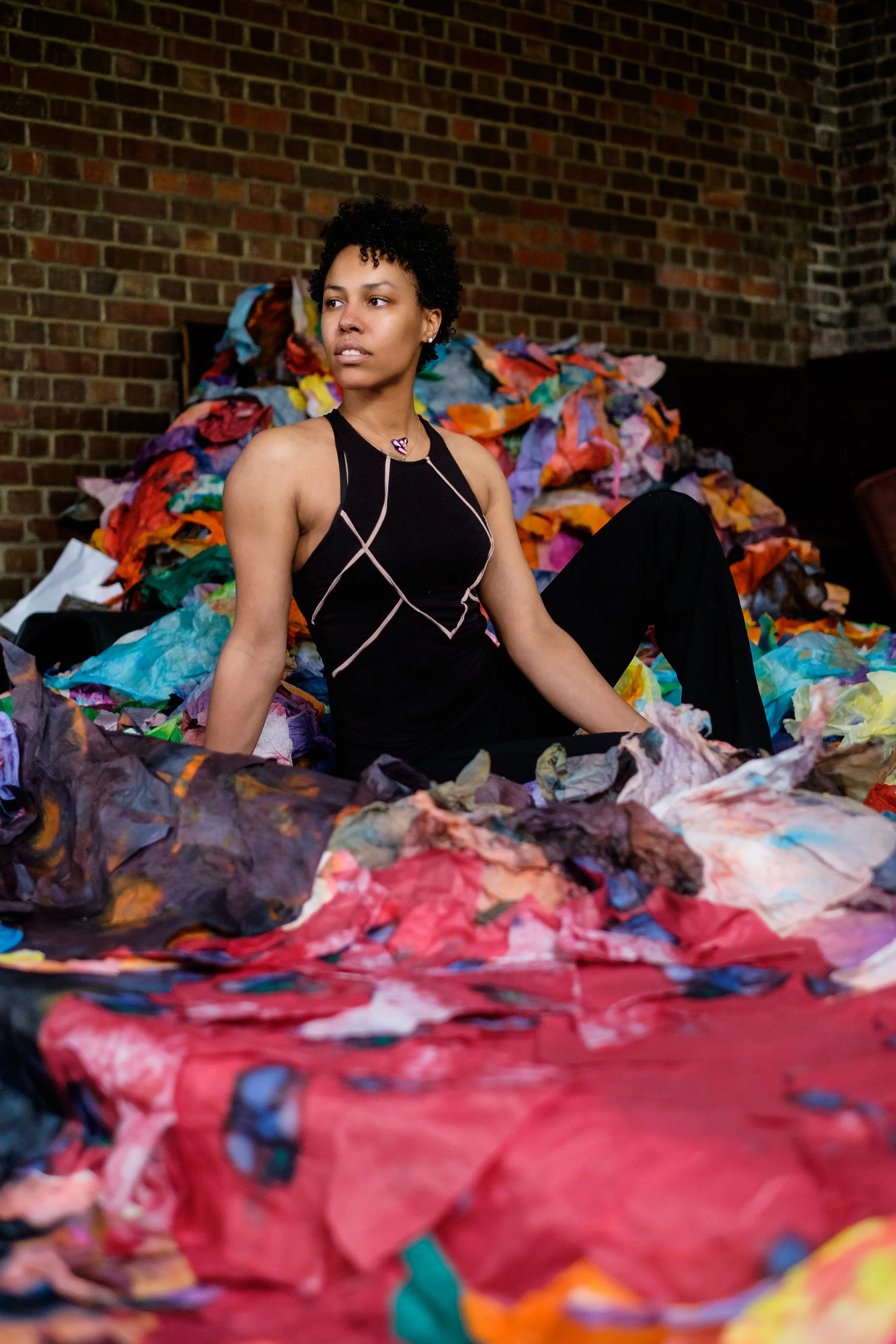
Version 19
| resource | rdf:resource | https://scalar.chapman.edu/scalar/beginagain/maya-freelon-1.19 |
| versionnumber | ov:versionnumber | 19 |
| title | dcterms:title | Maya Freelon |
| description | dcterms:description | Begin/Again, spinning tissue ink monoprint, 2018 |
| content | sioc:content | Maya Freelon is an award-winning artist best known for her lively, colorful paper sculptures, made primarily from tissue paper. Her godmother, Maya Angelou, described her work as “visualizing the truth about the vulnerability and power of the human being." For the past decade, Freelon has experimented with familiar, inexpensive materials such as tissue paper and glue as part of her dedication to making “art that’s inclusive, art that’s accessible and art that helps bridges.” As the daughter of an architect father and jazz singing mother, she learned skill, focus, and wild improvisation, as well as art’s potential to make our everyday lives more joyful. She values venues and commissions that expose her work to large, diverse audiences, and believes an internet router is as deserving of artistic attention as a gallery wall. In addition to museum exhibitions, she has produced work for Google and Cadillac, and the Smithsonian, as well as for hotels, healthcare facilities, and government embassies. Her art has a wide, popular appeal and been featured in Cosmopolitan Magazine, Ebony Magazine, the Washington Post, Huffington Post, and Modern Luxury Magazine.About the WorkFreelon discovered her favorite medium of tissue paper by a happy accident. While she was an art student she lived with her grandmother, Queen Mother Frances J. Pierce, and one day came across some tissue paper tucked away in the basement. Influenced by her grandmother, who came from a family of sharecroppers ("who never got their fair share") and had been an elementary school teacher for thirty years, she never wasted anything. A water leak had caused the colors in the tissue paper to bleed. "It was a metaphor for finding beauty in the simplest form, the fragility of life," reflects Freelon. It is also a way to honor her grandmother, who has been a constant source of inspiration and support, and whose favorite sayings often provide Freelon with the titles for her artwork.Since that day, Freelon has mined the creative possibilities of tissue paper. It’s a choice guided by politics as well as aesthetics. When Freelon uses this humble material in the high art context of museums and galleries, she challenges paradigms of power and honors the creative potential of every member of a community. "I am because we are," she insists, and has worked with groups of people to create collaborative "tissue quilts" in homage to African American quilting bees. To create Begin/Again, Freelon started with vibrantly dyed tissue paper. While the tissue was still wet, it was pressed into an absorbent paper then spun on a pottery wheel, creating a visual vortex of braided colors. "> About the ArtistMaya Freelon is an award-winning artist best known for her lively, colorful paper sculptures, made primarily from tissue paper. Her godmother, Maya Angelou, described her work as “visualizing the truth about the vulnerability and power of the human being." For the past decade, Freelon has experimented with familiar, inexpensive materials such as tissue paper and glue as part of her dedication to making “art that’s inclusive, art that’s accessible and art that helps bridges.” As the daughter of an architect father and jazz singing mother, she learned skill, focus, and wild improvisation, as well as art’s potential to make our everyday lives more joyful. She values venues and commissions that expose her work to large, diverse audiences, and believes an internet router is as deserving of artistic attention as a gallery wall. In addition to museum exhibitions, she has produced work for Google and Cadillac, and the Smithsonian, as well as for hotels, healthcare facilities, and government embassies. Her art has a wide, popular appeal and been featured in Cosmopolitan Magazine, Ebony Magazine, the Washington Post, Huffington Post, and Modern Luxury Magazine.About the WorkFreelon discovered her favorite medium of tissue paper by a happy accident. While she was an art student she lived with her grandmother, Queen Mother Frances J. Pierce, and one day came across some tissue paper tucked away in the basement. Influenced by her grandmother, who came from a family of sharecroppers ("who never got their fair share") and had been an elementary school teacher for thirty years, she never wasted anything. A water leak had caused the colors in the tissue paper to bleed. "It was a metaphor for finding beauty in the simplest form, the fragility of life," reflects Freelon. It is also a way to honor her grandmother, who has been a constant source of inspiration and support, and whose favorite sayings often provide Freelon with the titles for her artwork.Since that day, Freelon has mined the creative possibilities of tissue paper. It’s a choice guided by politics as well as aesthetics. When Freelon uses this humble material in the high art context of museums and galleries, she challenges paradigms of power and honors the creative potential of every member of a community. "I am because we are," she insists, and has worked with groups of people to create collaborative "tissue quilts" in homage to African American quilting bees. To create Begin/Again, Freelon started with vibrantly dyed tissue paper. While the tissue was still wet, it was pressed into an absorbent paper then spun on a pottery wheel, creating a visual vortex of braided colors. |
| default view | scalar:defaultView | image_header |
| was attributed to | prov:wasAttributedTo | https://scalar.chapman.edu/scalar/beginagain/users/3 |
| created | dcterms:created | 2020-08-13T17:52:49+00:00 |
| type | rdf:type | http://scalar.usc.edu/2012/01/scalar-ns#Version |
Version 18
| resource | rdf:resource | https://scalar.chapman.edu/scalar/beginagain/maya-freelon-1.18 |
| versionnumber | ov:versionnumber | 18 |
| title | dcterms:title | Maya Freelon |
| description | dcterms:description | Begin/Again, spinning tissue ink monoprint, 2018 |
| content | sioc:content | Maya Freelon is an award-winning artist best known for her lively, colorful paper sculptures, made primarily from tissue paper. Her godmother, Maya Angelou, described her work as “visualizing the truth about the vulnerability and power of the human being." For the past decade, Freelon has experimented with familiar, inexpensive materials such as tissue paper and glue as part of her dedication to making “art that’s inclusive, art that’s accessible and art that helps bridges.” As the daughter of an architect father and jazz singing mother, she learned skill, focus, and wild improvisation, as well as art’s potential to make our everyday lives more joyful. She values venues and commissions that expose her work to large, diverse audiences, and believes an internet router is as deserving of artistic attention as a gallery wall. In addition to museum exhibitions, she has produced work for Google and Cadillac, and the Smithsonian, as well as for hotels, healthcare facilities, and government embassies. Her art has a wide, popular appeal and been featured in Cosmopolitan Magazine, Ebony Magazine, the Washington Post, Huffington Post, and Modern Luxury Magazine.About the WorkFreelon discovered her favorite medium of tissue paper by a happy accident. While she was an art student she lived with her grandmother, Queen Mother Frances J. Pierce, and one day came across some tissue paper tucked away in the basement. Influenced by her grandmother, who came from a family of sharecroppers ("who never got their fair share") and had been an elementary school teacher for thirty years, she never wasted anything. A water leak had caused the colors in the tissue paper to bleed. "It was a metaphor for finding beauty in the simplest form, the fragility of life," reflects Freelon. It is also a way to honor her grandmother, who has been a constant source of inspiration and support, and whose favorite sayings often provide Freelon with the titles for her artwork.Since that day, Freelon has mined the creative possibilities of tissue paper. It’s a choice guided by politics as well as aesthetics. When Freelon uses this humble material in the high art context of museums and galleries, she challenges paradigms of power and honors the creative potential of every member of a community. "I am because we are," she insists, and has worked with groups of people to create collaborative "tissue quilts" in homage to African American quilting bees. To create Begin/Again, Freelon started with vibrantly dyed tissue paper. While the tissue was still wet, it was pressed into an absorbent paper then spun on a pottery wheel, creating a visual vortex of braided colors. "> About the ArtistMaya Freelon is an award-winning artist best known for her lively, colorful paper sculptures, made primarily from tissue paper. Her godmother, Maya Angelou, described her work as “visualizing the truth about the vulnerability and power of the human being." For the past decade, Freelon has experimented with familiar, inexpensive materials such as tissue paper and glue as part of her dedication to making “art that’s inclusive, art that’s accessible and art that helps bridges.” As the daughter of an architect father and jazz singing mother, she learned skill, focus, and wild improvisation, as well as art’s potential to make our everyday lives more joyful. She values venues and commissions that expose her work to large, diverse audiences, and believes an internet router is as deserving of artistic attention as a gallery wall. In addition to museum exhibitions, she has produced work for Google and Cadillac, and the Smithsonian, as well as for hotels, healthcare facilities, and government embassies. Her art has a wide, popular appeal and been featured in Cosmopolitan Magazine, Ebony Magazine, the Washington Post, Huffington Post, and Modern Luxury Magazine.About the WorkFreelon discovered her favorite medium of tissue paper by a happy accident. While she was an art student she lived with her grandmother, Queen Mother Frances J. Pierce, and one day came across some tissue paper tucked away in the basement. Influenced by her grandmother, who came from a family of sharecroppers ("who never got their fair share") and had been an elementary school teacher for thirty years, she never wasted anything. A water leak had caused the colors in the tissue paper to bleed. "It was a metaphor for finding beauty in the simplest form, the fragility of life," reflects Freelon. It is also a way to honor her grandmother, who has been a constant source of inspiration and support, and whose favorite sayings often provide Freelon with the titles for her artwork.Since that day, Freelon has mined the creative possibilities of tissue paper. It’s a choice guided by politics as well as aesthetics. When Freelon uses this humble material in the high art context of museums and galleries, she challenges paradigms of power and honors the creative potential of every member of a community. "I am because we are," she insists, and has worked with groups of people to create collaborative "tissue quilts" in homage to African American quilting bees. To create Begin/Again, Freelon started with vibrantly dyed tissue paper. While the tissue was still wet, it was pressed into an absorbent paper then spun on a pottery wheel, creating a visual vortex of braided colors. |
| default view | scalar:defaultView | image_header |
| was attributed to | prov:wasAttributedTo | https://scalar.chapman.edu/scalar/beginagain/users/3 |
| created | dcterms:created | 2020-08-13T17:52:30+00:00 |
| type | rdf:type | http://scalar.usc.edu/2012/01/scalar-ns#Version |
Version 17
| resource | rdf:resource | https://scalar.chapman.edu/scalar/beginagain/maya-freelon-1.17 |
| versionnumber | ov:versionnumber | 17 |
| title | dcterms:title | Maya Freelon |
| description | dcterms:description | Begin/Again, spinning tissue ink monoprint, 2018 |
| content | sioc:content | Maya Freelon is an award-winning artist best known for her lively, colorful paper sculptures, made primarily from tissue paper. Her godmother, Maya Angelou, described her work as “visualizing the truth about the vulnerability and power of the human being." For the past decade, Freelon has experimented with familiar, inexpensive materials such as tissue paper and glue as part of her dedication to making “art that’s inclusive, art that’s accessible and art that helps bridges.” As the daughter of an architect father and jazz singing mother, she learned skill, focus, and wild improvisation, as well as art’s potential to make our everyday lives more joyful. She values venues and commissions that expose her work to large, diverse audiences, and believes an internet router is as deserving of artistic attention as a gallery wall. In addition to museum exhibitions, she has produced work for Google and Cadillac, and the Smithsonian, as well as for hotels, healthcare facilities, and government embassies. Her art has a wide, popular appeal and been featured in Cosmopolitan Magazine, Ebony Magazine, the Washington Post, Huffington Post, and Modern Luxury Magazine.About the WorkFreelon discovered her favorite medium of tissue paper by a happy accident. While she was an art student she lived with her grandmother, Queen Mother Frances J. Pierce, and one day came across some tissue paper tucked away in the basement. Influenced by her grandmother, who came from a family of sharecroppers ("who never got their fair share") and had been an elementary school teacher for thirty years, she never wasted anything. A water leak had caused the colors in the tissue paper to bleed. "It was a metaphor for finding beauty in the simplest form, the fragility of life," reflects Freelon. It is also a way to honor her grandmother, who has been a constant source of inspiration and support, and whose favorite sayings often provide Freelon with the titles for her artwork.Since that day, Freelon has mined the creative possibilities of tissue paper. It’s a choice guided by politics as well as aesthetics. When Freelon uses this humble material in the high art context of museums and galleries, she challenges paradigms of power and honors the creative potential of every member of a community. "I am because we are," she insists, and has worked with groups of people to create collaborative "tissue quilts" in homage to African American quilting bees. To create Begin/Again, Freelon started with vibrantly dyed tissue paper. While the tissue was still wet, it was pressed into an absorbent paper then spun on a pottery wheel, creating a visual vortex of braided colors. "> About the ArtistMaya Freelon is an award-winning artist best known for her lively, colorful paper sculptures, made primarily from tissue paper. Her godmother, Maya Angelou, described her work as “visualizing the truth about the vulnerability and power of the human being." For the past decade, Freelon has experimented with familiar, inexpensive materials such as tissue paper and glue as part of her dedication to making “art that’s inclusive, art that’s accessible and art that helps bridges.” As the daughter of an architect father and jazz singing mother, she learned skill, focus, and wild improvisation, as well as art’s potential to make our everyday lives more joyful. She values venues and commissions that expose her work to large, diverse audiences, and believes an internet router is as deserving of artistic attention as a gallery wall. In addition to museum exhibitions, she has produced work for Google and Cadillac, and the Smithsonian, as well as for hotels, healthcare facilities, and government embassies. Her art has a wide, popular appeal and been featured in Cosmopolitan Magazine, Ebony Magazine, the Washington Post, Huffington Post, and Modern Luxury Magazine.About the WorkFreelon discovered her favorite medium of tissue paper by a happy accident. While she was an art student she lived with her grandmother, Queen Mother Frances J. Pierce, and one day came across some tissue paper tucked away in the basement. Influenced by her grandmother, who came from a family of sharecroppers ("who never got their fair share") and had been an elementary school teacher for thirty years, she never wasted anything. A water leak had caused the colors in the tissue paper to bleed. "It was a metaphor for finding beauty in the simplest form, the fragility of life," reflects Freelon. It is also a way to honor her grandmother, who has been a constant source of inspiration and support, and whose favorite sayings often provide Freelon with the titles for her artwork.Since that day, Freelon has mined the creative possibilities of tissue paper. It’s a choice guided by politics as well as aesthetics. When Freelon uses this humble material in the high art context of museums and galleries, she challenges paradigms of power and honors the creative potential of every member of a community. "I am because we are," she insists, and has worked with groups of people to create collaborative "tissue quilts" in homage to African American quilting bees. To create Begin/Again, Freelon started with vibrantly dyed tissue paper. While the tissue was still wet, it was pressed into an absorbent paper then spun on a pottery wheel, creating a visual vortex of braided colors. |
| default view | scalar:defaultView | image_header |
| was attributed to | prov:wasAttributedTo | https://scalar.chapman.edu/scalar/beginagain/users/3 |
| created | dcterms:created | 2020-08-13T17:51:56+00:00 |
| type | rdf:type | http://scalar.usc.edu/2012/01/scalar-ns#Version |
Version 16
| resource | rdf:resource | https://scalar.chapman.edu/scalar/beginagain/maya-freelon-1.16 |
| versionnumber | ov:versionnumber | 16 |
| title | dcterms:title | Maya Freelon |
| description | dcterms:description | Begin/Again, spinning tissue ink monoprint, 2018 |
| content | sioc:content | Maya Freelon is an award-winning artist best known for her lively, colorful paper sculptures, made primarily from tissue paper. Her godmother, Maya Angelou, described her work as “visualizing the truth about the vulnerability and power of the human being." For the past decade, Freelon has experimented with familiar, inexpensive materials such as tissue paper and glue as part of her dedication to making “art that’s inclusive, art that’s accessible and art that helps bridges.” As the daughter of an architect father and jazz singing mother, she learned skill, focus, and wild improvisation, as well as art’s potential to make our everyday lives more joyful. She values venues and commissions that expose her work to large, diverse audiences, and believes an internet router is as deserving of artistic attention as a gallery wall. In addition to museum exhibitions, she has produced work for Google and Cadillac, and the Smithsonian, as well as for hotels, healthcare facilities, and government embassies. Her art has a wide, popular appeal and been featured in Cosmopolitan Magazine, Ebony Magazine, the Washington Post, Huffington Post, and Modern Luxury Magazine.About the WorkFreelon discovered her favorite medium of tissue paper by a happy accident. While she was an art student she lived with her grandmother, Queen Mother Frances J. Pierce, and one day came across some tissue paper tucked away in the basement. Influenced by her grandmother, who came from a family of sharecroppers ("who never got their fair share") and had been an elementary school teacher for thirty years, she never wasted anything. A water leak had caused the colors in the tissue paper to bleed. "It was a metaphor for finding beauty in the simplest form, the fragility of life," reflects Freelon. It is also a way to honor her grandmother, who has been a constant source of inspiration and support, and whose favorite sayings often provide Freelon with the titles for her artwork.Since that day, Freelon has mined the creative possibilities of tissue paper. It’s a choice guided by politics as well as aesthetics. When Freelon uses this humble material in the high art context of museums and galleries, she challenges paradigms of power and honors the creative potential of every member of a community. "I am because we are," she insists, and has worked with groups of people to create collaborative "tissue quilts" in homage to African American quilting bees. To create Begin/Again, Freelon started with vibrantly dyed tissue paper. While the tissue was still wet, it was pressed into an absorbent paper then spun on a pottery wheel, creating a visual vortex of braided colors. "> About the ArtistMaya Freelon is an award-winning artist best known for her lively, colorful paper sculptures, made primarily from tissue paper. Her godmother, Maya Angelou, described her work as “visualizing the truth about the vulnerability and power of the human being." For the past decade, Freelon has experimented with familiar, inexpensive materials such as tissue paper and glue as part of her dedication to making “art that’s inclusive, art that’s accessible and art that helps bridges.” As the daughter of an architect father and jazz singing mother, she learned skill, focus, and wild improvisation, as well as art’s potential to make our everyday lives more joyful. She values venues and commissions that expose her work to large, diverse audiences, and believes an internet router is as deserving of artistic attention as a gallery wall. In addition to museum exhibitions, she has produced work for Google and Cadillac, and the Smithsonian, as well as for hotels, healthcare facilities, and government embassies. Her art has a wide, popular appeal and been featured in Cosmopolitan Magazine, Ebony Magazine, the Washington Post, Huffington Post, and Modern Luxury Magazine.About the WorkFreelon discovered her favorite medium of tissue paper by a happy accident. While she was an art student she lived with her grandmother, Queen Mother Frances J. Pierce, and one day came across some tissue paper tucked away in the basement. Influenced by her grandmother, who came from a family of sharecroppers ("who never got their fair share") and had been an elementary school teacher for thirty years, she never wasted anything. A water leak had caused the colors in the tissue paper to bleed. "It was a metaphor for finding beauty in the simplest form, the fragility of life," reflects Freelon. It is also a way to honor her grandmother, who has been a constant source of inspiration and support, and whose favorite sayings often provide Freelon with the titles for her artwork.Since that day, Freelon has mined the creative possibilities of tissue paper. It’s a choice guided by politics as well as aesthetics. When Freelon uses this humble material in the high art context of museums and galleries, she challenges paradigms of power and honors the creative potential of every member of a community. "I am because we are," she insists, and has worked with groups of people to create collaborative "tissue quilts" in homage to African American quilting bees. To create Begin/Again, Freelon started with vibrantly dyed tissue paper. While the tissue was still wet, it was pressed into an absorbent paper then spun on a pottery wheel, creating a visual vortex of braided colors. |
| default view | scalar:defaultView | image_header |
| was attributed to | prov:wasAttributedTo | https://scalar.chapman.edu/scalar/beginagain/users/3 |
| created | dcterms:created | 2020-08-13T17:48:56+00:00 |
| type | rdf:type | http://scalar.usc.edu/2012/01/scalar-ns#Version |
Version 15
| resource | rdf:resource | https://scalar.chapman.edu/scalar/beginagain/maya-freelon-1.15 |
| versionnumber | ov:versionnumber | 15 |
| title | dcterms:title | Maya Freelon |
| description | dcterms:description | Begin/Again, spinning tissue ink monoprint, 2018 |
| content | sioc:content | Maya Freelon is an award-winning artist best known for her lively, colorful paper sculptures, made primarily from tissue paper. Her godmother, Maya Angelou, described her work as “visualizing the truth about the vulnerability and power of the human being." For the past decade, Freelon has experimented with familiar, inexpensive materials such as tissue paper and glue as part of her dedication to making “art that’s inclusive, art that’s accessible and art that helps bridges.” As the daughter of an architect father and jazz singing mother, she learned skill, focus, and wild improvisation, as well as art’s potential to make our everyday lives more joyful. She values venues and commissions that expose her work to large, diverse audiences, and believes an internet router is as deserving of artistic attention as a gallery wall. In addition to museum exhibitions, she has produced work for Google and Cadillac, as well as for hotels, healthcare facilities, and government embassies. Her art has a wide, popular appeal and been featured in Cosmopolitan Magazine, Ebony Magazine, the Washington Post, Huffington Post, and Modern Luxury Magazine.About the WorkFreelon discovered her favorite medium of tissue paper by a happy accident. While she was an art student she lived with her grandmother, Queen Mother Frances J. Pierce, and one day came across some tissue paper tucked away in the basement. Influenced by her grandmother, who came from a family of sharecroppers ("who never got their fair share") and had been an elementary school teacher for thirty years, she never wasted anything. A water leak had caused the colors in the tissue paper to bleed. "It was a metaphor for finding beauty in the simplest form, the fragility of life," reflects Freelon. It is also a way to honor her grandmother, who has been a constant source of inspiration and support, and whose favorite sayings often provide Freelon with the titles for her artwork.Since that day, Freelon has mined the creative possibilities of tissue paper. It’s a choice guided by politics as well as aesthetics. When Freelon uses this humble material in the high art context of museums and galleries, she challenges paradigms of power and honors the creative potential of every member of a community. "I am because we are," she insists, and has worked with groups of people to create collaborative "tissue quilts" in homage to African American quilting bees. To create Begin/Again, Freelon started with vibrantly dyed tissue paper. While the tissue was still wet, it was pressed into an absorbent paper then spun on a pottery wheel, creating a visual vortex of braided colors. "> About the ArtistMaya Freelon is an award-winning artist best known for her lively, colorful paper sculptures, made primarily from tissue paper. Her godmother, Maya Angelou, described her work as “visualizing the truth about the vulnerability and power of the human being." For the past decade, Freelon has experimented with familiar, inexpensive materials such as tissue paper and glue as part of her dedication to making “art that’s inclusive, art that’s accessible and art that helps bridges.” As the daughter of an architect father and jazz singing mother, she learned skill, focus, and wild improvisation, as well as art’s potential to make our everyday lives more joyful. She values venues and commissions that expose her work to large, diverse audiences, and believes an internet router is as deserving of artistic attention as a gallery wall. In addition to museum exhibitions, she has produced work for Google and Cadillac, as well as for hotels, healthcare facilities, and government embassies. Her art has a wide, popular appeal and been featured in Cosmopolitan Magazine, Ebony Magazine, the Washington Post, Huffington Post, and Modern Luxury Magazine.About the WorkFreelon discovered her favorite medium of tissue paper by a happy accident. While she was an art student she lived with her grandmother, Queen Mother Frances J. Pierce, and one day came across some tissue paper tucked away in the basement. Influenced by her grandmother, who came from a family of sharecroppers ("who never got their fair share") and had been an elementary school teacher for thirty years, she never wasted anything. A water leak had caused the colors in the tissue paper to bleed. "It was a metaphor for finding beauty in the simplest form, the fragility of life," reflects Freelon. It is also a way to honor her grandmother, who has been a constant source of inspiration and support, and whose favorite sayings often provide Freelon with the titles for her artwork.Since that day, Freelon has mined the creative possibilities of tissue paper. It’s a choice guided by politics as well as aesthetics. When Freelon uses this humble material in the high art context of museums and galleries, she challenges paradigms of power and honors the creative potential of every member of a community. "I am because we are," she insists, and has worked with groups of people to create collaborative "tissue quilts" in homage to African American quilting bees. To create Begin/Again, Freelon started with vibrantly dyed tissue paper. While the tissue was still wet, it was pressed into an absorbent paper then spun on a pottery wheel, creating a visual vortex of braided colors. |
| default view | scalar:defaultView | image_header |
| was attributed to | prov:wasAttributedTo | https://scalar.chapman.edu/scalar/beginagain/users/3 |
| created | dcterms:created | 2020-08-12T03:29:05+00:00 |
| type | rdf:type | http://scalar.usc.edu/2012/01/scalar-ns#Version |
Version 14
| resource | rdf:resource | https://scalar.chapman.edu/scalar/beginagain/maya-freelon-1.14 |
| versionnumber | ov:versionnumber | 14 |
| title | dcterms:title | Maya Freelon |
| description | dcterms:description | Begin/Again, spinning tissue ink monoprint, 2018 |
| content | sioc:content | Maya Freelon is an award-winning artist best known for her lively, colorful paper sculptures, made primarily from tissue paper. Her godmother, Maya Angelou, described her work as “visualizing the truth about the vulnerability and power of the human being." For the past decade, Freelon has experimented with familiar, inexpensive materials such as tissue paper and glue as part of her dedication to making “art that’s inclusive, art that’s accessible and art that helps bridges.” As the daughter of an architect father and jazz singing mother, she learned skill, focus, and wild improvisation, as well as art’s potential to make our everyday lives more joyful. She values venues and commissions that expose her work to large, diverse audiences, and believes an internet router is as deserving of artistic attention as a gallery wall. In addition to museum exhibitions, she has produced work for Google and Cadillac, as well as for hotels, healthcare facilities, and government embassies. Her art has a wide, popular appeal and been featured in Cosmopolitan Magazine, Ebony Magazine, the Washington Post, Huffington Post, and Modern Luxury Magazine.">About the ArtistMaya Freelon is an award-winning artist best known for her lively, colorful paper sculptures, made primarily from tissue paper. Her godmother, Maya Angelou, described her work as “visualizing the truth about the vulnerability and power of the human being." For the past decade, Freelon has experimented with familiar, inexpensive materials such as tissue paper and glue as part of her dedication to making “art that’s inclusive, art that’s accessible and art that helps bridges.” As the daughter of an architect father and jazz singing mother, she learned skill, focus, and wild improvisation, as well as art’s potential to make our everyday lives more joyful. She values venues and commissions that expose her work to large, diverse audiences, and believes an internet router is as deserving of artistic attention as a gallery wall. In addition to museum exhibitions, she has produced work for Google and Cadillac, as well as for hotels, healthcare facilities, and government embassies. Her art has a wide, popular appeal and been featured in Cosmopolitan Magazine, Ebony Magazine, the Washington Post, Huffington Post, and Modern Luxury Magazine. |
| default view | scalar:defaultView | image_header |
| was attributed to | prov:wasAttributedTo | https://scalar.chapman.edu/scalar/beginagain/users/3 |
| created | dcterms:created | 2020-08-12T03:25:41+00:00 |
| type | rdf:type | http://scalar.usc.edu/2012/01/scalar-ns#Version |
Version 13
| resource | rdf:resource | https://scalar.chapman.edu/scalar/beginagain/maya-freelon-1.13 |
| versionnumber | ov:versionnumber | 13 |
| title | dcterms:title | Maya Freelon |
| description | dcterms:description | Begin/Again, spinning tissue ink monoprint, 2018 |
| content | sioc:content | Maya Freelon is an award-winning artist best known for her lively, colorful paper sculptures, made primarily from tissue paper. Her godmother, Maya Angelou, described her work as “visualizing the truth about the vulnerability and power of the human being." For the past decade, Freelon has experimented with familiar, inexpensive materials such as tissue paper and glue as part of her dedication to making “art that’s inclusive, art that’s accessible and art that helps bridges.” As the daughter of an architect father and jazz singing mother, she learned skill, focus, and wild improvisation, as well as art’s potential to make our everyday lives more joyful. She values venues and commissions that expose her work to large, diverse audiences, and believes an internet router is as deserving of artistic attention as a gallery wall. In addition to museum exhibitions, she has produced work for Google and Cadillac, as well as for hotels, healthcare facilities, and government embassies. Her art has a wide, popular appeal and been featured in Cosmopolitan Magazine, Ebony Magazine, the Washington Post, Huffington Post, and Modern Luxury Magazine.">About the ArtistMaya Freelon is an award-winning artist best known for her lively, colorful paper sculptures, made primarily from tissue paper. Her godmother, Maya Angelou, described her work as “visualizing the truth about the vulnerability and power of the human being." For the past decade, Freelon has experimented with familiar, inexpensive materials such as tissue paper and glue as part of her dedication to making “art that’s inclusive, art that’s accessible and art that helps bridges.” As the daughter of an architect father and jazz singing mother, she learned skill, focus, and wild improvisation, as well as art’s potential to make our everyday lives more joyful. She values venues and commissions that expose her work to large, diverse audiences, and believes an internet router is as deserving of artistic attention as a gallery wall. In addition to museum exhibitions, she has produced work for Google and Cadillac, as well as for hotels, healthcare facilities, and government embassies. Her art has a wide, popular appeal and been featured in Cosmopolitan Magazine, Ebony Magazine, the Washington Post, Huffington Post, and Modern Luxury Magazine. |
| default view | scalar:defaultView | image_header |
| was attributed to | prov:wasAttributedTo | https://scalar.chapman.edu/scalar/beginagain/users/3 |
| created | dcterms:created | 2020-08-12T03:25:29+00:00 |
| type | rdf:type | http://scalar.usc.edu/2012/01/scalar-ns#Version |
Version 12
| resource | rdf:resource | https://scalar.chapman.edu/scalar/beginagain/maya-freelon-1.12 |
| versionnumber | ov:versionnumber | 12 |
| title | dcterms:title | Maya Freelon |
| description | dcterms:description | Begin/Again, spinning tissue ink monoprint, 2018 |
| content | sioc:content | About the ArtistMaya Freelon is an award-winning artist best known for her lively, colorful paper sculptures, made primarily from tissue paper. Her godmother, Maya Angelou, described her work as “visualizing the truth about the vulnerability and power of the human being." For the past decade, Freelon has experimented with familiar, inexpensive materials such as tissue paper and glue as part of her dedication to making “art that’s inclusive, art that’s accessible and art that helps bridges.” As the daughter of an architect father and jazz singing mother, she learned skill, focus, and wild improvisation, as well as art’s potential to make our everyday lives more joyful. She values venues and commissions that expose her work to large, diverse audiences, and believes an internet router is as deserving of artistic attention as a gallery wall. In addition to museum exhibitions, she has produced work for Google and Cadillac, as well as for hotels, healthcare facilities, and government embassies. Her art has a wide, popular appeal and been featured in Cosmopolitan Magazine, Ebony Magazine, the Washington Post, Huffington Post, and Modern Luxury Magazine. |
| default view | scalar:defaultView | image_header |
| was attributed to | prov:wasAttributedTo | https://scalar.chapman.edu/scalar/beginagain/users/3 |
| created | dcterms:created | 2020-08-12T03:24:38+00:00 |
| type | rdf:type | http://scalar.usc.edu/2012/01/scalar-ns#Version |
Version 11
| resource | rdf:resource | https://scalar.chapman.edu/scalar/beginagain/maya-freelon-1.11 |
| versionnumber | ov:versionnumber | 11 |
| title | dcterms:title | Maya Freelon |
| description | dcterms:description | Begin/Again, spinning tissue ink monoprint, 2018 |
| content | sioc:content | About the ArtistMaya Freelon is an award-winning artist best known for her lively, colorful paper sculptures, made primarily from tissue paper. Her godmother, Maya Angelou, described her work as “visualizing the truth about the vulnerability and power of the human being." For the past decade, Freelon has experimented with familiar, inexpensive materials such as tissue paper and glue as part of her dedication to making “art that’s inclusive, art that’s accessible and art that helps bridges.” As the daughter of an architect father and jazz singing mother, she learned skill, focus, and wild improvisation, as well as art’s potential to make our everyday lives more joyful. She values venues and commissions that expose her work to large, diverse audiences, and believes an internet router is as deserving of artistic attention as a gallery wall. In addition to museum exhibitions, she has produced work for Google and Cadillac, as well as for hotels, healthcare facilities, and government embassies. Her art has a wide, popular appeal and been featured in Cosmopolitan Magazine, Ebony Magazine, the Washington Post, Huffington Post, and Modern Luxury Magazine. |
| default view | scalar:defaultView | image_header |
| was attributed to | prov:wasAttributedTo | https://scalar.chapman.edu/scalar/beginagain/users/3 |
| created | dcterms:created | 2020-08-12T03:24:27+00:00 |
| type | rdf:type | http://scalar.usc.edu/2012/01/scalar-ns#Version |
Version 10
| resource | rdf:resource | https://scalar.chapman.edu/scalar/beginagain/maya-freelon-1.10 |
| versionnumber | ov:versionnumber | 10 |
| title | dcterms:title | Maya Freelon |
| description | dcterms:description | Begin/Again, spinning tissue ink monoprint, 2018 |
| content | sioc:content | About the ArtistMaya Freelon is an award-winning artist best known for her lively, colorful paper sculptures, made primarily from tissue paper. Her godmother, Maya Angelou, described her work as “visualizing the truth about the vulnerability and power of the human being." For the past decade, Freelon has experimented with familiar, inexpensive materials such as tissue paper and glue as part of her dedication to making “art that’s inclusive, art that’s accessible and art that helps bridges.” As the daughter of an architect father and jazz singing mother, she learned skill, focus, and wild improvisation, as well as art’s potential to make our everyday lives more joyful. She values venues and commissions that expose her work to large, diverse audiences, and believes an internet router is as deserving of artistic attention as a gallery wall. In addition to museum exhibitions, she has produced work for Google and Cadillac, as well as for hotels, healthcare facilities, and government embassies. Her art has a wide, popular appeal and been featured in Cosmopolitan Magazine, Ebony Magazine, the Washington Post, Huffington Post, and Modern Luxury Magazine. |
| default view | scalar:defaultView | plain |
| was attributed to | prov:wasAttributedTo | https://scalar.chapman.edu/scalar/beginagain/users/3 |
| created | dcterms:created | 2020-08-12T03:24:10+00:00 |
| type | rdf:type | http://scalar.usc.edu/2012/01/scalar-ns#Version |
Version 9
| resource | rdf:resource | https://scalar.chapman.edu/scalar/beginagain/maya-freelon-1.9 |
| versionnumber | ov:versionnumber | 9 |
| title | dcterms:title | Maya Freelon |
| description | dcterms:description | Begin/Again, spinning tissue ink monoprint, 2018 |
| content | sioc:content | About the ArtistMaya Freelon is an award-winning artist best known for her lively, colorful paper sculptures, made primarily from tissue paper. Her godmother, Maya Angelou, described her work as “visualizing the truth about the vulnerability and power of the human being." For the past decade, Freelon has experimented with familiar, inexpensive materials such as tissue paper and glue as part of her dedication to making “art that’s inclusive, art that’s accessible and art that helps bridges.” As the daughter of an architect father and jazz singing mother, she learned skill, focus, and wild improvisation, as well as art’s potential to make our everyday lives more joyful. She values venues and commissions that expose her work to large, diverse audiences, and believes an internet router is as deserving of artistic attention as a gallery wall. In addition to museum exhibitions, she has produced work for Google and Cadillac, as well as for hotels, healthcare facilities, and government embassies. Her art has a wide, popular appeal and been featured in Cosmopolitan Magazine, Ebony Magazine, the Washington Post, Huffington Post, and Modern Luxury Magazine. |
| default view | scalar:defaultView | image_header |
| was attributed to | prov:wasAttributedTo | https://scalar.chapman.edu/scalar/beginagain/users/3 |
| created | dcterms:created | 2020-08-12T03:23:47+00:00 |
| type | rdf:type | http://scalar.usc.edu/2012/01/scalar-ns#Version |
Version 8
| resource | rdf:resource | https://scalar.chapman.edu/scalar/beginagain/maya-freelon-1.8 |
| versionnumber | ov:versionnumber | 8 |
| title | dcterms:title | Maya Freelon |
| description | dcterms:description | Begin/Again, spinning tissue ink monoprint, 2018 |
| content | sioc:content | About the ArtistMaya Freelon is an award-winning artist best known for her lively, colorful paper sculptures, made primarily from tissue paper. Her godmother, Maya Angelou, described her work as “visualizing the truth about the vulnerability and power of the human being." For the past decade, Freelon has experimented with familiar, inexpensive materials such as tissue paper and glue as part of her dedication to making “art that’s inclusive, art that’s accessible and art that helps bridges.” As the daughter of an architect father and jazz singing mother, she learned skill, focus, and wild improvisation, as well as art’s potential to make our everyday lives more joyful. She values venues and commissions that expose her work to large, diverse audiences, and believes an internet router is as deserving of artistic attention as a gallery wall. In addition to museum exhibitions, she has produced work for Google and Cadillac, as well as for hotels, healthcare facilities, and government embassies. Her art has a wide, popular appeal and been featured in Cosmopolitan Magazine, Ebony Magazine, the Washington Post, Huffington Post, and Modern Luxury Magazine. |
| default view | scalar:defaultView | image_header |
| was attributed to | prov:wasAttributedTo | https://scalar.chapman.edu/scalar/beginagain/users/3 |
| created | dcterms:created | 2020-08-12T03:23:44+00:00 |
| type | rdf:type | http://scalar.usc.edu/2012/01/scalar-ns#Version |
Version 7
| resource | rdf:resource | https://scalar.chapman.edu/scalar/beginagain/maya-freelon-1.7 |
| versionnumber | ov:versionnumber | 7 |
| title | dcterms:title | Maya Freelon |
| description | dcterms:description | Begin/Again, spinning tissue ink monoprint, 2018 |
| content | sioc:content | About the ArtistMaya Freelon is an award-winning artist best known for her lively, colorful paper sculptures, made primarily from tissue paper. Her godmother, Maya Angelou, described her work as “visualizing the truth about the vulnerability and power of the human being." For the past decade, Freelon has experimented with familiar, inexpensive materials such as tissue paper and glue as part of her dedication to making “art that’s inclusive, art that’s accessible and art that helps bridges.” As the daughter of an architect father and jazz singing mother, she learned skill, focus, and wild improvisation, as well as art’s potential to make our everyday lives more joyful. She values venues and commissions that expose her work to large, diverse audiences, and believes an internet router is as deserving of artistic attention as a gallery wall. In addition to museum exhibitions, she has produced work for Google and Cadillac, as well as for hotels, healthcare facilities, and government embassies. Her art has a wide, popular appeal and been featured in Cosmopolitan Magazine, Ebony Magazine, the Washington Post, Huffington Post, and Modern Luxury Magazine. |
| default view | scalar:defaultView | image_header |
| was attributed to | prov:wasAttributedTo | https://scalar.chapman.edu/scalar/beginagain/users/3 |
| created | dcterms:created | 2020-08-12T03:22:54+00:00 |
| type | rdf:type | http://scalar.usc.edu/2012/01/scalar-ns#Version |
Version 6
| resource | rdf:resource | https://scalar.chapman.edu/scalar/beginagain/maya-freelon-1.6 |
| versionnumber | ov:versionnumber | 6 |
| title | dcterms:title | Maya Freelon |
| description | dcterms:description | Begin/Again, spinning tissue ink monoprint, 2018 |
| content | sioc:content | About the ArtistMaya Freelon is an award-winning artist best known for her lively, colorful paper sculptures, made primarily from tissue paper. Her godmother, Maya Angelou, described her work as “visualizing the truth about the vulnerability and power of the human being." For the past decade, Freelon has experimented with familiar, inexpensive materials such as tissue paper and glue as part of her dedication to making “art that’s inclusive, art that’s accessible and art that helps bridges.” As the daughter of an architect father and jazz singing mother, she learned skill, focus, and wild improvisation, as well as art’s potential to make our everyday lives more joyful. She values venues and commissions that expose her work to large, diverse audiences, and believes an internet router is as deserving of artistic attention as a gallery wall. In addition to museum exhibitions, she has produced work for Google and Cadillac, as well as for hotels, healthcare facilities, and government embassies. Her art has a wide, popular appeal and been featured in Cosmopolitan Magazine, Ebony Magazine, the Washington Post, Huffington Post, and Modern Luxury Magazine. |
| default view | scalar:defaultView | image_header |
| was attributed to | prov:wasAttributedTo | https://scalar.chapman.edu/scalar/beginagain/users/3 |
| created | dcterms:created | 2020-08-12T03:22:18+00:00 |
| type | rdf:type | http://scalar.usc.edu/2012/01/scalar-ns#Version |
Version 5
| resource | rdf:resource | https://scalar.chapman.edu/scalar/beginagain/maya-freelon-1.5 |
| versionnumber | ov:versionnumber | 5 |
| title | dcterms:title | Maya Freelon |
| description | dcterms:description | Begin/Again, spinning tissue ink monoprint, 2018 |
| content | sioc:content | About the ArtistMaya Freelon is an award-winning artist best known for her lively, colorful paper sculptures, made primarily from tissue paper. Her godmother, Maya Angelou, described her work as “visualizing the truth about the vulnerability and power of the human being." For the past decade, Freelon has experimented with familiar, inexpensive materials such as tissue paper and glue as part of her dedication to making “art that’s inclusive, art that’s accessible and art that helps bridges.” As the daughter of an architect father and jazz singing mother, she learned skill, focus, and wild improvisation, as well as art’s potential to make our everyday lives more joyful. She values venues and commissions that expose her work to large, diverse audiences, and believes an internet router is as deserving of artistic attention as a gallery wall. In addition to museum exhibitions, she has produced work for Google and Cadillac, as well as for hotels, healthcare facilities, and government embassies. Her art has a wide, popular appeal and been featured in Cosmopolitan Magazine, Ebony Magazine, the Washington Post, Huffington Post, and Modern Luxury Magazine. |
| default view | scalar:defaultView | image_header |
| was attributed to | prov:wasAttributedTo | https://scalar.chapman.edu/scalar/beginagain/users/3 |
| created | dcterms:created | 2020-08-12T03:21:39+00:00 |
| type | rdf:type | http://scalar.usc.edu/2012/01/scalar-ns#Version |
Version 4
| resource | rdf:resource | https://scalar.chapman.edu/scalar/beginagain/maya-freelon-1.4 |
| versionnumber | ov:versionnumber | 4 |
| title | dcterms:title | Maya Freelon |
| description | dcterms:description | Begin/Again, spinning tissue ink monoprint, 2018 |
| content | sioc:content | About the ArtistMaya Freelon is an award-winning artist best known for her lively, colorful paper sculptures, made primarily from tissue paper. Her godmother, Maya Angelou, described her work as “visualizing the truth about the vulnerability and power of the human being." For the past decade, Freelon has experimented with familiar, inexpensive materials such as tissue paper and glue as part of her dedication to making “art that’s inclusive, art that’s accessible and art that helps bridges.” As the daughter of an architect father and jazz singing mother, she learned skill, focus, and wild improvisation, as well as art’s potential to make our everyday lives more joyful. She values venues and commissions that expose her work to large, diverse audiences, and believes an internet router is as deserving of artistic attention as a gallery wall. In addition to museum exhibitions, she has produced work for Google and Cadillac, as well as for hotels, healthcare facilities, and government embassies. Her art has a wide, popular appeal and been featured in Cosmopolitan Magazine, Ebony Magazine, the Washington Post, Huffington Post, and Modern Luxury Magazine. |
| default view | scalar:defaultView | image_header |
| was attributed to | prov:wasAttributedTo | https://scalar.chapman.edu/scalar/beginagain/users/3 |
| created | dcterms:created | 2020-08-12T03:21:19+00:00 |
| type | rdf:type | http://scalar.usc.edu/2012/01/scalar-ns#Version |
Version 3
| resource | rdf:resource | https://scalar.chapman.edu/scalar/beginagain/maya-freelon-1.3 |
| versionnumber | ov:versionnumber | 3 |
| title | dcterms:title | Maya Freelon |
| description | dcterms:description | Begin/Again, spinning tissue ink monoprint, 2018 |
| content | sioc:content | About the ArtistMaya Freelon is an award-winning artist best known for her lively, colorful paper sculptures, made primarily from tissue paper. Her godmother, Maya Angelou, described her work as “visualizing the truth about the vulnerability and power of the human being." For the past decade, Freelon has experimented with familiar, inexpensive materials such as tissue paper and glue as part of her dedication to making “art that’s inclusive, art that’s accessible and art that helps bridges.” As the daughter of an architect father and jazz singing mother, she learned skill, focus, and wild improvisation, as well as art’s potential to make our everyday lives more joyful. She values venues and commissions that expose her work to large, diverse audiences, and believes an internet router is as deserving of artistic attention as a gallery wall. In addition to museum exhibitions, she has produced work for Google and Cadillac, as well as for hotels, healthcare facilities, and government embassies. Her art has a wide, popular appeal and been featured in Cosmopolitan Magazine, Ebony Magazine, the Washington Post, Huffington Post, and Modern Luxury Magazine. |
| default view | scalar:defaultView | image_header |
| was attributed to | prov:wasAttributedTo | https://scalar.chapman.edu/scalar/beginagain/users/3 |
| created | dcterms:created | 2020-08-12T03:16:52+00:00 |
| type | rdf:type | http://scalar.usc.edu/2012/01/scalar-ns#Version |
Version 2
| resource | rdf:resource | https://scalar.chapman.edu/scalar/beginagain/maya-freelon-1.2 |
| versionnumber | ov:versionnumber | 2 |
| title | dcterms:title | Maya Freelon |
| description | dcterms:description | Begin/Again, spinning tissue ink monoprint, 2018 |
| content | sioc:content | About the ArtistMaya Freelon is an award-winning artist best known for her lively, colorful paper sculptures, made primarily from tissue paper. Her godmother, Maya Angelou, described her work as “visualizing the truth about the vulnerability and power of the human being." For the past decade, Freelon has experimented with familiar, inexpensive materials such as tissue paper and glue as part of her dedication to making “art that’s inclusive, art that’s accessible and art that helps bridges.” As the daughter of an architect father and jazz singing mother, she learned skill, focus, and wild improvisation, as well as art’s potential to make our everyday lives more joyful. She values venues and commissions that expose her work to large, diverse audiences, and believes an internet router is as deserving of artistic attention as a gallery wall. In addition to museum exhibitions, she has produced work for Google and Cadillac, as well as for hotels, healthcare facilities, and government embassies. Her art has a wide, popular appeal and been featured in Cosmopolitan Magazine, Ebony Magazine, the Washington Post, Huffington Post, and Modern Luxury Magazine. |
| default view | scalar:defaultView | image_header |
| was attributed to | prov:wasAttributedTo | https://scalar.chapman.edu/scalar/beginagain/users/3 |
| created | dcterms:created | 2020-08-12T03:14:45+00:00 |
| type | rdf:type | http://scalar.usc.edu/2012/01/scalar-ns#Version |
Version 1
| resource | rdf:resource | https://scalar.chapman.edu/scalar/beginagain/maya-freelon-1.1 |
| versionnumber | ov:versionnumber | 1 |
| title | dcterms:title | Maya Freelon |
| description | dcterms:description | Begin/Again, spinning tissue ink monoprint, 2018 |
| content | sioc:content | About the ArtistMaya Freelon is an award-winning artist best known for her lively, colorful paper sculptures, made primarily from tissue paper. Her godmother, Maya Angelou, described her work as “visualizing the truth about the vulnerability and power of the human being." For the past decade, Freelon has experimented with familiar, inexpensive materials such as tissue paper and glue as part of her dedication to making “art that’s inclusive, art that’s accessible and art that helps bridges.” As the daughter of an architect father and jazz singing mother, she learned skill, focus, and wild improvisation, as well as art’s potential to make our everyday lives more joyful. She values venues and commissions that expose her work to large, diverse audiences, and believes an internet router is as deserving of artistic attention as a gallery wall. In addition to museum exhibitions, she has produced work for Google and Cadillac, as well as for hotels, healthcare facilities, and government embassies. Her art has a wide, popular appeal and been featured in Cosmopolitan Magazine, Ebony Magazine, the Washington Post, Huffington Post, and Modern Luxury Magazine. |
| default view | scalar:defaultView | plain |
| was attributed to | prov:wasAttributedTo | https://scalar.chapman.edu/scalar/beginagain/users/3 |
| created | dcterms:created | 2020-08-12T03:14:32+00:00 |
| type | rdf:type | http://scalar.usc.edu/2012/01/scalar-ns#Version |