Manuel Mendive
About the Artist
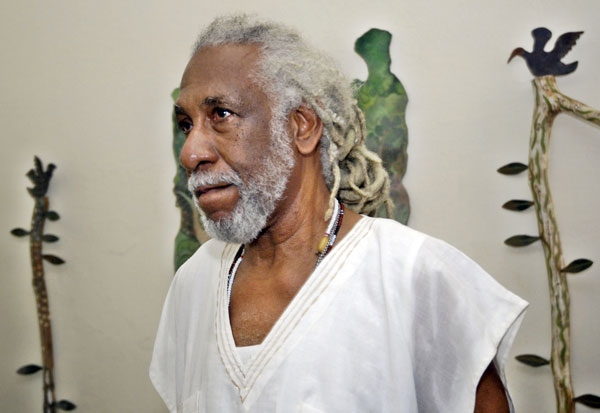
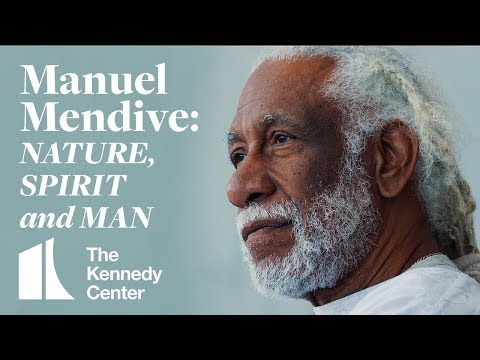
Born in Havana Cuba in 1944, Manuel Mendive (pronounced "men-dee-vey") is an Afro-Cuban painter, sculptor, and performance artist. His colorful, evocative paintings and carvings—as well as his dynamic performance and body art—pay tribute to the historic and religious art forms of Africa and Cuba. Altars, masks, and dance associated with Santería and other Yoruba-originated religions have inspired his work, which brings a contemporary insight into the history of slavery and African mythologies as they transformed the Caribbean Islands. In the 1970s, Mendive gained recognition for his unique combination of European and African styles in promoting Afro-Cuban culture. Through this fusion of European painting techniques and African imagery, Mendive explores the socio-cultural impacts of the African diaspora and the way in which the African culture arrived in Latin America as a result of the slave trade.About the Work
This print by Manuel Mendive captures the fusion of Latin American, European, and Cubo-African sensibilities that has shaped the lives and cultures of the African Disapora. Mendive’s work is grounded in a family history of Yoruba practices of Santeria, one of many African Diasporan religions characterized by iconographies and narratives that originate in traditional West African cultures. Mendive is often cited as the first Afro-American artist to derive his imagery from within the Santería community. Initially trained to use Western art techniques to paint in a social realism style, Mendive quickly rejected the strict style of realism and returned to his spiritual roots where humans and orishas (mediators between the human and spiritual realms) live side-by-side. Through his paintings, sculptures, and performances, Mendive is said to invoke áse (spelled aché in Cuba), a sacred ancestral energy and representation of the Supreme Power that unites the aesthetic vision of Africans and their descendants. Historian Roger Bastide describe áse as the collective consciousness for Africans in the Disapora that “renewed the vitality” of the symbols, values, and meanings that survived the Middle Passage. The fluid lines and sense of movement in Mendive’s work exemplifies how in West African culture the “fourth or time dimension is dominant… matter is only the vehicle, or the outward and visible expression, of energy or life force. Thus it is energy and not matter, dynamic and not static being, which is the true nature of things.”From the Artist
Artist Performances and Video Art
Visitor Reflections
Judith Bettleheim, Professor of Art History, Emerita San Francisco State University
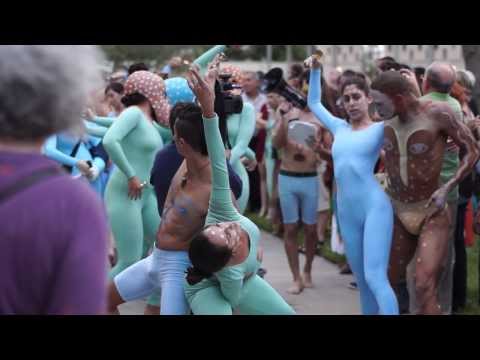
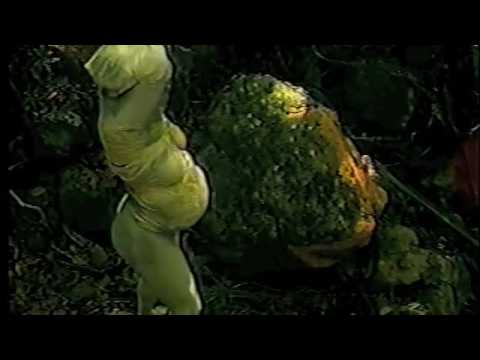
Every time I see a Manuel Mendive serigraph, I can’t help but recall all the misinformation that surrounds this artist. He is considered one of the most important figures in the AfroCubanismo movement, and he is often referred to as a “primitive” or “intuitive”. Yet his work is solidly based on his practice of the religion Santería, and he holds a degree from one of Cuba’s most important art schools. Santería is grounded in Yoruba based practices derived from the area of Africa now known as Nigeria.Mendive works simultaneously in two genres-his popular serigraphs (screen prints) and his groundbreaking public performances in which he paints the bodies of the dancers with imaginative and colorful configurations of motifs., emphasizing eyes, hands, and contoured flowing lines.
These same aesthetic formulas can be seen in the serigraph pictured here, dated 1995 and published in an edition of 30. And importantly Mendive has included imagery based on Santería. For example the merging of the turtle on the back of a human form is most often associated with the oricha Chango, a major spirit in the Santería pantheon. The tree rooted in the earth may reference the royal palm, not literally but metaphorically. Not every motif can be described iconographically. Many are evoked in a flat, colorful palette preferred by Mendive. In total, Manuel Mendive creates an atmosphere of personal spirituality.