The Self
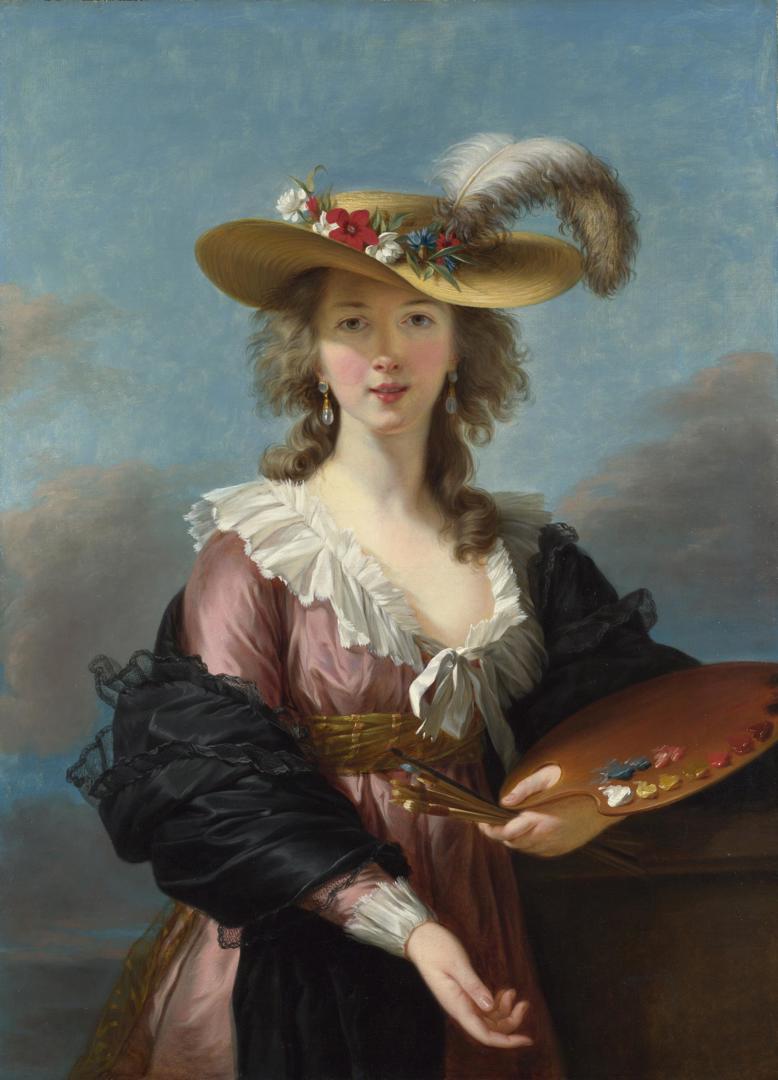
Lebrun’s Self-Portrait in a Straw Hat is a piece which emphasizes both her feminine beauty and her originality and skill as an artist. She used portraiture and dress as a means to assert herself among her male counterparts. In the portrait, Lebrun illustrates herself in a soft and lightweight dress, wearing a black shawl with a modest straw hat, her hair in a simple style. One of her hands holds a palette and her paintbrushes while her other hand is extended outwards towards the direction of the viewer.[1] This simple gesture, of one hand holding her palette as the other hand is extended outwards towards the viewer, is a gesture which speaks to the dualistic nature of Lebrun’s identity as both artist and woman.[2] In addition to her stance reaching out to the viewer, her styling of herself through the art of dress functions in her self-representation to emphasize her simple beauty and authenticity as opposed to artifice. As put forth by Elizabeth Wilson in her work Adorned in Dreams, the eighteenth century emphasized increasing notions of domesticity and the private sphere as it pertained to women and ideals of femininity. Notions of delicacy and fragility colored the perception of proper femininity for the bourgeoisie.[3] In contrast to this eighteenth century concept of fragile femininity contained to the domestic sphere, Lebrun depicts herself not only outside as opposed to contained in the domestic sphere, but her use of clothing in her portrait functions to depict her as a strong woman who is not constrained by eighteenth century fashion trends of tight corsets and superfluousness. She depicts herself wearing a straw hat as opposed to a softer fabric such as felt. This in of itself speaks to her using the art of dress to subtly craft an image of herself as an authentic and genuine woman who is choosing to negate traditional images of feminine dress. As opposed to showing herself in alignment with fashion trends of the bourgeoisie, she illustrates herself wearing modest colors with a looser fit than a corset style, and subtle ornamentation. In this way, Lebrun not only uses dress to establish herself as a sophisticated artist, but she is able to express her femininity as a modern and career-oriented woman. In this way, the power of dress is that it allows for the individual to disseminate subliminal notions regarding gender and the self.
[1] Elisabeth Vigee Lebrun, Self-Portrait in a Straw Hat, 1782, oil on canvas.
[2] Catherine R. Montfort, “Self-Portraits, Portraits of Self: Adélaïde Labille-Guiard and Elisabeth Vigée Lebrun, Women Artists of the Eighteenth Century,” Pacific Coast Philology 40, no. 1 (2005): 10-11.
[3] Wilson, Adorned in Dreams, 118.