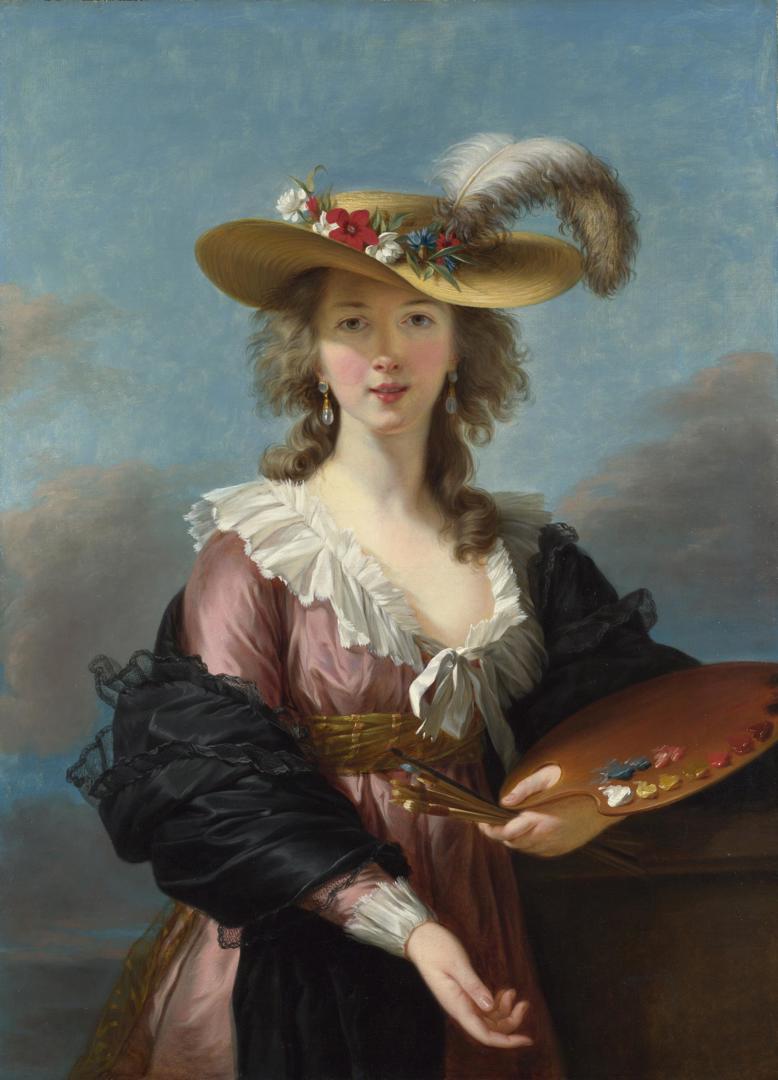
Motherhood
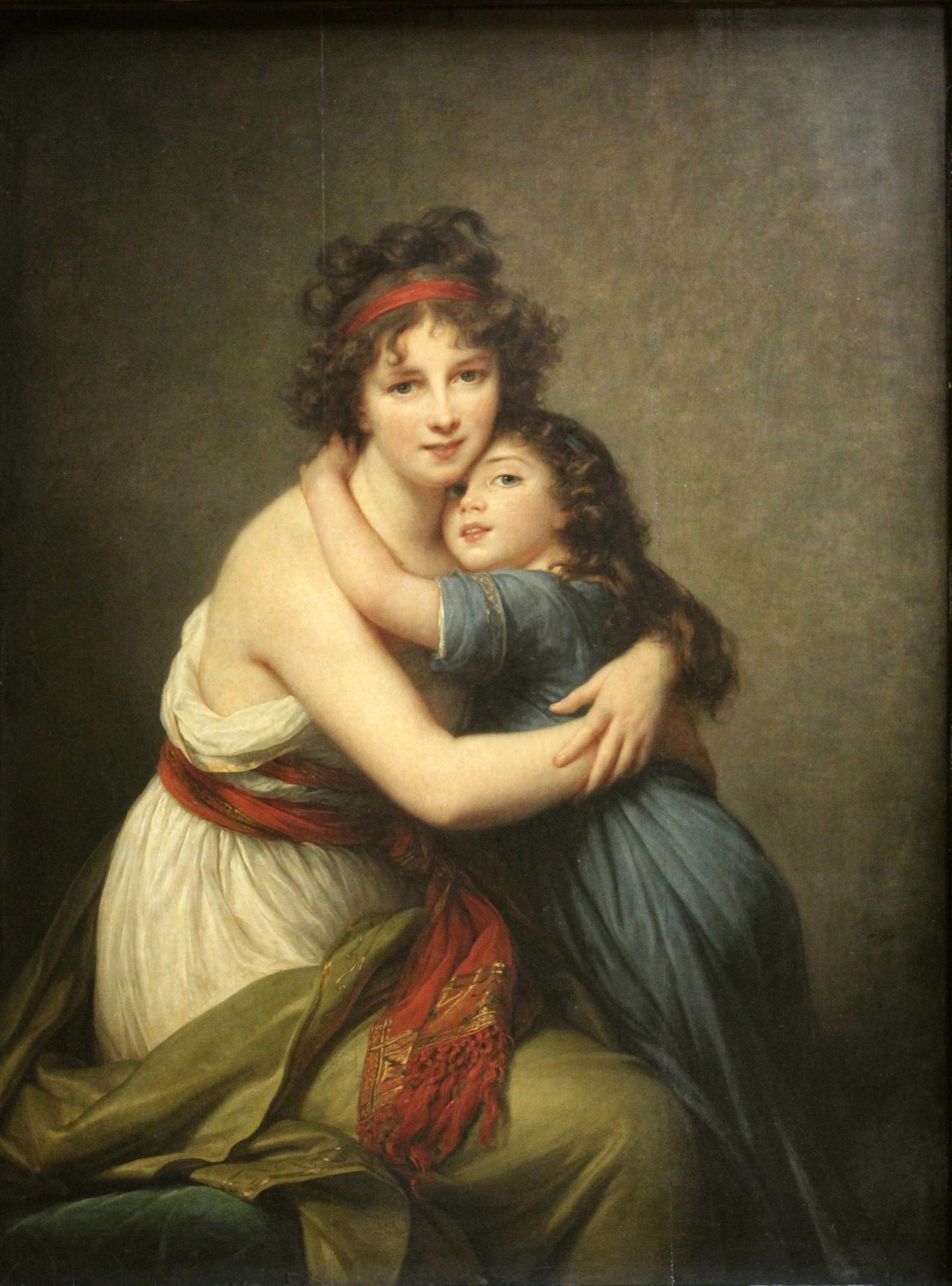
The theme of motherhood is one which Lebrun actively engages with in multiple of her works. Motherhood is inextricably interwoven into her identity and her self-presentation through portraiture. There are two particular works composed by Lebrun showing herself with her daughter, Julie which illustrate the complex relationship between self-presentation, motherhood, and dress. In both portraits with her daughter, Self-portrait with her Daughter, Julie from 1786 and Self-portrait with her Daughter, Julie from 1789, Lebrun depicts herself in a loving embrace with her daughter.[1] Lebrun’s decision to depict herself with her daughter in such a warm and maternal position is illustrative of Lebrun’s dichotomic position as both artist and mother. The art sphere is one which has been male-dominated and in this way, Lebrun’s success as a female artist illustrates her high degree of skill and talent. Lebrun’s minority position as a woman in the art world gives her work a uniqueness that her male counterparts lack. Rather than compose only portraits of herself, Lebrun explores her relationship with motherhood, self, and art through these self-portraits with her daughter. In her writing, Souvenirs, Lebrun relays how motherhood was the greatest joy of her life.[2] Yet, while she describes motherhood as the greatest joy, she goes on to describe her consumption with her art saying that throughout her pregnancy and even on the day she gave birth, “I was still in my studio, trying to work on my Venus Binding the Wings of Cupid in the intervals between labor pains.”[3] This reflects the dual nature of Lebrun’s passion: split between motherhood and art. The self-portraits of Lebrun with her daughter Julie from 1786 and 1789 are the physical and artistic manifestation of the syncretic relationship between motherhood and art.
Neo-Grecian-influenced Style of Dress
Additionally, Lebrun’s decision to dress both herself as well as her daughter in the style reminiscent of Neo-Grecian dress as opposed to the fashion trends of the late eighteenth century is indicative of her originality both as an artist and as a woman of the eighteenth century who is responding to the social shifts of her time and is using the art of dress to communicate her identity as an attentive mother. The thin and loose fabric worn by both Lebrun as well as her daughter Julie in these images allows for closer contact between daughter and mother. Had Lebrun fashioned herself and Julie in thicker, richer fabrics akin to the fashion trends of eighteenth-century France, the image would not feel as personal and maternal since a thicker barrier would be present between mother and child. Additionally, her decision to depict herself in light fabrics which cling to her soft feminine curves is indicative of Lebrun’s intimate mothering style wherein she is very much involved in her daughter’s life. As a child herself, Lebrun was raised by a wet nurse for the first five years of her life as was the custom for children of the bourgeoisie under the Old Regime of France.[4] This common cultural phenomenon of a detached mothering style wherein French mothers would use wet nurses is in stark contrast to the depiction of motherhood as constructed by Lebrun in both her self portraits with her daughter. Lebrun uses the nuances of dress in order to present subliminal notions of her approach to motherhood. The Neo-Grecian reminiscent style of dress chosen by Lebrun in both these portraits functions to additionally emphasize her femininity. In referencing classical notions of dress and femininity, Lebrun uses clothing to align herself with classical notions of natural feminine beauty emphasizing soft curves, a lack of artifice, and the showing of skin.
As put forth by E. Claire Cage in her article, “The Sartorial Self: Neoclassical Fashion and Gender Identity in France, 1797-1804,” the phenomenon of Neoclassical fashion was a highly gendered one which centered on women.[5] The thin fabrics akin to Neo-Grecian style of dress functioned to symbolically and literally liberate the female body and breasts. This type of dress which derived from the Greek classical past not only promoted ideas regarding nature, but also essentialized notions of motherhood within femininity.[6] Neoclassical dress also functioned to act in a political context in which it acted in opposition to ideals put forth by the Old Regime of France. Neoclassical dress in this way represented notions of nature, simplicity, and goodness which functioned to respond to the tense political and artifice-filled society of France in the late eighteenth century.[7]
For Lebrun then, her use of Neoclassical-reminiscent dress in her two self portraits with her daughter function to simultaneously respond to the tense political and social climate of her time in French society while also decorating her not-self in a way which communicates her views on motherhood and femininity which contrast those of the bourgeoisie notions of motherhood.
[1] Elisabeth Vigee Lebrun, Self-Portrait with her Daughter, Julie, 1786, oil on canvas; Elisabeth Vigee Lebrun, Self-Portrait with her Daughter, Julie, 1789, oil on canvas.
[2] Angela Rosenthal, “Infant Academies and the Childhood of Art: Elisabeth Vigée-Lebrun’s ‘Julie with a Mirror,’” Eighteenth-Century Studies 37, no. 4 (2004): 619.
[3] Lebrun qtd. in Angela Rosenthal, “Infant Academies and the Childhood of Art: Elisabeth Vigée-Lebrun’s ‘Julie with a Mirror,’” Eighteenth-Century Studies 37, no. 4 (2004): 620.
[4]May Gita, Elisabeth Vigée Le Brun: The Odyssey of an Artist in an Age of Revolution, Yale University Press, 2005, 11.
[5] E. Claire Cage, “The Sartorial Self: Neoclassical Fashion and Gender Identity in France, 1797-1804.” Eighteenth-Century Studies 42, no. 2 (2009): 196.
[6] E. Claire Cage, “The Sartorial Self: Neoclassical Fashion and Gender Identity in France, 1797-1804,” 197.
[7] E. Claire Cage, “The Sartorial Self: Neoclassical Fashion and Gender Identity in France, 1797-1804,” 196.