Japanese American Agency and the Superman Controversy
1 media/background-generic-11.png media/Sup12reduced_Page_1.jpg 2023-07-14T19:54:33+00:00 Fiona Bumgarner 649808186eb775a94c17328c7e78608b1777fc57 156 16 plain 2023-12-15T21:52:57+00:00 Jessica Bocinski a602570e86f7a6936e40ab07e0fddca6eccf4e9bPage
| resource | rdf:resource | https://scalar.chapman.edu/scalar/imagesandimaginings/japanese-american-agency-and-the-superman-controversy |
| type | rdf:type | http://scalar.usc.edu/2012/01/scalar-ns#Composite |
| is live | scalar:isLive | 1 |
| background | scalar:background | media/background-generic-11.png |
| banner | scalar:banner | media/Sup12reduced_Page_1.jpg |
| was attributed to | prov:wasAttributedTo | https://scalar.chapman.edu/scalar/imagesandimaginings/users/290 |
| created | dcterms:created | 2023-07-14T19:54:33+00:00 |
Version 16
| resource | rdf:resource | https://scalar.chapman.edu/scalar/imagesandimaginings/japanese-american-agency-and-the-superman-controversy.16 |
| versionnumber | ov:versionnumber | 16 |
| title | dcterms:title | Japanese American Agency and the Superman Controversy |
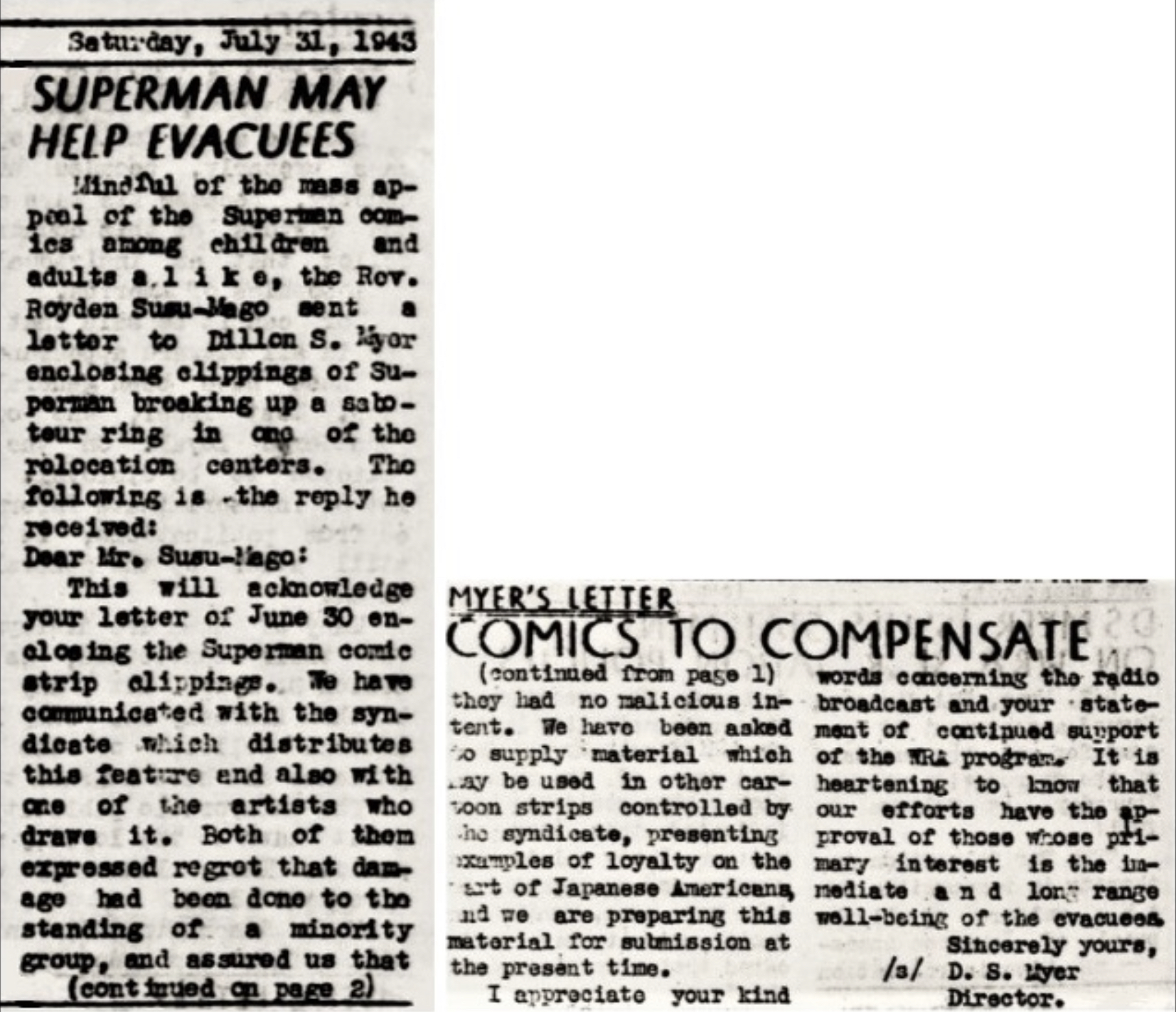
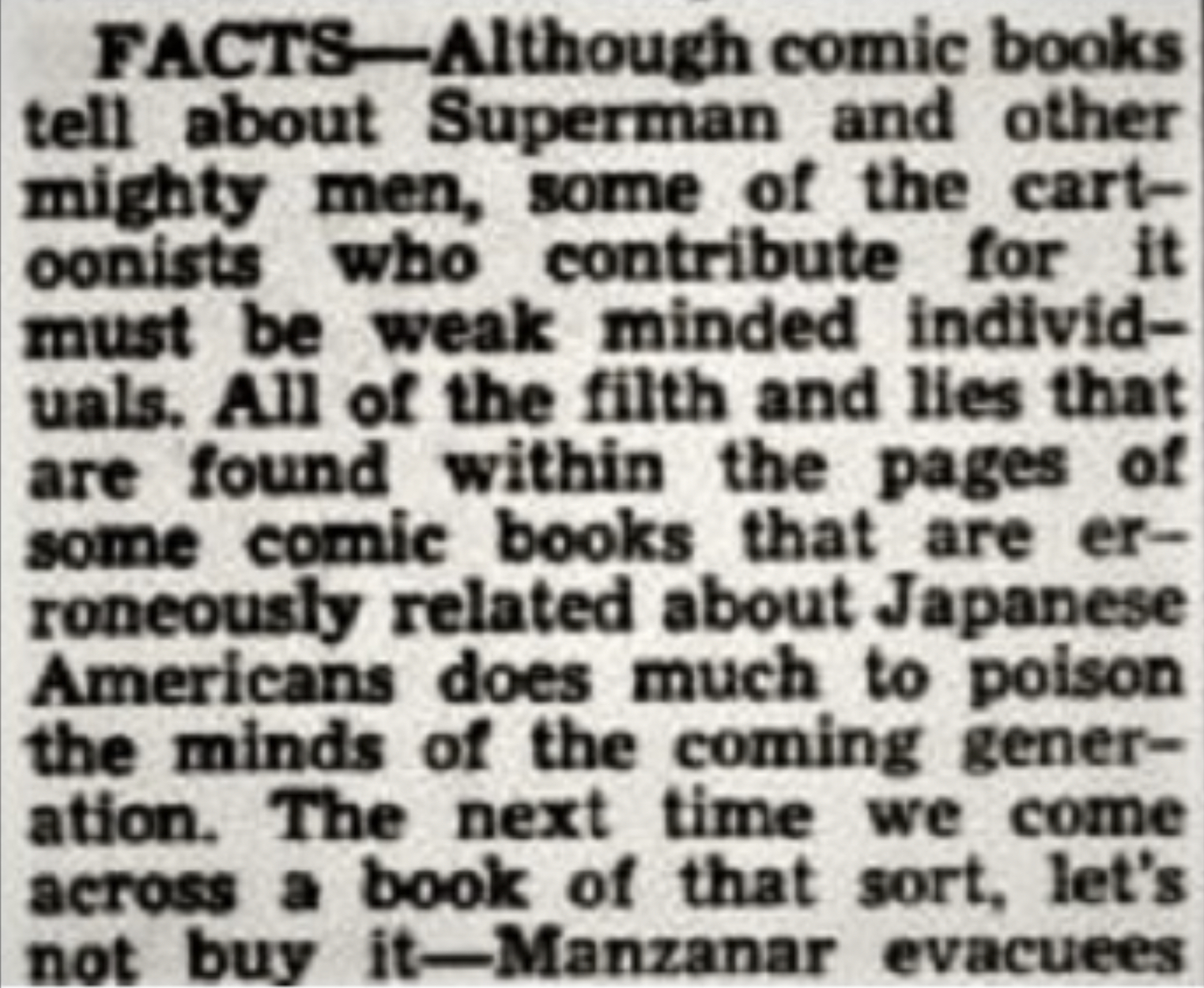
| content | sioc:content | The controversy surrounding the 1943 Superman comic series, Sneer Strikes, shows that both the Japanese American community and the United States Government were aware of the power of comics to influence public opinion. Japanese American internees across the country responded to the Superman series in the camp newspapers they created. These groups did not passively accept the racist imagery being used to villainize their community.
Their outcries were supported by some Black-owned newspapers and a handful of local newspapers, including the Des Moines Register, which published an article titled "Unfavorable Comment Voiced on Superman." It read: "I fear that [Superman's] present adventure in the Japanese relocation camp cannot help but create misunderstanding and unfounded prejudice among readers."
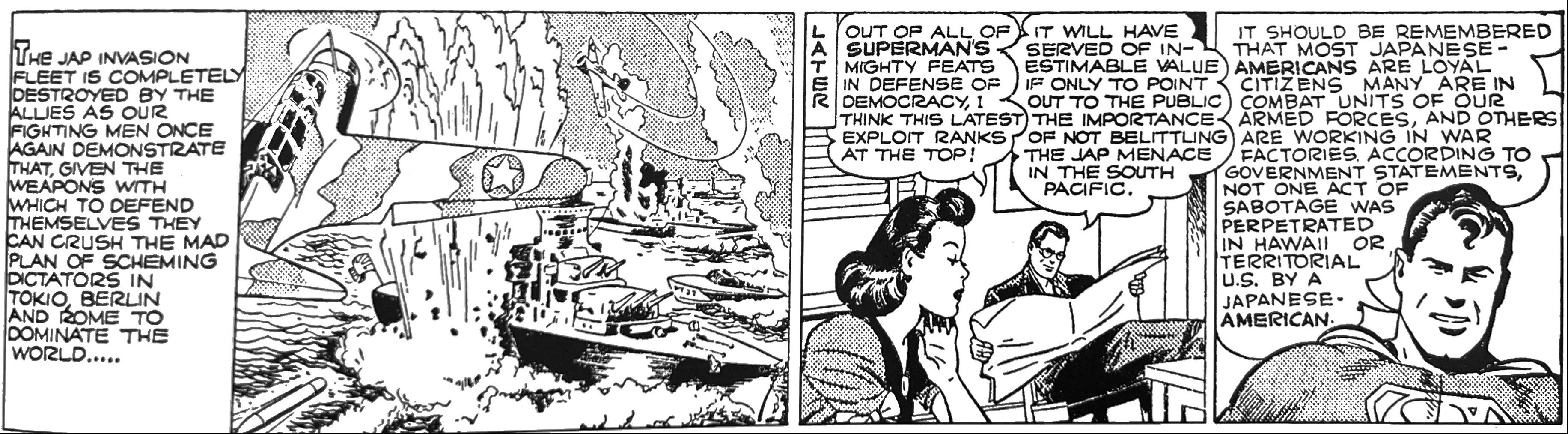
It might seem strange that the WRA (War Relocation Authority) would support the Japanese American community's critique of the Superman series, but it served their own interests as well. The representation of Japanese saboteurs plotting in camp in the Superman comic made the entire incarceration program look like a failure - like the government had not done a good job of protecting the American public from "disloyal" Japanese Americans. The very images that the government used to justify the incarceration of Japanese Americans now made their own program look like a failure. To gain back the good-will of the government, the Superman creators added an additional panel to the end of the series. This panel, which does not match the rest of the story-line, says "It should be remembered that most Japanese-Americans are loyal citizens... According to government statements, not one act of sabotage was perpetrated in Hawaii or territorial U.S. by a Japanese-American."
Want to Learn More? Let's Talk About It!
The controversy surrounding the 1943 Superman comic series, Sneer Strikes, shows that both the Japanese American community and the United States Government were aware of the power of comics to influence public opinion.
Their outcries were supported by some Black-owned newspapers and a handful of local newspapers, including the Des Moines Register, which published an article titled "Unfavorable Comment Voiced on Superman." It read: "I fear that [Superman's] present adventure in the Japanese relocation camp cannot help but create misunderstanding and unfounded prejudice among readers."
It might seem strange that the WRA (War Relocation Authority) would support the Japanese American community's critique of the Superman series, but it served their own interests as well. The representation of Japanese saboteurs plotting in camp in the Superman comic made the entire incarceration program look like a failure - like the government had not done a good job of protecting the American public from "disloyal" Japanese Americans. The very images that the government used to justify the incarceration of Japanese Americans now made their own program look like a failure. To gain back the good-will of the government, the Superman creators added an additional panel to the end of the series. This panel, which does not match the rest of the story-line, says "It should be remembered that most Japanese-Americans are loyal citizens... According to government statements, not one act of sabotage was perpetrated in Hawaii or territorial U.S. by a Japanese-American."
Want to Learn More? Let's Talk About It!
|
| default view | scalar:defaultView | plain |
| was attributed to | prov:wasAttributedTo | https://scalar.chapman.edu/scalar/imagesandimaginings/users/3 |
| created | dcterms:created | 2023-12-15T21:52:57+00:00 |
| type | rdf:type | http://scalar.usc.edu/2012/01/scalar-ns#Version |
Version 15
| resource | rdf:resource | https://scalar.chapman.edu/scalar/imagesandimaginings/japanese-american-agency-and-the-superman-controversy.15 |
| versionnumber | ov:versionnumber | 15 |
| title | dcterms:title | Japanese American Agency and the Superman Controversy |
| content | sioc:content | The controversy surrounding the 1943 Superman comic series, Sneer Strikes, shows that both the Japanese American community and the United States Government were aware of the power of comics to influence public opinion. Listen to Gordon H. Chang, Professor of History at Stanford University, podcast episode where he discusses the effect of Superman on the Japanese American Incarceration. Japanese American internees across the country responded to the Superman series in the camp newspapers they created. These groups did not passively accept the racist imagery being used to villainize their community.
Their outcries were supported by some Black-owned newspapers and a handful of local newspapers, including the Des Moines Register, which published an article titled "Unfavorable Comment Voiced on Superman." It read: "I fear that [Superman's] present adventure in the Japanese relocation camp cannot help but create misunderstanding and unfounded prejudice among readers."
It might seem strange that the WRA (War Relocation Authority) would support the Japanese American community's critique of the Superman series, but it served their own interests as well. The representation of Japanese saboteurs plotting in camp in the Superman comic made the entire incarceration program look like a failure - like the government had not done a good job of protecting the American public from "disloyal" Japanese Americans. The very images that the government used to justify the incarceration of Japanese Americans now made their own program look like a failure. To gain back the good-will of the government, the Superman creators added an additional panel to the end of the series. This panel, which does not match the rest of the story-line, says "It should be remembered that most Japanese-Americans are loyal citizens... According to government statements, not one act of sabotage was perpetrated in Hawaii or territorial U.S. by a Japanese-American."
Let's Talk About It!
The controversy surrounding the 1943 Superman comic series, Sneer Strikes, shows that both the Japanese American community and the United States Government were aware of the power of comics to influence public opinion.
Their outcries were supported by some Black-owned newspapers and a handful of local newspapers, including the Des Moines Register, which published an article titled "Unfavorable Comment Voiced on Superman." It read: "I fear that [Superman's] present adventure in the Japanese relocation camp cannot help but create misunderstanding and unfounded prejudice among readers."
It might seem strange that the WRA (War Relocation Authority) would support the Japanese American community's critique of the Superman series, but it served their own interests as well. The representation of Japanese saboteurs plotting in camp in the Superman comic made the entire incarceration program look like a failure - like the government had not done a good job of protecting the American public from "disloyal" Japanese Americans. The very images that the government used to justify the incarceration of Japanese Americans now made their own program look like a failure. To gain back the good-will of the government, the Superman creators added an additional panel to the end of the series. This panel, which does not match the rest of the story-line, says "It should be remembered that most Japanese-Americans are loyal citizens... According to government statements, not one act of sabotage was perpetrated in Hawaii or territorial U.S. by a Japanese-American."
Let's Talk About It!
|
| default view | scalar:defaultView | plain |
| was attributed to | prov:wasAttributedTo | https://scalar.chapman.edu/scalar/imagesandimaginings/users/3 |
| created | dcterms:created | 2023-12-15T18:59:45+00:00 |
| type | rdf:type | http://scalar.usc.edu/2012/01/scalar-ns#Version |
Version 14
| resource | rdf:resource | https://scalar.chapman.edu/scalar/imagesandimaginings/japanese-american-agency-and-the-superman-controversy.14 |
| versionnumber | ov:versionnumber | 14 |
| title | dcterms:title | Japanese American Agency and the Superman Controversy |
| content | sioc:content | The controversy surrounding the 1943 Superman comic series, Sneer Strikes, shows that both the Japanese American community and the United States Government were aware of the power of comics to influence public opinion. Listen to Gordon H. Chang, Professor of History at Stanford University, podcast episode where he discusses the affect of Superman on the Japanese American Incarceration. Japanese American internees across the country responded to the Superman series in the camp newspapers they created. These groups did not passively accept the racist imagery being used to villainize their community.
Their outcries were supported by some Black-owned newspapers and a handful of local newspapers, including the Des Moines Register, which published an article titled "Unfavorable Comment Voiced on Superman." It read: "I fear that [Superman's] present adventure in the Japanese relocation camp cannot help but create misunderstanding and unfounded prejudice among readers."
It might seem strange that the WRA (War Relocation Authority) would support the Japanese American community's critique of the Superman series, but it served their own interests as well. The representation of Japanese saboteurs plotting in camp in the Superman comic made the entire incarceration program look like a failure - like the government had not done a good job of protecting the American public from "disloyal" Japanese Americans. The very images that the government used to justify the incarceration of Japanese Americans now made their own program look like a failure. To gain back the good-will of the government, the Superman creators added an additional panel to the end of the series. This panel, which does not match the rest of the story-line, says "It should be remembered that most Japanese-Americans are loyal citizens... According to government statements, not one act of sabotage was perpetrated in Hawaii or territorial U.S. by a Japanese-American."
Let's Talk About It!
The controversy surrounding the 1943 Superman comic series, Sneer Strikes, shows that both the Japanese American community and the United States Government were aware of the power of comics to influence public opinion.
Their outcries were supported by some Black-owned newspapers and a handful of local newspapers, including the Des Moines Register, which published an article titled "Unfavorable Comment Voiced on Superman." It read: "I fear that [Superman's] present adventure in the Japanese relocation camp cannot help but create misunderstanding and unfounded prejudice among readers."
It might seem strange that the WRA (War Relocation Authority) would support the Japanese American community's critique of the Superman series, but it served their own interests as well. The representation of Japanese saboteurs plotting in camp in the Superman comic made the entire incarceration program look like a failure - like the government had not done a good job of protecting the American public from "disloyal" Japanese Americans. The very images that the government used to justify the incarceration of Japanese Americans now made their own program look like a failure. To gain back the good-will of the government, the Superman creators added an additional panel to the end of the series. This panel, which does not match the rest of the story-line, says "It should be remembered that most Japanese-Americans are loyal citizens... According to government statements, not one act of sabotage was perpetrated in Hawaii or territorial U.S. by a Japanese-American."
Let's Talk About It!
|
| default view | scalar:defaultView | plain |
| was attributed to | prov:wasAttributedTo | https://scalar.chapman.edu/scalar/imagesandimaginings/users/3 |
| created | dcterms:created | 2023-12-15T18:59:21+00:00 |
| type | rdf:type | http://scalar.usc.edu/2012/01/scalar-ns#Version |
Version 13
| resource | rdf:resource | https://scalar.chapman.edu/scalar/imagesandimaginings/japanese-american-agency-and-the-superman-controversy.13 |
| versionnumber | ov:versionnumber | 13 |
| title | dcterms:title | Japanese American Agency and the Superman Controversy |
| content | sioc:content | The controversy surrounding the 1943 Superman comic series, Sneer Strikes, shows that both the Japanese American community and the United States Government were aware of the power of comics to influence public opinion. Japanese American internees across the country responded to the Superman series in the camp newspapers they created. These groups did not passively accept the racist imagery being used to villainize their community.
Their outcries were supported by some Black-owned newspapers and a handful of local newspapers, including the Des Moines Register, which published an article titled "Unfavorable Comment Voiced on Superman." It read: "I fear that [Superman's] present adventure in the Japanese relocation camp cannot help but create misunderstanding and unfounded prejudice among readers."
It might seem strange that the WRA (War Relocation Authority) would support the Japanese American community's critique of the Superman series, but it served their own interests as well. The representation of Japanese saboteurs plotting in camp in the Superman comic made the entire incarceration program look like a failure - like the government had not done a good job of protecting the American public from "disloyal" Japanese Americans. The very images that the government used to justify the incarceration of Japanese Americans now made their own program look like a failure. To gain back the good-will of the government, the Superman creators added an additional panel to the end of the series. This panel, which does not match the rest of the story-line, says "It should be remembered that most Japanese-Americans are loyal citizens... According to government statements, not one act of sabotage was perpetrated in Hawaii or territorial U.S. by a Japanese-American."
Let's Talk About It!
The controversy surrounding the 1943 Superman comic series, Sneer Strikes, shows that both the Japanese American community and the United States Government were aware of the power of comics to influence public opinion.
Their outcries were supported by some Black-owned newspapers and a handful of local newspapers, including the Des Moines Register, which published an article titled "Unfavorable Comment Voiced on Superman." It read: "I fear that [Superman's] present adventure in the Japanese relocation camp cannot help but create misunderstanding and unfounded prejudice among readers."
It might seem strange that the WRA (War Relocation Authority) would support the Japanese American community's critique of the Superman series, but it served their own interests as well. The representation of Japanese saboteurs plotting in camp in the Superman comic made the entire incarceration program look like a failure - like the government had not done a good job of protecting the American public from "disloyal" Japanese Americans. The very images that the government used to justify the incarceration of Japanese Americans now made their own program look like a failure. To gain back the good-will of the government, the Superman creators added an additional panel to the end of the series. This panel, which does not match the rest of the story-line, says "It should be remembered that most Japanese-Americans are loyal citizens... According to government statements, not one act of sabotage was perpetrated in Hawaii or territorial U.S. by a Japanese-American."
Let's Talk About It!
|
| default view | scalar:defaultView | plain |
| was attributed to | prov:wasAttributedTo | https://scalar.chapman.edu/scalar/imagesandimaginings/users/222 |
| created | dcterms:created | 2023-07-26T23:42:05+00:00 |
| type | rdf:type | http://scalar.usc.edu/2012/01/scalar-ns#Version |
Version 12
| resource | rdf:resource | https://scalar.chapman.edu/scalar/imagesandimaginings/japanese-american-agency-and-the-superman-controversy.12 |
| versionnumber | ov:versionnumber | 12 |
| title | dcterms:title | Japanese American Agency and the Superman Controversy |
| content | sioc:content | The controversy surrounding the 1943 Superman comic series, Sneer Strikes, shows that both the Japanese American community and the United States Government were aware of the power of comics to influence public opinion. Japanese American internees across the country responded to the Superman series in the camp newspapers they created. These groups did not passively accept the racist imagery being used to villainize their community.
Their outcries were supported by some Black-owned newspapers and a handful of local newspapers, including the Des Moines Register, which published an article titled "Unfavorable Comment Voiced on Superman." It read: "I fear that [Superman's] present adventure in the Japanese relocation camp cannot help but create misunderstanding and unfounded prejudice among readers."
It might seem strange that the WRA (War Relocation Authority) would support the Japanese American community's critique of the Superman series, but it served their own interests as well. The representation of Japanese saboteurs plotting in camp in the Superman comic made the entire incarceration program look like a failure - like the government had not done a good job of protecting the American public from "disloyal" Japanese Americans. The very images that the government used to justify the incarceration of Japanese Americans now made their own program look like a failure. To gain back the good-will of the government, the Superman creators added an additional panel to the end of the series. This panel, which does not match the rest of the story-line, says "It should be remembered that most Japanese-Americans are loyal citizens... According to government statements, not one act of sabotage was perpetrated in Hawaii or territorial U.S. by a Japanese-American."
Let's Talk About It!
The controversy surrounding the 1943 Superman comic series, Sneer Strikes, shows that both the Japanese American community and the United States Government were aware of the power of comics to influence public opinion.
Their outcries were supported by some Black-owned newspapers and a handful of local newspapers, including the Des Moines Register, which published an article titled "Unfavorable Comment Voiced on Superman." It read: "I fear that [Superman's] present adventure in the Japanese relocation camp cannot help but create misunderstanding and unfounded prejudice among readers."
It might seem strange that the WRA (War Relocation Authority) would support the Japanese American community's critique of the Superman series, but it served their own interests as well. The representation of Japanese saboteurs plotting in camp in the Superman comic made the entire incarceration program look like a failure - like the government had not done a good job of protecting the American public from "disloyal" Japanese Americans. The very images that the government used to justify the incarceration of Japanese Americans now made their own program look like a failure. To gain back the good-will of the government, the Superman creators added an additional panel to the end of the series. This panel, which does not match the rest of the story-line, says "It should be remembered that most Japanese-Americans are loyal citizens... According to government statements, not one act of sabotage was perpetrated in Hawaii or territorial U.S. by a Japanese-American."
Let's Talk About It!
|
| default view | scalar:defaultView | plain |
| was attributed to | prov:wasAttributedTo | https://scalar.chapman.edu/scalar/imagesandimaginings/users/3 |
| created | dcterms:created | 2023-07-17T18:26:30+00:00 |
| type | rdf:type | http://scalar.usc.edu/2012/01/scalar-ns#Version |
Version 11
| resource | rdf:resource | https://scalar.chapman.edu/scalar/imagesandimaginings/japanese-american-agency-and-the-superman-controversy.11 |
| versionnumber | ov:versionnumber | 11 |
| title | dcterms:title | Japanese American Agency and the Superman Controversy |
| content | sioc:content | The controversy surrounding the 1943 Superman comic series, Sneer Strikes, shows that both the Japanese American community and the United States Government were aware of the power of comics to influence public opinion. Japanese American internees across the country responded to the Superman series in the camp newspapers they created. These groups did not passively accept the racist imagery being used to villainize their community.
Their outcries were supported by some Black-owned newspapers and a handful of local newspapers, including the Des Moines Register, which published an article titled "Unfavorable Comment Voiced on Superman." It read: "I fear that [Superman's] present adventure in the Japanese relocation camp cannot help but create misunderstanding and unfounded prejudice among readers."
It might seem strange that the WRA (War Relocation Authority) would support the Japanese American community's critique of the Superman series, but it served their own interests as well. The representation of Japanese saboteurs plotting in camp in the Superman comic made the entire incarceration program look like a failure - like the government had not done a good job of protecting the American public from "disloyal" Japanese Americans. The very images that the government used to justify the incarceration of Japanese Americans now made their own program look like a failure. To gain back the good-will of the government, the Superman creators added an additional panel to the end of the series. This panel, which does not match the rest of the story-line, says "It should be remembered that most Japanese-Americans are loyal citizens... According to government statements, not one act of sabotage was perpetrated in Hawaii or territorial U.S. by a Japanese-American."
Let's Talk About It!
The controversy surrounding the 1943 Superman comic series, Sneer Strikes, shows that both the Japanese American community and the United States Government were aware of the power of comics to influence public opinion.
Their outcries were supported by some Black-owned newspapers and a handful of local newspapers, including the Des Moines Register, which published an article titled "Unfavorable Comment Voiced on Superman." It read: "I fear that [Superman's] present adventure in the Japanese relocation camp cannot help but create misunderstanding and unfounded prejudice among readers."
It might seem strange that the WRA (War Relocation Authority) would support the Japanese American community's critique of the Superman series, but it served their own interests as well. The representation of Japanese saboteurs plotting in camp in the Superman comic made the entire incarceration program look like a failure - like the government had not done a good job of protecting the American public from "disloyal" Japanese Americans. The very images that the government used to justify the incarceration of Japanese Americans now made their own program look like a failure. To gain back the good-will of the government, the Superman creators added an additional panel to the end of the series. This panel, which does not match the rest of the story-line, says "It should be remembered that most Japanese-Americans are loyal citizens... According to government statements, not one act of sabotage was perpetrated in Hawaii or territorial U.S. by a Japanese-American."
Let's Talk About It!
|
| default view | scalar:defaultView | plain |
| was attributed to | prov:wasAttributedTo | https://scalar.chapman.edu/scalar/imagesandimaginings/users/3 |
| created | dcterms:created | 2023-07-17T18:26:03+00:00 |
| type | rdf:type | http://scalar.usc.edu/2012/01/scalar-ns#Version |
Version 10
| resource | rdf:resource | https://scalar.chapman.edu/scalar/imagesandimaginings/japanese-american-agency-and-the-superman-controversy.10 |
| versionnumber | ov:versionnumber | 10 |
| title | dcterms:title | Japanese American Agency and the Superman Controversy |
| content | sioc:content | The controversy surrounding the 1943 Superman comic series, Sneer Strikes, shows that both the Japanese American community and the United States Government were aware of the power of comics to influence public opinion. Japanese American internees across the country responded to the Superman series in the camp newspapers they created. These groups did not passively accept the racist imagery being used to villainize their community.
Their outcries were supported by some Black-owned newspapers and a handful of local newspapers, including the Des Moines Register, which published an article titled "Unfavorable Comment Voiced on Superman." It read: "I fear that [Superman's] present adventure in the Japanese relocation camp cannot help but create misunderstanding and unfounded prejudice among readers."
It might seem strange that the WRA (War Relocation Authority) would support the Japanese American community's critique of the Superman series, but it served their own interests as well. The representation of Japanese saboteurs plotting in camp in the Superman comic made the entire incarceration program look like a failure - like the government had not done a good job of protecting the American public from "disloyal" Japanese Americans. The very images that the government used to justify the incarceration of Japanese Americans now made their own program look like a failure. To gain back the good-will of the government, the Superman creators added an additional panel to the end of the series. This panel, which does not match the rest of the story-line, says "It should be remembered that most Japanese-Americans are loyal citizens... According to government statements, not one act of sabotage was perpetrated in Hawaii or territorial U.S. by a Japanese-American."
Let's Talk About It!
The controversy surrounding the 1943 Superman comic series, Sneer Strikes, shows that both the Japanese American community and the United States Government were aware of the power of comics to influence public opinion.
Their outcries were supported by some Black-owned newspapers and a handful of local newspapers, including the Des Moines Register, which published an article titled "Unfavorable Comment Voiced on Superman." It read: "I fear that [Superman's] present adventure in the Japanese relocation camp cannot help but create misunderstanding and unfounded prejudice among readers."
It might seem strange that the WRA (War Relocation Authority) would support the Japanese American community's critique of the Superman series, but it served their own interests as well. The representation of Japanese saboteurs plotting in camp in the Superman comic made the entire incarceration program look like a failure - like the government had not done a good job of protecting the American public from "disloyal" Japanese Americans. The very images that the government used to justify the incarceration of Japanese Americans now made their own program look like a failure. To gain back the good-will of the government, the Superman creators added an additional panel to the end of the series. This panel, which does not match the rest of the story-line, says "It should be remembered that most Japanese-Americans are loyal citizens... According to government statements, not one act of sabotage was perpetrated in Hawaii or territorial U.S. by a Japanese-American."
Let's Talk About It!
|
| default view | scalar:defaultView | plain |
| was attributed to | prov:wasAttributedTo | https://scalar.chapman.edu/scalar/imagesandimaginings/users/3 |
| created | dcterms:created | 2023-07-17T18:25:42+00:00 |
| type | rdf:type | http://scalar.usc.edu/2012/01/scalar-ns#Version |
Version 9
| resource | rdf:resource | https://scalar.chapman.edu/scalar/imagesandimaginings/japanese-american-agency-and-the-superman-controversy.9 |
| versionnumber | ov:versionnumber | 9 |
| title | dcterms:title | Japanese American Agency and the Superman Controversy |
| content | sioc:content | The controversy surrounding the 1943 Superman comic series, Sneer Strikes, shows that both the Japanese American community and the United States Government were aware of the power of comics to influence public opinion. Japanese American internees across the country responded to the Superman series in the camp newspapers they created. These groups did not passively accept the racist imagery being used to villainize their community.
Their outcries were supported by some Black-owned newspapers and a handful of local newspapers, including the Des Moines Register, which published an article titled "Unfavorable Comment Voiced on Superman." It read: "I fear that [Superman's] present adventure in the Japanese relocation camp cannot help but create misunderstanding and unfounded prejudice among readers."
It might seem strange that the WRA (War Relocation Authority) would support the Japanese American community's critique of the Superman series, but it served their own interests as well. The representation of Japanese saboteurs plotting in camp in the Superman comic made the entire incarceration program look like a failure - like the government had not done a good job of protecting the American public from "disloyal" Japanese Americans. The very images that the government used to justify the incarceration of Japanese Americans now made their own program look like a failure. To gain back the good-will of the government, the Superman creators added an additional panel to the end of the series. This panel, which does not match the rest of the story-line, says "It should be remembered that most Japanese-Americans are loyal citizens... According to government statements, not one act of sabotage was perpetrated in Hawaii or territorial U.S. by a Japanese-American."
Let's Talk About It!
The controversy surrounding the 1943 Superman comic series, Sneer Strikes, shows that both the Japanese American community and the United States Government were aware of the power of comics to influence public opinion.
Their outcries were supported by some Black-owned newspapers and a handful of local newspapers, including the Des Moines Register, which published an article titled "Unfavorable Comment Voiced on Superman." It read: "I fear that [Superman's] present adventure in the Japanese relocation camp cannot help but create misunderstanding and unfounded prejudice among readers."
It might seem strange that the WRA (War Relocation Authority) would support the Japanese American community's critique of the Superman series, but it served their own interests as well. The representation of Japanese saboteurs plotting in camp in the Superman comic made the entire incarceration program look like a failure - like the government had not done a good job of protecting the American public from "disloyal" Japanese Americans. The very images that the government used to justify the incarceration of Japanese Americans now made their own program look like a failure. To gain back the good-will of the government, the Superman creators added an additional panel to the end of the series. This panel, which does not match the rest of the story-line, says "It should be remembered that most Japanese-Americans are loyal citizens... According to government statements, not one act of sabotage was perpetrated in Hawaii or territorial U.S. by a Japanese-American."
Let's Talk About It!
|
| default view | scalar:defaultView | plain |
| was attributed to | prov:wasAttributedTo | https://scalar.chapman.edu/scalar/imagesandimaginings/users/3 |
| created | dcterms:created | 2023-07-17T18:25:22+00:00 |
| type | rdf:type | http://scalar.usc.edu/2012/01/scalar-ns#Version |
Version 8
| resource | rdf:resource | https://scalar.chapman.edu/scalar/imagesandimaginings/japanese-american-agency-and-the-superman-controversy.8 |
| versionnumber | ov:versionnumber | 8 |
| title | dcterms:title | Japanese American Agency and the Superman Controversy |
| content | sioc:content | The controversy surrounding the 1943 Superman comic series, Sneer Strikes, shows that both the Japanese American community and the United States Government were aware of the power of comics to influence public opinion. Japanese American internees across the country responded to the Superman series in the camp newspapers they created. These groups did not passively accept the racist imagery being used to villainize their community.
Their outcries were supported by some Black-owned newspapers and a handful of local newspapers, including the Des Moines Register, which published an article titled "Unfavorable Comment Voiced on Superman." It read: "I fear that [Superman's] present adventure in the Japanese relocation camp cannot help but create misunderstanding and unfounded prejudice among readers."
It might seem strange that the WRA (War Relocation Authority) would support the Japanese American community's critique of the Superman series, but it served their own interests as well. The representation of Japanese saboteurs plotting in camp in the Superman comic made the entire incarceration program look like a failure - like the government had not done a good job of protecting the American public from "disloyal" Japanese Americans. The very images that the government used to justify the incarceration of Japanese Americans now made their own program look like a failure. To gain back the good-will of the government, the Superman creators added an additional panel to the end of the series. This panel, which does not match the rest of the story-line, says "It should be remembered that most Japanese-Americans are loyal citizens... According to government statements, not one act of sabotage was perpetrated in Hawaii or territorial U.S. by a Japanese-American."
Let's Talk About It!
The controversy surrounding the 1943 Superman comic series, Sneer Strikes, shows that both the Japanese American community and the United States Government were aware of the power of comics to influence public opinion.
Their outcries were supported by some Black-owned newspapers and a handful of local newspapers, including the Des Moines Register, which published an article titled "Unfavorable Comment Voiced on Superman." It read: "I fear that [Superman's] present adventure in the Japanese relocation camp cannot help but create misunderstanding and unfounded prejudice among readers."
It might seem strange that the WRA (War Relocation Authority) would support the Japanese American community's critique of the Superman series, but it served their own interests as well. The representation of Japanese saboteurs plotting in camp in the Superman comic made the entire incarceration program look like a failure - like the government had not done a good job of protecting the American public from "disloyal" Japanese Americans. The very images that the government used to justify the incarceration of Japanese Americans now made their own program look like a failure. To gain back the good-will of the government, the Superman creators added an additional panel to the end of the series. This panel, which does not match the rest of the story-line, says "It should be remembered that most Japanese-Americans are loyal citizens... According to government statements, not one act of sabotage was perpetrated in Hawaii or territorial U.S. by a Japanese-American."
Let's Talk About It!
|
| default view | scalar:defaultView | plain |
| was attributed to | prov:wasAttributedTo | https://scalar.chapman.edu/scalar/imagesandimaginings/users/3 |
| created | dcterms:created | 2023-07-17T18:24:19+00:00 |
| type | rdf:type | http://scalar.usc.edu/2012/01/scalar-ns#Version |
Version 7
| resource | rdf:resource | https://scalar.chapman.edu/scalar/imagesandimaginings/japanese-american-agency-and-the-superman-controversy.7 |
| versionnumber | ov:versionnumber | 7 |
| title | dcterms:title | Japanese American Agency and the Superman Controversy |
| content | sioc:content | The controversy surrounding the 1943 Superman comic series, Sneer Strikes, shows that both the Japanese American community and the United States Government were aware of the power of comics to influence public opinion. Japanese American internees across the country responded to the Superman series in the camp newspapers they created. These groups did not passively accept the racist imagery being used to villainize their community.
Their outcries were supported by some Black-owned newspapers and a handful of local newspapers, including the Des Moines Register, which published an article titled "Unfavorable Comment Voiced on Superman." It read: "I fear that [Superman's] present adventure in the Japanese relocation camp cannot help but create misunderstanding and unfounded prejudice among readers."
It might seem strange that the WRA (War Relocation Authority) would support the Japanese American community's critique of the Superman series, but it served their own interests as well. The representation of Japanese saboteurs plotting in camp in the Superman comic made the entire incarceration program look like a failure - like the government had not done a good job of protecting the American public from "disloyal" Japanese Americans. The very images that the government used to justify the incarceration of Japanese Americans now made their own program look like a failure. To gain back the good-will of the government, the Superman creators added an additional panel to the end of the series. This panel, which does not match the rest of the story-line, says "It should be remembered that most Japanese-Americans are loyal citizens... According to government statements, not one act of sabotage was perpetrated in Hawaii or territorial U.S. by a Japanese-American."
Let's Talk About It!
The controversy surrounding the 1943 Superman comic series, Sneer Strikes, shows that both the Japanese American community and the United States Government were aware of the power of comics to influence public opinion.
Their outcries were supported by some Black-owned newspapers and a handful of local newspapers, including the Des Moines Register, which published an article titled "Unfavorable Comment Voiced on Superman." It read: "I fear that [Superman's] present adventure in the Japanese relocation camp cannot help but create misunderstanding and unfounded prejudice among readers."
It might seem strange that the WRA (War Relocation Authority) would support the Japanese American community's critique of the Superman series, but it served their own interests as well. The representation of Japanese saboteurs plotting in camp in the Superman comic made the entire incarceration program look like a failure - like the government had not done a good job of protecting the American public from "disloyal" Japanese Americans. The very images that the government used to justify the incarceration of Japanese Americans now made their own program look like a failure. To gain back the good-will of the government, the Superman creators added an additional panel to the end of the series. This panel, which does not match the rest of the story-line, says "It should be remembered that most Japanese-Americans are loyal citizens... According to government statements, not one act of sabotage was perpetrated in Hawaii or territorial U.S. by a Japanese-American."
Let's Talk About It!
|
| default view | scalar:defaultView | plain |
| was attributed to | prov:wasAttributedTo | https://scalar.chapman.edu/scalar/imagesandimaginings/users/3 |
| created | dcterms:created | 2023-07-17T18:23:07+00:00 |
| type | rdf:type | http://scalar.usc.edu/2012/01/scalar-ns#Version |
Version 6
| resource | rdf:resource | https://scalar.chapman.edu/scalar/imagesandimaginings/japanese-american-agency-and-the-superman-controversy.6 |
| versionnumber | ov:versionnumber | 6 |
| title | dcterms:title | Japanese American Agency and the Superman Controversy |
| content | sioc:content | The controversy surrounding the 1943 Superman comic series, Sneer Strikes, shows that both the Japanese American community and the United States Government were aware of the power of comics to influence public opinion. Japanese American internees across the country responded to the Superman series in the camp newspapers they created. These groups did not passively accept the racist imagery being used to villainize their community.
Their outcries were supported by some Black-owned newspapers and a handful of local newspapers, including the Des Moines Register, which published an article titled "Unfavorable Comment Voiced on Superman." It read: "I fear that [Superman's] present adventure in the Japanese relocation camp cannot help but create misunderstanding and unfounded prejudice among readers."
It might seem strange that the WRA (War Relocation Authority) would support the Japanese American community's critique of the Superman series, but it served their own interests as well. The representation of Japanese saboteurs plotting in camp in the Superman comic made the entire incarceration program look like a failure - like the government had not done a good job of protecting the American public from "disloyal" Japanese Americans. The very images that the government used to justify the incarceration of Japanese Americans now made their own program look like a failure. To gain back the good-will of the government, the Superman creators added an additional panel to the end of the series. This panel, which does not match the rest of the story-line, says "It should be remembered that most Japanese-Americans are loyal citizens... According to government statements, not one act of sabotage was perpetrated in Hawaii or territorial U.S. by a Japanese-American."
Let's Talk About It!
The controversy surrounding the 1943 Superman comic series, Sneer Strikes, shows that both the Japanese American community and the United States Government were aware of the power of comics to influence public opinion.
Their outcries were supported by some Black-owned newspapers and a handful of local newspapers, including the Des Moines Register, which published an article titled "Unfavorable Comment Voiced on Superman." It read: "I fear that [Superman's] present adventure in the Japanese relocation camp cannot help but create misunderstanding and unfounded prejudice among readers."
It might seem strange that the WRA (War Relocation Authority) would support the Japanese American community's critique of the Superman series, but it served their own interests as well. The representation of Japanese saboteurs plotting in camp in the Superman comic made the entire incarceration program look like a failure - like the government had not done a good job of protecting the American public from "disloyal" Japanese Americans. The very images that the government used to justify the incarceration of Japanese Americans now made their own program look like a failure. To gain back the good-will of the government, the Superman creators added an additional panel to the end of the series. This panel, which does not match the rest of the story-line, says "It should be remembered that most Japanese-Americans are loyal citizens... According to government statements, not one act of sabotage was perpetrated in Hawaii or territorial U.S. by a Japanese-American."
Let's Talk About It!
|
| default view | scalar:defaultView | plain |
| was attributed to | prov:wasAttributedTo | https://scalar.chapman.edu/scalar/imagesandimaginings/users/290 |
| created | dcterms:created | 2023-07-14T20:08:16+00:00 |
| type | rdf:type | http://scalar.usc.edu/2012/01/scalar-ns#Version |
Version 5
| resource | rdf:resource | https://scalar.chapman.edu/scalar/imagesandimaginings/japanese-american-agency-and-the-superman-controversy.5 |
| versionnumber | ov:versionnumber | 5 |
| title | dcterms:title | Japanese American Agency and the Superman Controversy |
| content | sioc:content | The controversy surrounding the 1943 Superman comic series, Sneer Strikes, shows that both the Japanese American community and the United States Government were aware of the power of comics to influence public opinion. Japanese American internees across the country responded to the Superman series in the camp newspapers they created. These groups did not passively accept the racist imagery being used to villainize their community.
Their outcries were supported by some Black-owned newspapers and a handful of local newspapers, including the Des Moines Register, which published an article titled "Unfavorable Comment Voiced on Superman." It read: "I fear that [Superman's] present adventure in the Japanese relocation camp cannot help but create misunderstanding and unfounded prejudice among readers."
It might seem strange that the WRA (War Relocation Authority) would support the Japanese American community's critique of the Superman series, but it served their own interests as well. The representation of Japanese saboteurs plotting in camp in the Superman comic made the entire incarceration program look like a failure - like the government had not done a good job of protecting the American public from "disloyal" Japanese Americans. The very images that the government used to justify the incarceration of Japanese Americans now made their own program look like a failure. To gain back the good-will of the government, the Superman creators added an additional panel to the end of the series. This panel, which does not match the rest of the story-line, says "It should be remembered that most Japanese-Americans are loyal citizens... According to government statements, not one act of sabotage was perpetrated in Hawaii or territorial U.S. by a Japanese-American."
The controversy surrounding the 1943 Superman comic series, Sneer Strikes, shows that both the Japanese American community and the United States Government were aware of the power of comics to influence public opinion.
Their outcries were supported by some Black-owned newspapers and a handful of local newspapers, including the Des Moines Register, which published an article titled "Unfavorable Comment Voiced on Superman." It read: "I fear that [Superman's] present adventure in the Japanese relocation camp cannot help but create misunderstanding and unfounded prejudice among readers."
It might seem strange that the WRA (War Relocation Authority) would support the Japanese American community's critique of the Superman series, but it served their own interests as well. The representation of Japanese saboteurs plotting in camp in the Superman comic made the entire incarceration program look like a failure - like the government had not done a good job of protecting the American public from "disloyal" Japanese Americans. The very images that the government used to justify the incarceration of Japanese Americans now made their own program look like a failure. To gain back the good-will of the government, the Superman creators added an additional panel to the end of the series. This panel, which does not match the rest of the story-line, says "It should be remembered that most Japanese-Americans are loyal citizens... According to government statements, not one act of sabotage was perpetrated in Hawaii or territorial U.S. by a Japanese-American."
|
| default view | scalar:defaultView | plain |
| was attributed to | prov:wasAttributedTo | https://scalar.chapman.edu/scalar/imagesandimaginings/users/290 |
| created | dcterms:created | 2023-07-14T20:03:58+00:00 |
| type | rdf:type | http://scalar.usc.edu/2012/01/scalar-ns#Version |
Version 4
| resource | rdf:resource | https://scalar.chapman.edu/scalar/imagesandimaginings/japanese-american-agency-and-the-superman-controversy.4 |
| versionnumber | ov:versionnumber | 4 |
| title | dcterms:title | Japanese American Agency and the Superman Controversy |
| content | sioc:content | The controversy surrounding the 1943 Superman comic series, Sneer Strikes, shows that both the Japanese American community and the United States Government were aware of the power of comics to influence public opinion. Japanese American internees across the country responded to the Superman series in the camp newspapers they created. These groups did not passively accept the racist imagery being used to villainize their community.
Their outcries were supported by some Black-owned newspapers and a handful of local newspapers, including the Des Moines Register, which published an article titled "Unfavorable Comment Voiced on Superman." It read: "I fear that [Superman's] present adventure in the Japanese relocation camp cannot help but create misunderstanding and unfounded prejudice among readers."
It might seem strange that the WRA (War Relocation Authority) would support the Japanese American community's critique of the Superman series, but it served their own interests as well. The representation of Japanese saboteurs plotting in camp in the Superman comic made the entire incarceration program look like a failure - like the government had not done a good job of protecting the American public from "disloyal" Japanese Americans. The very images that the government used to justify the incarceration of Japanese Americans now made their own program look like a failure. To gain back the good-will of the government, the Superman creators added an additional panel to the end of the series. This panel, which does not match the rest of the story-line, says "It should be remembered that most Japanese-Americans are loyal citizens... According to government statements, not one act of sabotage was perpetrated in Hawaii or territorial U.S. by a Japanese-American."
The controversy surrounding the 1943 Superman comic series, Sneer Strikes, shows that both the Japanese American community and the United States Government were aware of the power of comics to influence public opinion.
Their outcries were supported by some Black-owned newspapers and a handful of local newspapers, including the Des Moines Register, which published an article titled "Unfavorable Comment Voiced on Superman." It read: "I fear that [Superman's] present adventure in the Japanese relocation camp cannot help but create misunderstanding and unfounded prejudice among readers."
It might seem strange that the WRA (War Relocation Authority) would support the Japanese American community's critique of the Superman series, but it served their own interests as well. The representation of Japanese saboteurs plotting in camp in the Superman comic made the entire incarceration program look like a failure - like the government had not done a good job of protecting the American public from "disloyal" Japanese Americans. The very images that the government used to justify the incarceration of Japanese Americans now made their own program look like a failure. To gain back the good-will of the government, the Superman creators added an additional panel to the end of the series. This panel, which does not match the rest of the story-line, says "It should be remembered that most Japanese-Americans are loyal citizens... According to government statements, not one act of sabotage was perpetrated in Hawaii or territorial U.S. by a Japanese-American."
|
| default view | scalar:defaultView | plain |
| was attributed to | prov:wasAttributedTo | https://scalar.chapman.edu/scalar/imagesandimaginings/users/290 |
| created | dcterms:created | 2023-07-14T20:02:18+00:00 |
| type | rdf:type | http://scalar.usc.edu/2012/01/scalar-ns#Version |
Version 3
| resource | rdf:resource | https://scalar.chapman.edu/scalar/imagesandimaginings/japanese-american-agency-and-the-superman-controversy.3 |
| versionnumber | ov:versionnumber | 3 |
| title | dcterms:title | Japanese American Agency and the Superman Controversy |
| content | sioc:content | The controversy surrounding the 1943 Superman comic series, Sneer Strikes, shows that both the Japanese American community and the United States Government were aware of the power of comics to influence public opinion. Japanese American internees across the country responded to the Superman series in the camp newspapers they created. These groups did not passively accept the racist imagery being used to villainize their community.
Their outcries were supported by some Black-owned newspapers and a handful of local newspapers, including the Des Moines Register, which published an article titled "Unfavorable Comment Voiced on Superman." It read: "I fear that [Superman's] present adventure in the Japanese relocation camp cannot help but create misunderstanding and unfounded prejudice among readers."
It might seem strange that the WRA (War Relocation Authority) would support the Japanese American community's critique of the Superman series, but it served their own interests as well. The representation of Japanese saboteurs plotting in camp in the Superman comic made the entire incarceration program look like a failure - like the government had not done a good job of protecting the American public from "disloyal" Japanese Americans. The very images that the government used to justify the incarceration of Japanese Americans now made their own program look like a failure. To gain back the good-will of the government, the Superman creators added an additional panel to the end of the series. This panel, which does not match the rest of the story-line, says "It should be remembered that most Japanese-Americans are loyal citizens... According to government statements, not one act of sabotage was perpetrated in Hawaii or territorial U.S. by a Japanese-American."
The controversy surrounding the 1943 Superman comic series, Sneer Strikes, shows that both the Japanese American community and the United States Government were aware of the power of comics to influence public opinion.
Their outcries were supported by some Black-owned newspapers and a handful of local newspapers, including the Des Moines Register, which published an article titled "Unfavorable Comment Voiced on Superman." It read: "I fear that [Superman's] present adventure in the Japanese relocation camp cannot help but create misunderstanding and unfounded prejudice among readers."
It might seem strange that the WRA (War Relocation Authority) would support the Japanese American community's critique of the Superman series, but it served their own interests as well. The representation of Japanese saboteurs plotting in camp in the Superman comic made the entire incarceration program look like a failure - like the government had not done a good job of protecting the American public from "disloyal" Japanese Americans. The very images that the government used to justify the incarceration of Japanese Americans now made their own program look like a failure. To gain back the good-will of the government, the Superman creators added an additional panel to the end of the series. This panel, which does not match the rest of the story-line, says "It should be remembered that most Japanese-Americans are loyal citizens... According to government statements, not one act of sabotage was perpetrated in Hawaii or territorial U.S. by a Japanese-American."
|
| default view | scalar:defaultView | plain |
| was attributed to | prov:wasAttributedTo | https://scalar.chapman.edu/scalar/imagesandimaginings/users/290 |
| created | dcterms:created | 2023-07-14T19:58:02+00:00 |
| type | rdf:type | http://scalar.usc.edu/2012/01/scalar-ns#Version |
Version 2
| resource | rdf:resource | https://scalar.chapman.edu/scalar/imagesandimaginings/japanese-american-agency-and-the-superman-controversy.2 |
| versionnumber | ov:versionnumber | 2 |
| title | dcterms:title | Japanese American Agency and the Superman Controversy |
| content | sioc:content | The controversy surrounding the 1943 Superman comic series, Sneer Strikes, shows that both the Japanese American community and the United States Government were aware of the power of comics to influence public opinion. Japanese American internees across the country responded to the Superman series in the camp newspapers they created. These groups did not passively accept the racist imagery being used to villainize their community.
Their outcries were supported by some Black-owned newspapers and a handful of local newspapers, including the Des Moines Register, which published an article titled "Unfavorable Comment Voiced on Superman." It read: "I fear that [Superman's] present adventure in the Japanese relocation camp cannot help but create misunderstanding and unfounded prejudice among readers."
It might seem strange that the WRA (War Relocation Authority) would support the Japanese American community's critique of the Superman series, but it served their own interests as well. The representation of Japanese saboteurs plotting in camp in the Superman comic made the entire incarceration program look like a failure - like the government had not done a good job of protecting the American public from "disloyal" Japanese Americans. The very images that the government used to justify the incarceration of Japanese Americans now made their own program look like a failure. To gain back the good-will of the government, the Superman creators added an additional panel to the end of the series. This panel, which does not match the rest of the story-line, says "It should be remembered that most Japanese-Americans are loyal citizens... According to government statements, not one act of sabotage was perpetrated in Hawaii or territorial U.S. by a Japanese-American."
The controversy surrounding the 1943 Superman comic series, Sneer Strikes, shows that both the Japanese American community and the United States Government were aware of the power of comics to influence public opinion.
Their outcries were supported by some Black-owned newspapers and a handful of local newspapers, including the Des Moines Register, which published an article titled "Unfavorable Comment Voiced on Superman." It read: "I fear that [Superman's] present adventure in the Japanese relocation camp cannot help but create misunderstanding and unfounded prejudice among readers."
It might seem strange that the WRA (War Relocation Authority) would support the Japanese American community's critique of the Superman series, but it served their own interests as well. The representation of Japanese saboteurs plotting in camp in the Superman comic made the entire incarceration program look like a failure - like the government had not done a good job of protecting the American public from "disloyal" Japanese Americans. The very images that the government used to justify the incarceration of Japanese Americans now made their own program look like a failure. To gain back the good-will of the government, the Superman creators added an additional panel to the end of the series. This panel, which does not match the rest of the story-line, says "It should be remembered that most Japanese-Americans are loyal citizens... According to government statements, not one act of sabotage was perpetrated in Hawaii or territorial U.S. by a Japanese-American."
|
| default view | scalar:defaultView | plain |
| was attributed to | prov:wasAttributedTo | https://scalar.chapman.edu/scalar/imagesandimaginings/users/290 |
| created | dcterms:created | 2023-07-14T19:57:25+00:00 |
| type | rdf:type | http://scalar.usc.edu/2012/01/scalar-ns#Version |
Version 1
| resource | rdf:resource | https://scalar.chapman.edu/scalar/imagesandimaginings/japanese-american-agency-and-the-superman-controversy.1 |
| versionnumber | ov:versionnumber | 1 |
| title | dcterms:title | Japanese American Agency and the Superman Controversy |
| content | sioc:content | The controversy surrounding the 1943 Superman comic series, Sneer Strikes, shows that both the Japanese American community and the United States Government were aware of the power of comics to influence public opinion. Japanese American internees across the country responded to the Superman series in the camp newspapers they created. These groups did not passively accept the racist imagery being used to villainize their community.
Their outcries were supported by some Black-owned newspapers and a handful of local newspapers, including the Des Moines Register, which published an article titled "Unfavorable Comment Voiced on Superman." It read: "I fear that [Superman's] present adventure in the Japanese relocation camp cannot help but create misunderstanding and unfounded prejudice among readers."
It might seem strange that the WRA (War Relocation Authority) would support the Japanese American community's critique of the Superman series, but it served their own interests as well. The representation of Japanese saboteurs plotting in camp in the Superman comic made the entire incarceration program look like a failure - like the government had not done a good job of protecting the American public from "disloyal" Japanese Americans. The very images that the government used to justify the incarceration of Japanese Americans now made their own program look like a failure. To gain back the good-will of the government, the Superman creators added an additional panel to the end of the series. This panel, which does not match the rest of the story-line, says "It should be remembered that most Japanese-Americans are loyal citizens... According to government statements, not one act of sabotage was perpetrated in Hawaii or territorial U.S. by a Japanese-American."
The controversy surrounding the 1943 Superman comic series, Sneer Strikes, shows that both the Japanese American community and the United States Government were aware of the power of comics to influence public opinion.
Their outcries were supported by some Black-owned newspapers and a handful of local newspapers, including the Des Moines Register, which published an article titled "Unfavorable Comment Voiced on Superman." It read: "I fear that [Superman's] present adventure in the Japanese relocation camp cannot help but create misunderstanding and unfounded prejudice among readers."
It might seem strange that the WRA (War Relocation Authority) would support the Japanese American community's critique of the Superman series, but it served their own interests as well. The representation of Japanese saboteurs plotting in camp in the Superman comic made the entire incarceration program look like a failure - like the government had not done a good job of protecting the American public from "disloyal" Japanese Americans. The very images that the government used to justify the incarceration of Japanese Americans now made their own program look like a failure. To gain back the good-will of the government, the Superman creators added an additional panel to the end of the series. This panel, which does not match the rest of the story-line, says "It should be remembered that most Japanese-Americans are loyal citizens... According to government statements, not one act of sabotage was perpetrated in Hawaii or territorial U.S. by a Japanese-American."
|
| default view | scalar:defaultView | plain |
| was attributed to | prov:wasAttributedTo | https://scalar.chapman.edu/scalar/imagesandimaginings/users/290 |
| created | dcterms:created | 2023-07-14T19:54:33+00:00 |
| type | rdf:type | http://scalar.usc.edu/2012/01/scalar-ns#Version |