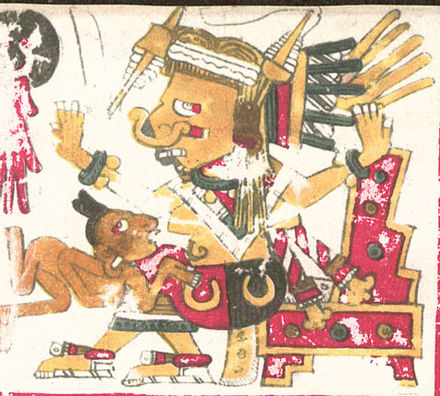
Tlazōlteōtl
1 media/440px-Tlazoteotl_7_thumb.jpeg 2024-04-24T21:41:00+00:00 Maggie Ge 4aa9272a6c57dc577497962163264b9dc0c8c343 356 2 Tlazolteotl is an Aztec Goddess associated with numerous meanings, including birth, fertility, midwives, purification and also filth; She is easily identified, usually with black around her mouth, sometimes with a conical hat or riding a broom, and often squatting in a birth-giving posture. Tlazolteotl is one of the most endearing and complex goddesses of the Mesoamericans. #MaizeDeity plain 2024-05-01T20:33:41+00:00 Maggie Ge 4aa9272a6c57dc577497962163264b9dc0c8c343This page has paths:
- 1 2024-05-01T21:39:44+00:00 Christopher Gilman 1985b99a2acd541caa12a10c3ebf6896565283ab Media Gallery Christopher Gilman 3 structured_gallery 2024-05-03T21:22:23+00:00 Christopher Gilman 1985b99a2acd541caa12a10c3ebf6896565283ab
This page has tags:
- 1 2024-05-01T21:39:44+00:00 Christopher Gilman 1985b99a2acd541caa12a10c3ebf6896565283ab Media Gallery Christopher Gilman 1 plain 2024-05-01T21:39:44+00:00 Christopher Gilman 1985b99a2acd541caa12a10c3ebf6896565283ab
This page is referenced by:
-
1
2024-04-24T20:36:34+00:00
Maize - The Flesh of the Sun God
14
In Aztec food culture, maize was the most important and indispensable crop, even influencing the development of their mythology. Its status was akin to that of wheat in Europe or rice in East Asia, hence the Aztec civilization is also called the "Corn Civilization". #foodways #ritual #MaizeDeity
plain
2024-05-01T21:51:58+00:00
The Historical Origins and Significance of Maize
Maize is an ancient crop whose origins can be traced back to at least 8,000 years ago in the Mesoamerican region. In the ancient civilizations of Mexico, maize was considered the grain of life, and was an important food and offering for the Maya and Aztec civilizations. In these civilizations, the planting and harvesting of maize were seen as sacred tasks, requiring special rituals and prayers. In Maya civilization, maize was called "the flesh of the gods", while in Aztec civilization, maize was viewed as the flesh of the sun god.
According to Aztec cosmogony and oral traditions recorded in the Florentine Codex, maize was a divine gift bestowed upon the Mexica people by the gods themselves. The origin story narrates how the gods created humans from maize dough, establishing an inextricable link between the crop and the very existence of the Aztec people.
As the Aztec Empire expanded and Tenochtitlán-Mexico City rose to prominence as its capital, the cultivation of maize played a pivotal role in its economic and cultural prosperity. The Florentine Codex's illustrations and texts offer insights into the sophisticated agricultural practices and techniques employed by the Aztecs to ensure bountiful maize harvests, such as the construction of intricate irrigation systems, the use of specialized tools, and the development of advanced methods for soil management and crop rotation.Its Symbolism and Ritual Significance
Maize, or corn, was revered as a sacred crop, embodying the perpetual cycle of life, death, and renewal that sustained the Aztec civilization. The symbolism, ritual significance, and deities associated with maize in Aztec culture were deeply ingrained into the fabric of their religious beliefs, cosmology, and daily life. The following sequence of three panels show how deeply maize is integrated into their daily lives.These three images depict various stages and aspects of agricultural practices and maize cultivation among the Aztec people. The first panel shows a figure engaged in tilling, planting, and caring for the fields and crops. The middle panel then describes the cultivation of irrigated and swampy lands, where the figure is shown transplanting and fertilizing maize, chili peppers, and other crops. The final panel focuses on the harvesting, storage, and processing of the maize crop, with the figure carefully sorting, hanging, and preserving the different types of ears of corn.
One particularly striking element of the illustration on the right is the presence of maize plants or cobs in various stages of growth, depicted with meticulous detail. These representations of maize serve as a powerful visual reminder of the crop's central role in the ceremony and its significance as a sacred, life-giving force.
The overall composition of the image is vibrant and visually striking, with the maize as the focal point, surrounded by everyday customary activities and symbolic representations of the maize and agricultural harvest.
The Nahuatl-to-English text describes in vivid detail the agricultural practices and techniques associated with this auspicious sign, highlighting the centrality of maize cultivation within Nahua society and cosmology. We read about the careful tilling of the land, the building of mounds, the irrigation of fields, and the cultivation of maize, chili peppers, and other crops. Importantly, the text emphasizes the spiritual and material rewards of these agricultural labors, stating that the farmer "witnessed the successful results of his fatigue and pains" and thus "attained his wealth and his contentment." This reflects the Nahua belief in the interconnectedness of human effort, the natural world, and the attainment of prosperity and spiritual fulfillment.
Although this image only has the Nahuatl and Nahuatl-to-English text, by closely examining the Nahuatl text alongside the visual imagery, we gain a more holistic understanding of the Nahua conceptualization of Ce Tochtli as a calendrical sign imbued with profound spiritual, agricultural, and cosmological meaning. The text allows us to witness the Nahua worldview in action, highlighting the interconnected relationship between human labor, the natural world, and the attainment of material and spiritual well-being.
Maize was considered a divine gift from the gods, representing the cosmic order and the intrinsic connection between the Aztec people and the natural world. In Aztec culture, maize was revered as a sacred and life-giving force, embodying the perpetual cycle of birth, growth, and nourishment that sustained their civilization. The symbolism of maize permeated every aspect of Aztec life, from religious rituals and ceremonies to artistic expressions and daily customs.
Symbolism
The various stages of the maize plant's growth cycle were imbued with symbolic meanings. The sprouting of the seed represented the act of creation and the emergence of life, while the mature cob symbolized fertility, abundance, and the cyclical nature of existence. The vibrant colors of the maize kernels, ranging from golden yellow to deep red, were associated with the sun, blood, and the life-sustaining forces of the universe. The yellow color of maize was seen as the color of the sun and life, while the shape of the maize cob was used to symbolize the mother's body. Therefore, maize was viewed as a sacred food in Mexican culture, representing the continuity of the land and culture.
Maize played a central role in numerous Aztec rituals and ceremonies, marking the critical phases of the agricultural cycle and paying homage to the deities responsible for its growth and abundance.
Ritual Significance
One of the most significant ceremonies was the Huey Tozoztli, also known as the Great Vigil or the Feast of the Preceding Year. This ritual celebrated the arrival of the new agricultural cycle and the planting of the first maize seeds. Intricate maize effigies (tzunteteo) were meticulously crafted from a dough made of maize and adorned with symbolic elements. These effigies were placed on altars, adorned with offerings of flowers, incense, and other precious materials, and ritually sacrificed to honor the maize deities. The Florentine Codex provides detailed accounts and vivid illustrations of this important festival, offering invaluable insights into the intricate rituals and artistic expressions associated with maize.
In the central part of the illustration on the right, there is a group of elaborately dressed figures, likely representing nobles, priests, or other high-ranking participants in the ritual. These central figures are shown holding symbolic offerings, such as flowers or plants (could be corn cobs), as part of the ceremonial observances. Behind the group of central figures, there is a stone structure with circular decorations, which could depict an altar or ceremonial platform used during the Huey Tozoztli festival. Surrounding this central scene are numerous floating images of maize cobs or ears of corn, depicted in various colors and styles. These maize motifs emphasize the importance of the corn plant and its symbolic association with the ritual. Additionally, there are small bowl-like vessels scattered throughout the composition, potentially containing ritual foods, beverages, or other offerings used during the Huey Tozoztli celebration.
The overall scene conveys a sense of ceremonial grandeur, with the ornately attired central figures, the prominent architectural feature, and the abundant maize imagery collectively highlighting the significance of this important Aztec festival within their religious and cultural traditions.In thinking about this image, I am considering the topic that the Aztecs celebrated the cyclical forces of nature with a variety of rituals and festivals as discussed by Manuel Aguilar-Moreno(Aguilar-Moreno 2006, 55).
In addition to the above, the Nahuatl passages offer nuanced details about the ritual symbolism of the frog offering, the maize-centered practices, and the roles of young female participants. Concepts like "calonoac" and the careful preparation and blessing of the maize seed stocks highlight the centrality of these observances to Nahua worldviews.
I realized that the visual elements may not always directly correspond to the entire Nahuatl textual descriptions I stated above, the only Nahuatl text that directly relates to the visual elements is the passage describing the young girls carrying the bundled maize cobs, adorned with red feathers and face paint.In analyzing both the Spanish-to-English Translation and Nahuatl-to-English Translation text passages that associated with this image, I am considering the point made by Kim Richter and Alicia Houtrowthat that the images always provide a third source of information that complements and augments the alphabetic texts(Houtrow & Richter 2024, 11).
Another important ritual was the Feast of Huitzilopochtli, dedicated to the Aztec patron deity and the god of war. During this ceremony, maize-based dishes and beverages, such as tamales and atole, a thick, corn-based beverage, were offered to the gods as a symbol of gratitude for the bountiful harvest and as a means of ensuring continued agricultural prosperity.
Deities Associated with Maize
The Aztec pantheon included several deities directly associated with maize, reflecting the crop's sacred status and its importance in the cultural and agricultural traditions of the Aztec people.
Oxomoco
Oxomoco was the principal female deity of maize, fertility, and the maize crop cycle among the Aztecs. Her name means "She of the Ripe Maize Crop" in the Nahuatl language. Oxomoco was depicted as a young woman wearing elaborate maize plant clothing and headdresses made of maize. Her temples contained representations of maize plants and ears of maize themselves. Rituals for Oxomoco focused on ensuring abundant harvests through offerings of food, incense, and sacrifices. She was closely associated with Chicomecoatl, another maize goddess. Together they represented the vital importance of maize agriculture to Aztec society and life.Cipactonal
Cipactonal, also known as Tzipactonal or Chimalmanan, The principal male deity of maize and fertility, Cipactonal was the counterpart to Oxomoco. His name means "The Reverenced Maker of Souls" in the Nahuatl language. Cipactonal was depicted as a young man adorned with maize symbols like capes made of maize leaves. He represented the growth and virility aspects of the maize crop itself. Rituals made offerings to him during the critical maize sowing and sprouting stages of cultivation. Cipactonal was seen as providing the fertile soil and nourishing rains needed for successful maize cultivation. He was an important deity for the farmers who depended on bountiful maize harvests to sustain their society.
Both Oxomoco and Cipactonal were revered and invoked by the Aztecs during agricultural rituals and ceremonies, particularly those related to the planting and harvesting of maize. Their visual representations served as powerful symbols of the Aztec reverence for maize and the central role it played in sustaining their civilization.
Together, this divine couple Oxomoco and Cipactonal embodied the entire maize crop cycle from planting to harvest that was the foundation of Aztec agriculture and nutrition. Their ceremonies and rich iconography reinforced just how revered and crucial maize was, being featured prominently in elite codices like the Florentine Codex.In thinking about this image on the right, I am considering the Nahua concept of Oxomoco-Cipactonal as stated by the Nahuatl Dictionary Website(Oxomoco-Cipactonal. | Nahuatl Dictionary, n.d.).
The image shows the male deity Cipactonal and the female deity Oxomoco seated in a symmetrical, sitting and kneeling position facing each other on what seems to be a woven mat or petate with intricate designs evocative of maize plants or crops. As mentioned previously, Cipactonal is portrayed in a minimally clothed state, with a garment or cloak made from woven maize husks that blends seamlessly with his own form, highlighting his deep association with the sacred corn plant. More importantly, the focal point of the image is Oxomoco and Cipactonal actively engaged in the act of casting lots or divining using maize kernels. The presence of these corn kernels, which were likely used in divinatory rituals and practices, further emphasizes the central role of agriculture and the maize plant within Aztec cosmology and religious tradition.
The Nahuatl text offers valuable insights into the cultural significance ascribed to this revered pair within the Aztec cosmological framework. They are depicted as the originators and "lords" of the day count and astrological divination practices, suggesting their elevated status as preeminent knowledge-keepers. Notably, the text emphasizes the gendered dimensions of Oxomoco and Cipactonal, with Oxomoco described as a woman and Cipactonal as a man. This aligns with the visual representation, which shows the two figures side-by-side in a position of authority over the calendrical signs.
Additionally, the Nahuatl passage provides important context around Aztec burial practices and the symbolic associations of domestic items like spindles, cotton, and brooms. These details illuminate the Nahua worldview that imbued even mundane objects with deeper cultural and ritual meaning, reflecting an intimate connection between material culture, the natural world, and the human life cycle. Phrases like "they buried it" and "near the grinding stone, at the edge of the hearth" evoke a sense of the sacred that is central to Nahua belief systems.
Chicomecoatl/Cinteotl
The Maize Goddess, Chicomecōātl, held a prominent position in the Aztec pantheon, revered as the embodiment of the life-giving properties of maize and the patron of agricultural fertility. Some specialists believe that Cinteotl(the maize god, was born in a cave and emerged to the surface of the mountains and fields to bring food to human beings. In keeping with this concept, religious and spiritual symbolism was incorporated into everyday living) used to be the maize goddess Chicomecōātl(Aguilar-Moreno 2006, 52).
This image of Chicomecoatl is portrayed as a female figure, wearing a headdress that incorporates something like the ears of corn or corn leaves; and a huipil, a traditional Mesoamerican garment, which may be decorated with patterns or imagery related to maize and agriculture. The goddess is shown adorned with jewelry, such as necklace and earrings, which emphasize her divine and regal status.
In this image, Chicomecoatl is also depicted holding and surrounded by symbols of maize and agricultural abundance, such as stalks of corn, baskets of harvested maize, or other agricultural implements.
This image of Chicomecoatl is a powerful and symbolic representation of the Aztec reverence for maize and its central role in their cultural and spiritual beliefs. Her intricate regalia, adorned with maize motifs and serpent symbolism, embodied the life-giving properties of the sacred crop and its significance in sustaining the Aztec civilization. Corn on the cob and images accompanied by symbolic elements such as snakes and farm implements are prominent subjects in various artistic media, which also highlights the perfect fusion of religious and artistic traditions.
The Nahuatl text offers a remarkably detailed inventory of the various agricultural products associated with Chicomecoatl, the Aztec goddess of sustenance and maize. The extensive list of maize varieties, beans, amaranth, and chia seeds reflects the deep reverence and intimate knowledge the Nahuas held for these staple crops that were vital to their survival and prosperity.
The use of vivid, descriptive terminology to characterize the different cultivars - "coarse, brown maize," "white beans," "flesh-colored beans" - suggests a profound understanding and appreciation for the diverse manifestations of these agricultural bounties within the Nahua cosmological framework. Notably, the Nahuatl text states that "all these things, so they say, all of them they offered to [the goddess]." This highlights the centrality of ritual offerings and the veneration of Chicomecoatl as the divine source and protector of these fundamental foodstuffs. The detailed description of the goddess's adornment in red, her embroidered regalia, and the beheading of quail for her further emphasize the elaborate ceremonial observances dedicated to this revered figure.
The passage also contextualizes the Chicomecoatl festival within the broader Aztec ritual calendar, noting its connection to the Huey Tozoztli celebration and the subsequent "winding dance" associated with the Toxcatl festival. This situates the goddess and her festival within the cyclical rhythms of the Nahua cosmological worldview.
Xipe Totec
The god of spring and new vegetation, closely associated with Oxomoco. His arrival heralded the planting season, while Oxomoco ensured the growth and abundance of the maize crops.
In this image, Xipe Totec is portrayed as a male figure wearing the flayed skin of a sacrificial victim as a garment. This symbolic "flayed skin" represents the renewal and rebirth associated with this god. The deity is shown with yellow or golden skin, reflecting his association with the sun, warmth, and the cycles of nature. Xipe Totec is also depicted wearing elaborate headdresses, sometimes including feathers, which emphasize his divine status and importance within the Aztec pantheon.
Besides these, Xipe Totec is shown holding objects like a shield or other agricultural implements in this image, symbolizing his roles as a protector, provider, and patron of agricultural activities.
I believe this imagery also includes the depiction of sacrificial rituals and ceremonies associated with Xipe Totec, such as the flaying of human victims and the wearing of their skins by priests or devotees.
The goddess of fertility, purification, and birth, often associated with Cipactonal. Together, they were seen as the divine forces responsible for the abundance and nourishment of the Aztec people through the cultivation of maize. From the image below, we can tell that Tlazolteotl is easily identified. She is portrayed as a female figure in this image, with a yellow color scheme, which may symbolize her association with the earth, fertility, or the natural world.
Tlazolteotl
She is shown with a distinctive headdress or hairstyle that includes a series of spiral or circular elements. The goddess is also depicted in a seated position, which may symbolize her role as a midwife or her association with the earth and the cycle of birth and renewal. There is even a baby-like figure in front of her.
Through a close examination of the visual representations and accompanying Nahuatl and Spanish textual passages from the Florentine Codex, we have gained profound insights into the centrality of maize within the cosmological, ritual, and agricultural frameworks of Aztec civilization. An ancient crop originating over 8,000 years ago in Mesoamerica, maize held profound significance as the sacred "flesh of the gods" and a divine gift linking the Aztec people to the cosmos itself according to their origin myths recorded in the Florentine Codex. Its cultivation was deeply embedded into their economic prosperity, agricultural rituals like Huey Tozoztli celebrating the harvest, and the symbolism imbued in maize's vibrant colors, feminine forms, and growth stages representing birth, fertility, death and regeneration. Revered deities such as the feminine Oxomoco, masculine Cipactonal, and Chicomecoatl, the embodiment of maize's life-giving sustenance, oversaw the entire crop cycle - their ceremonies, iconography, and effigies cementing maize as the perpetual force nourishing and defining every aspect of Aztec civilization's identity, spiritual beliefs, cultural traditions, and very existence.
Works Cited
Alicia Maria Houtrouw and Kim Richter. 2024. Introducing the Florentine Codex (1575–77) and Its Three Narratives. Kim N. Richter, Getty Research Institute; Alicia Maria Houtrouw, Getty Research Institute.
Manuel Aguilar-Moreno. 2006. Handbook to Life in the Aztec World. Forward: John Pohl. New York, Facts on File.
Oxomoco-Cipactonal. | Nahuatl Dictionary. (n.d.). In Nahuatl Dictionary. https://nahuatl.wired-humanities.org/content/oxomoco-cipactonal