Prayers for Flint: Weaving the Past with the Present
In her paper, Stitching Race, presented in the 2012 Textile Society of America, Hampton described how “Each time my weft crosses the warp or my needle pierces the cloth, I reach through another layer of scorched earth that slavery has left behind, and I attempt to reframe the issues of race that haunt our modern lives.”
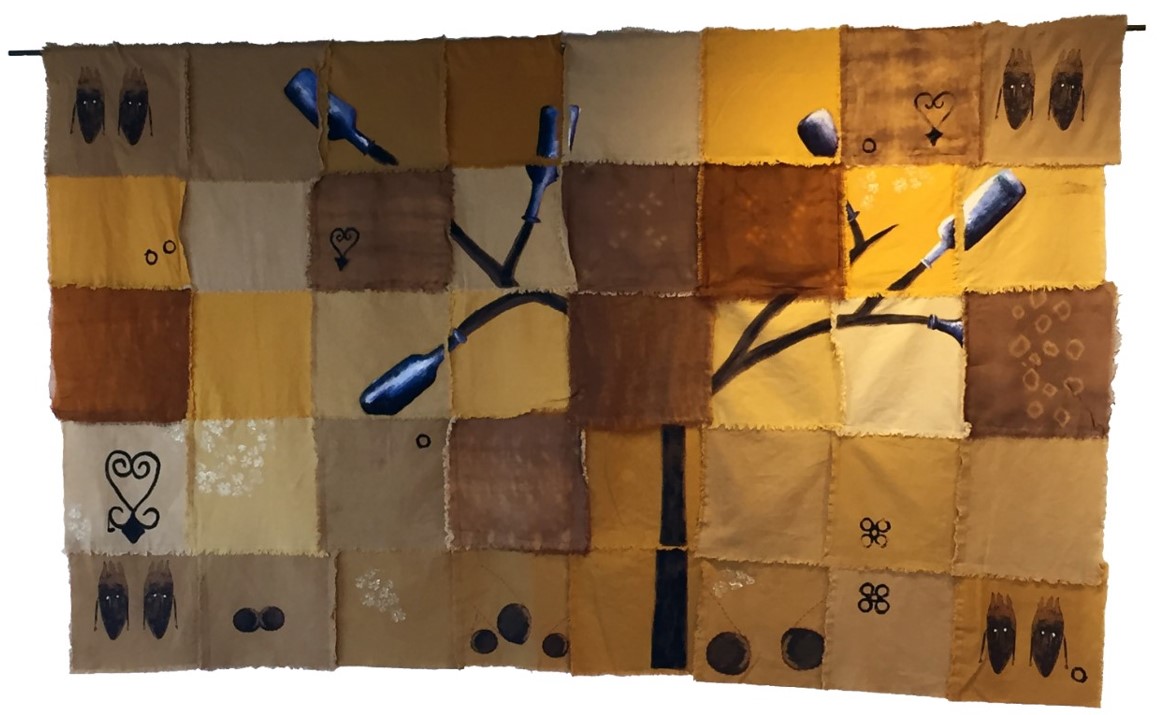
While much of Hampton’s work captures her family history, she also creates art that addresses how the legacy of slavery continues to shape the lives of African Americans today. Prayers for Flint (2018), for instance, is a work that memorializes the water crisis in Flint, Michigan. During a three-month residency, Hampton traveled to Flint to understand the water crisis and the emotional effect it was having on its residents. Hampton describes this work as an expression of thanks towards the people in Michigan who shared their lives and stories with her. The squares of fabric were dyed with samples of the polluted water she collected during her travels. The pairings of masks on the textile’s four corners are modeled after an African initiation mask she saw on display at the Flint Institute of Arts. She considers the mask to be “a reminder of African heritage… and [a vessel] of dreams for a better Flint.” The bottle tree in the center references the bottle trees found in the American South, mainly on African American homesteads, which are believed to trap evil spirits and protect the land. Lastly, the heart-shaped symbols are represents Sankofa, a Yoruba symbol and word that means “to remember your past so you do not have to repeat it.” These symbols and representations trace the lineage of history that lead to the current water crisis in Flint and offer hope, protection, and prayers for a better future.